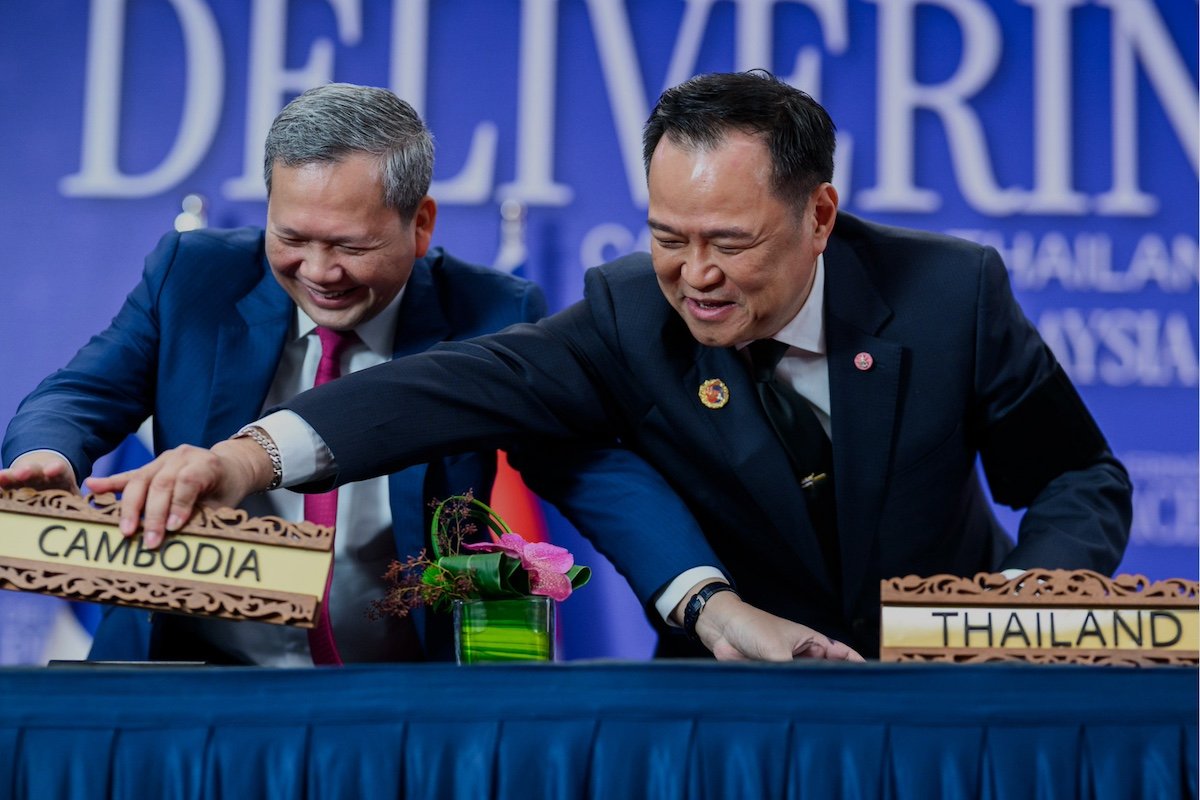
For over two decades, the 2001 Memorandum of Understanding between Cambodia and Thailand has served as the sole bilateral framework for managing overlapping maritime claims in the Gulf of Thailand. The agreement, which covers areas with potential offshore oil and gas reserves, has allowed both governments to pursue dialogue on joint development while preserving their respective legal positions. Now, Thailand’s recent threat to withdraw from this MOU risks unraveling that progress.
The value of the 2001 MOU lies not in resolving the dispute—it has not done so—but in keeping two interconnected questions on a peaceful track: how to explore joint development of petroleum resources in the overlapping claims area, and how to negotiate a maritime boundary where delimitation is required. By maintaining this channel, Cambodia and Thailand can continue talking with a view to reaching an agreement while safeguarding their legal positions. Removing it makes dialogue harder and increases the risk of misunderstanding or escalation.
This issue extends beyond the bilateral relationship. The waters between Cambodia and Thailand are part of Southeast Asia’s broader maritime environment. Developments here influence regional confidence, affecting fishing communities, energy companies, and investors monitoring stability in the region. As recent events in the Middle East have shown, maritime stability cannot be taken for granted—it directly affects energy supplies, trade routes, food security, and investor confidence. For Southeast Asia, a region heavily dependent on maritime trade, any erosion of predictability is a concern.
ASEAN’s Principles Under Pressure
ASEAN has consistently advocated dialogue and peaceful dispute resolution. These principles are most important when they are most difficult to maintain. Cooperation is easy when relations are calm; the real test is during periods of domestic tension or unresolved claims. Thailand’s threat to withdraw from the MOU comes at a sensitive time, as the two countries also face a dispute along their shared land border. Walking away from the maritime agreement would not resolve the underlying issues—it would undermine trust at a critical moment and heighten the risk of misunderstanding.
Cambodia does not view the 2001 MOU as a concession by either side, nor as a threat to Thailand or Cambodia. It is a means for both countries to protect their interests while maintaining dialogue. Neighbors do not need full agreement to continue discussions. The MOU’s practical value is that it allows Cambodia and Thailand to keep talking with a view to reaching an agreement while safeguarding their legal positions. Abandoning it does not solve disputes; it makes resolution more difficult.
Thailand’s decision also has implications for broader regional dynamics. As Thailand pitches a land bridge to bypass the Strait of Hormuz, the country is signaling its awareness of maritime vulnerabilities. Yet walking away from a dialogue mechanism with a neighbor sends a contradictory message. Similarly, the Iran conflict has prompted Indo-Pacific nations to reassess their security postures, underscoring the importance of maintaining stable maritime frameworks.
Cambodia’s position is clear: it will defend its sovereignty responsibly and peacefully. The country believes maritime claims should be resolved through dialogue and respect for international law. Agreements intended to prevent escalation should be upheld, not abandoned. Maritime and border disputes are complex and require time to resolve. This is why countries need established channels for dialogue.
Southeast Asia requires predictability and respect for agreements. ASEAN is strengthened when its members demonstrate that even challenging disputes can be managed through diplomacy and respect for the law. Thailand should uphold the 2001 Memorandum of Understanding, resume dialogue, and work with Cambodia to resolve outstanding issues through negotiation and in line with international law. Peace requires more than words. It relies on frameworks and commitments that prevent disputes from escalating. The 2001 MOU should be strengthened, not discarded.