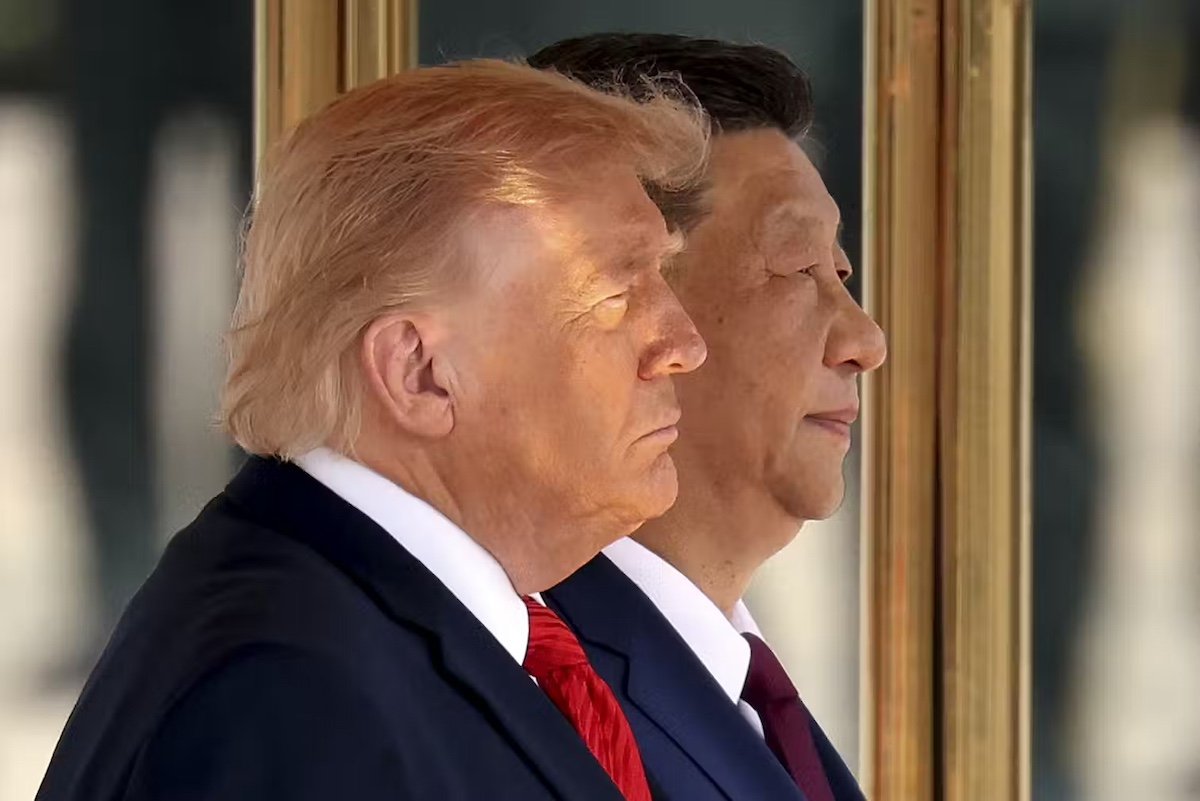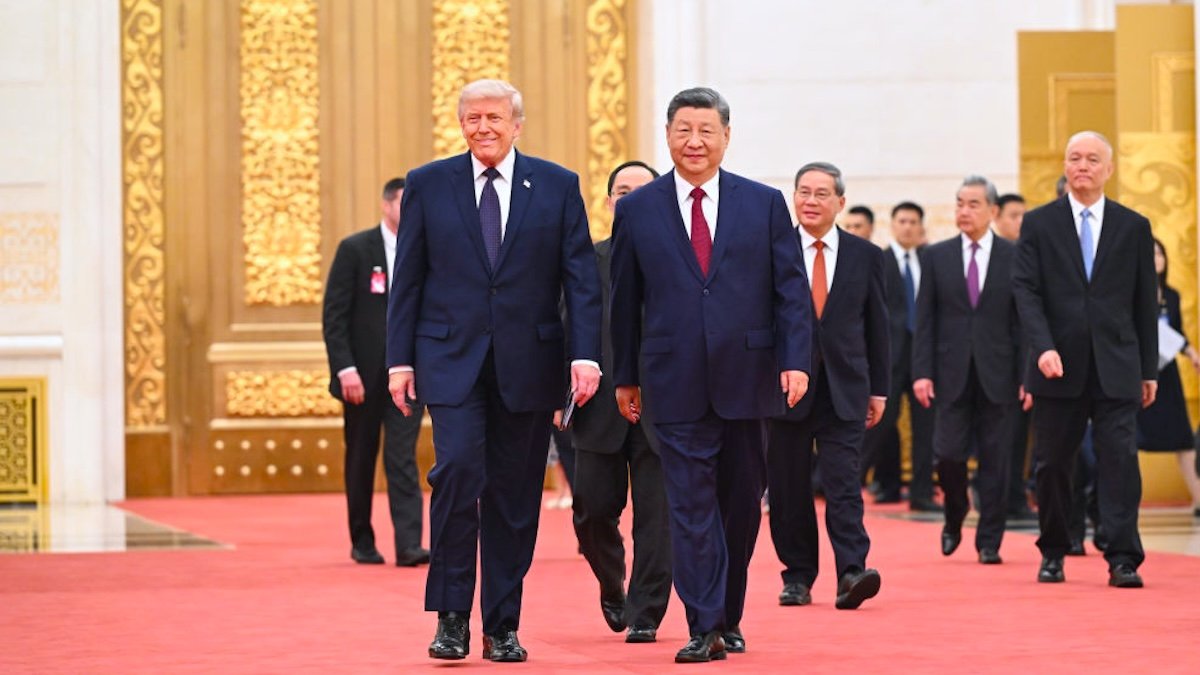
US President Donald Trump will host Chinese President Xi Jinping in Washington on September 24 for a summit that is expected to focus on managing the risks of frontier artificial intelligence (AI) models and protecting intellectual property. The meeting, first reported by Reuters on July 21, will be the first official US-China AI dialogue under the Trump administration, led on the American side by Treasury Secretary Scott Bessent.
Chinese state media and commentators say the Trump administration called for the summit because it fears Beijing is gaining the upper hand in the global AI race. This concern was amplified after China forged AI partnerships with 28 nations, mainly from the Global South, at the 2026 World Artificial Intelligence Conference (WAIC) in Shanghai on July 17. The prevailing view in Beijing is that Washington will use the talks to tighten controls on Chinese AI development, but that such curbs will only accelerate Chinese firms' push for self-sufficiency and the construction of an independent AI ecosystem.
Trump confirmed the report on July 23, saying the two leaders had already discussed AI during his trip to Beijing in May. "President Xi is coming over on September 24," Trump said. "We talked about it when I was over in Beijing, and we'll be talking about it again." He called AI "probably the biggest thing anybody's ever seen" and warned that the nation dominating the technology would hold the ultimate advantage. "Whoever wins that race is probably going to win," he said.
China's AI models catching up fast
Washington's push to engage China on AI comes against a backdrop of rapidly improving Chinese models. Firms including DeepSeek, Zhipu AI and Moonshot AI have released a string of low-cost, high-performance models this year that can match OpenAI's ChatGPT and Anthropic's Claude on key benchmarks. These Chinese firms are alleged to have trained their models partly by distilling knowledge from Western AI systems—a process akin to a student learning by studying a brilliant teacher's answers and reasoning patterns, rather than building knowledge from scratch. This allows them to avoid using expensive AI chips and achieve comparable results at a fraction of the cost.
They have also applied two efficiency techniques: mixture of experts (MoE) and sparse attention. MoE automatically routes each query to only the most relevant cluster of specialists within a model, rather than activating the entire system. Sparse attention allows the model to focus only on the most relevant portions of a text, reducing computing demands without sacrificing accuracy.
Global Times, a newspaper under the People's Daily, said in a commentary on July 26 that China's open-source AI models have grown powerful enough over the past two years to alarm America's leading AI laboratories. "Two years ago, names like Zhipu AI and Moonshot AI barely registered in the American tech press. Now their models are going toe-to-toe with those from Anthropic and OpenAI," the commentary said. "The United States' panic makes sense."
The commentary argued that, in the broader US-China relationship, Washington no longer expects to knock China out in one blow but tries to stretch the timeline, holding on to its window of advantage for as long as possible. "The failure to eliminate China doesn't mean the contest is over. On the contrary, as knocking China out becomes less feasible, the AI race between the US and China simply shifts to more specific and hard-fought fronts," it said. "As long as China stays true to a development path suited to its own realities, it will earn the standing it deserves in shaping AI's norms, rules and standards of access."
For many years, Chinese state media avoided directly acknowledging what the Global Times commentary calls China's "realities" in AI development—a phrase that has come to refer to the US sanctions and export controls that have constrained Chinese chipmakers and AI firms. The US barred Dutch chipmaking equipment maker ASML from selling extreme ultraviolet (EUV) lithography machines to China in 2019, and extended the restrictions to cover high-end deep ultraviolet (DUV) lithography in October 2023. From October 2022, it also banned exports of high-end Nvidia graphics processing units (GPUs) to China.
These moves had pushed Chinese chipmakers to source second-hand mid-end DUV machines to produce AI chips, import Nvidia chips through smugglers and shell companies, and train AI models in data centers in Southeast Asian countries. However, as Washington kept tightening its controls, Chinese AI firms such as DeepSeek have pivoted to training models through distillation, drawing knowledge from Western AI systems at a fraction of the cost of building from scratch.
US Treasury Secretary Scott Bessent said on July 21 that the Trump administration is finding evidence that Chinese AI models were built on American ones. He emphasized that Washington does not condone intellectual property theft. The issue of IP theft is likely to be a central point of contention at the September summit, especially given the broader trade tensions between the two countries. Trump's new tariffs on 60 countries, which are expected to cost Americans $100 billion annually, have already strained relations, and the AI talks could either ease or exacerbate those frictions.
Zhu Min, a former deputy governor of the People's Bank of China who spoke at a World Economic Forum panel in June, said China's AI strategy rests on one priority above all: putting AI to work across its vast industrial economy, particularly in factories. "China's greatest advantage was never about building the largest model. It lies in having more use cases, more factories, more diverse industries and cost-conscious business owners," Zhu said. "The real winners will not be the AI model makers but those doing deployment, integration and process restructuring. The vendors installing factory systems, connecting data pipelines, retraining workers and collecting annual fees will pocket more than anyone." Zhu singled out manufacturing as the sector where AI will penetrate deepest in China because the returns are most tangible.
The September summit will test whether the US and China can find common ground on AI governance, or whether the technology will become another front in their intensifying rivalry. For the broader Indo-Pacific region, the outcome could shape not only the future of AI regulation but also the balance of technological power between the world's two largest economies.