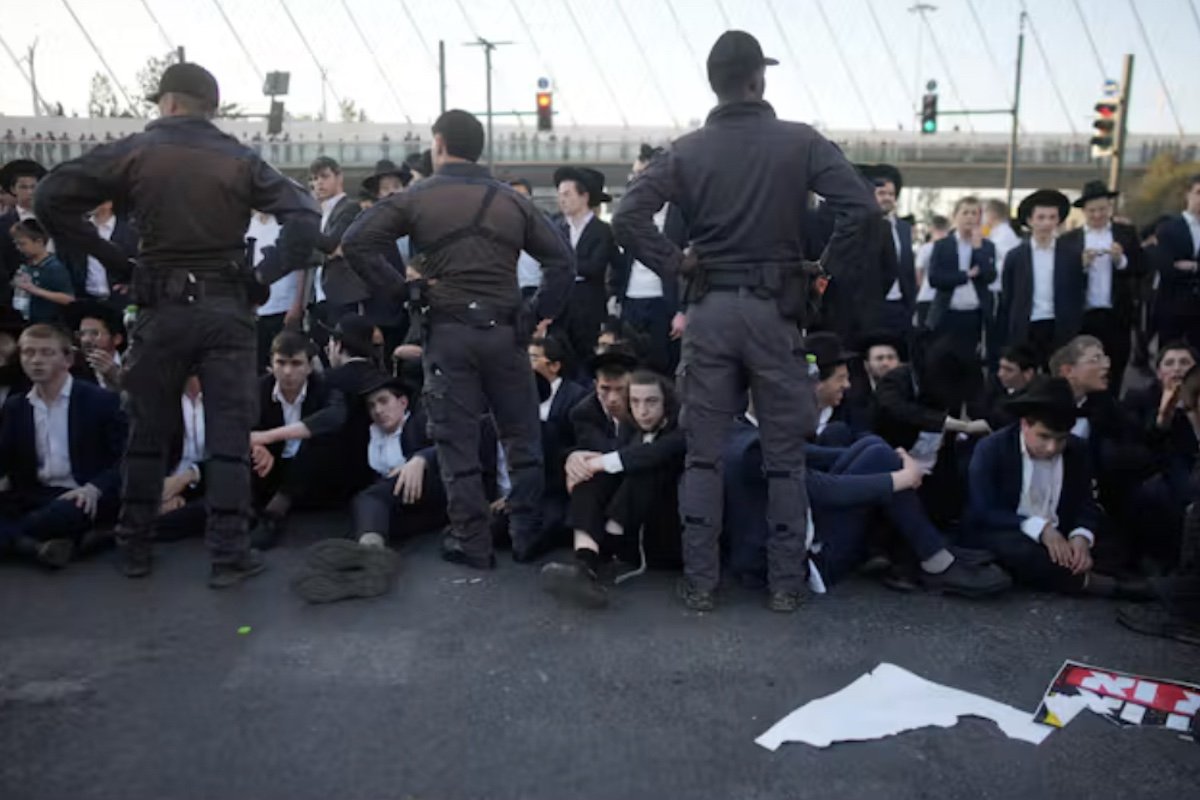
On October 20, 2026, just days before Israelis head to the polls, police detained dozens of young men suspected of dodging the military draft. Prime Minister Benjamin Netanyahu called the arrests “unacceptable,” a remark that underscored the delicate balance he must strike between the demands of the military and the political power of the ultra-Orthodox, or Haredi, community.
The detained men are students at Haredi religious schools, a group that for decades enjoyed a blanket exemption from the compulsory service that most Jewish Israelis must perform. That arrangement was struck down by the Supreme Court in 2024, but the government has failed to either legislate a new exemption or enforce the ruling. Netanyahu has said that Haredim not engaged in full-time study should enlist, yet his coalition has been unable to bridge the gap between the military's needs and the Haredi parties' insistence on preserving their way of life.
The issue has become increasingly explosive as Israel fights on multiple fronts. A large majority of Jewish voters now believe that Haredi communities should share the burden of national defense. But the Haredi parties, though representing a small slice of the population, hold outsized influence in Israel's parliamentary system, and Netanyahu may need them more than ever as he faces challenges from rival right-wing factions over his handling of the October 7, 2023, attacks and the ensuing wars.
A growing community with distinct political voices
Haredi Jews are characterized by strict observance of Jewish law and a rejection of liberal interpretations. They tend to live in close-knit neighborhoods, with an average of six children per family, and about half of the men devote their lives to religious study. The community's poverty rate stands at 33%, more than double the rate among non-Haredi Jews.
Currently, Haredim make up about 14% of Israel's population, but due to high birth rates, projections suggest they could constitute nearly a quarter of Israelis by 2050. This demographic trajectory amplifies their political weight.
Politically, the Haredi community is split along ethnic lines. Ashkenazi Haredim—those of northern and eastern European descent—are represented by United Torah Judaism (UTJ), while Sephardi and Mizrachi Haredim, whose roots lie in the Iberian Peninsula and the Middle East, align with Shas. In July 2026, a third party, Haredi Public, emerged, claiming to represent those who feel neglected by the established parties. It emphasizes employment, poverty, housing, and education, and notably includes women on its candidate list, a departure from the other two.
Israel's proportional representation system, with a low electoral threshold of 3.25%, allows many parties to win seats. No party has ever won an outright majority, so coalition governments are the norm. Likud, led by Netanyahu, has dominated coalitions for two decades, and the Haredi parties have been reliable conservative allies. Their support has been crucial, and as Netanyahu's position weakens, their leverage grows.
The draft exemption: a long-standing demand
Military service is mandatory for most Jewish Israelis—women serve two years, men nearly three, with reservist duty extending into their 40s. For decades, Haredi men received de facto exemptions, a policy that also served to subsidize their communities through government funding for religious schools. Given low employment rates and high poverty, many families rely on these subsidies.
The 2024 Supreme Court ruling declared the blanket exemption illegal, but the government has not implemented a lasting solution. The failure to reach a compromise led Shas and UTJ to leave the coalition in 2025, a move that further destabilized Netanyahu's government.
Despite the ruling, mass conscription of Haredim has not occurred. Protests have been held, and many have ignored draft notices. While tens of thousands of Haredi men are eligible but not serving, fewer than 500 evaders have been arrested in 2026. Netanyahu has argued against arrests, saying they are counterproductive.
The upcoming election, scheduled for October 27, 2026, is widely seen as a referendum on Netanyahu's leadership. His coalition has been fragile, and the Haredi parties' support is essential. They have made clear that their participation in any coalition will depend on securing a legal exemption for their constituents.
Public opinion, however, is firmly against exemptions. A recent poll showed that over 70% of Jewish Israelis want Haredim to serve. This puts Netanyahu in a bind: to keep his coalition, he must appease the Haredi parties; to win the election, he must appeal to the broader electorate.
The Haredi parties themselves are not monolithic. The new Haredi Public party could split the vote, potentially reducing the overall Haredi representation. Shas and UTJ have agreed to a surplus-vote sharing arrangement to maximize their seats, but the entry of a third party complicates the arithmetic.
As the election approaches, Netanyahu's fate may well hinge on the demands of a community that, while small, holds the keys to power. The draft issue is not just about military service; it is about the very nature of the Israeli state and who bears the cost of its defense. The outcome will resonate far beyond Israel's borders, affecting regional stability and the broader Middle East.
For now, Netanyahu walks a tightrope. He has called the arrests “unacceptable,” but he has also said that Haredim who are not studying should enlist. Whether he can satisfy both the Haredi parties and the Israeli public remains the central question of this election. The answer will likely determine not only his political future but also the direction of Israeli society for years to come.