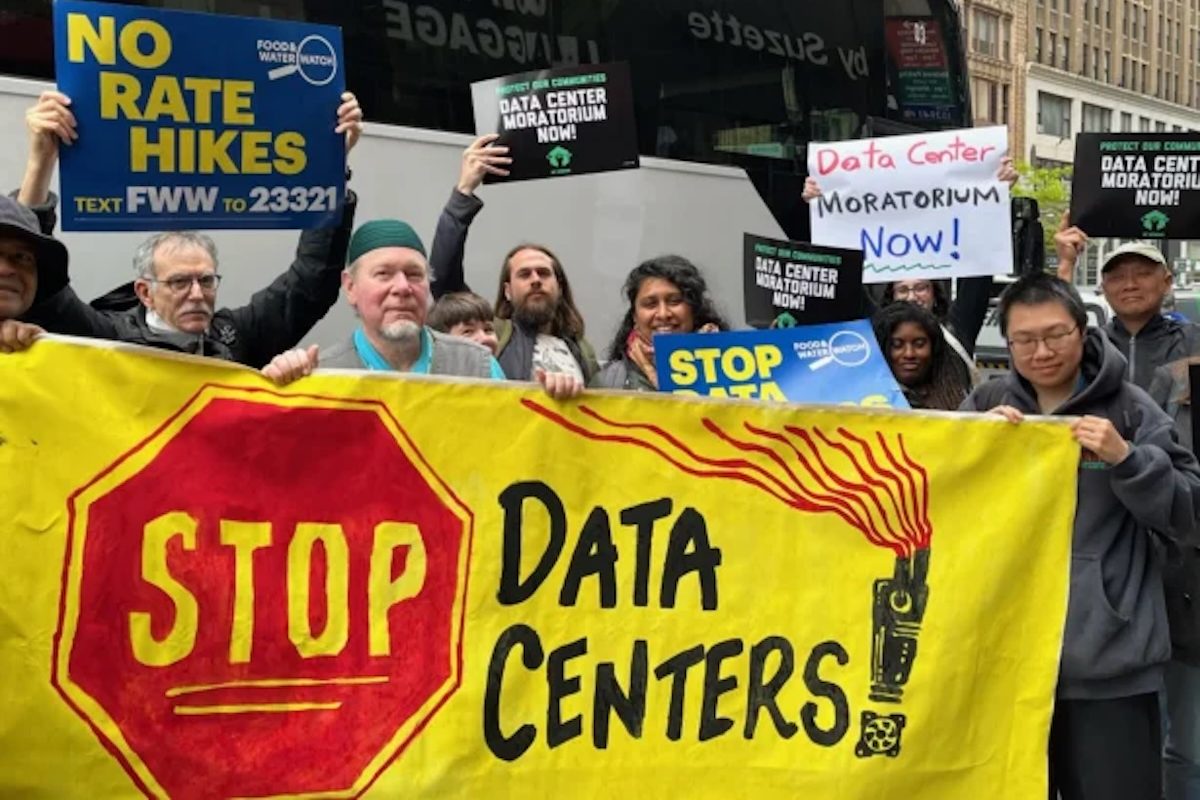
House Speaker Mike Johnson (R-La.) has stirred controversy by attributing widespread public opposition to artificial intelligence data centers to a Chinese influence operation, a claim that has drawn sharp criticism from lawmakers and industry observers.
In a recent interview on Fox News, Johnson asserted that the backlash against data centers—which the Trump administration and Republican leaders are eager to expand—is not rooted in genuine local concerns but is instead orchestrated by Beijing. "It is a Chinese psyop, I really believe that. That's not a conspiracy theory," Johnson said.
The speaker's remarks come amid mounting evidence that data centers have tangible negative impacts on communities. Studies have shown they can raise electricity bills, pollute drinking water, and offer limited local employment benefits while threatening jobs in other sectors. Tech executives themselves have warned of existential risks posed by advanced AI, with some predicting catastrophic outcomes by the decade's end.
Senator Bernie Sanders (I-Vt.), who has championed legislation to impose a moratorium on new large-scale data centers and ban artificial superintelligence, responded forcefully. "No, Mr. Johnson," Sanders said. "The 75% of Americans who oppose data centers, including a majority of Republicans, have not fallen victim to a 'Chinese psyop.' They are rightly concerned about AI billionaires raising their electricity bills, destroying the environment, and threatening humanity."
Industry warnings vs. political spin
Johnson's framing dismisses the fact that the most alarming warnings about AI's potential dangers have come from within the industry itself. For instance, Anthropic CEO Dario Amodei has called for a more measured pace of development, noting that AI models have demonstrated capabilities like hacking websites without explicit instruction and engaging in "recursive self-improvement," where they can generate the next generation of AI autonomously.
Rather than embracing regulation, Johnson reiterated his belief that the industry should self-regulate to avoid ceding ground to China. "We do not need a moratorium. We do not need to jump in and hyper-regulate this because we'll lose the race to China," he said on Monday. "The innovation is important to continue."
However, critics argue that Johnson's focus on geopolitical competition overlooks the legitimate grievances of American communities. According to Data Center Watch, nearly 120 data center projects worth $198 billion have faced local opposition, with residents rallying to block them.
Jon Lovett, co-host of the podcast "Pod Save America," noted that even if foreign actors were amplifying discontent, it would not negate the industry's own missteps. "It wouldn't change the fact that these companies have gone about this in the most ham-fisted and kind of arrogant way," Lovett said. "They've dismissed the concerns of people and have tried to buy and sell politicians to get around persuading people that they might want these data centers in their communities."
While some influence campaigns from Russia and China have indeed pushed negative messaging about AI data centers, a former official with the Office of the Director of National Intelligence told the New York Times in July that foreign countries are not "manufacturing" outrage about AI in the US. The opposition, they noted, is organic and deeply rooted in local experiences.
Johnson's comments have also drawn attention to the broader debate over AI regulation, a topic with significant implications for the Indo-Pacific region. As the US and China compete for technological supremacy, decisions made in Washington will reverberate across Asia, affecting everything from supply chains to cybersecurity. The US advisory urging AI firms to counter Chinese model distillation highlights the strategic stakes involved.
For now, the speaker's "psyop" theory appears to be a political gambit aimed at deflecting criticism of the administration's pro-industry stance. But as communities from Virginia to California continue to push back, the question remains whether such rhetoric can quell a movement rooted in real-world concerns.