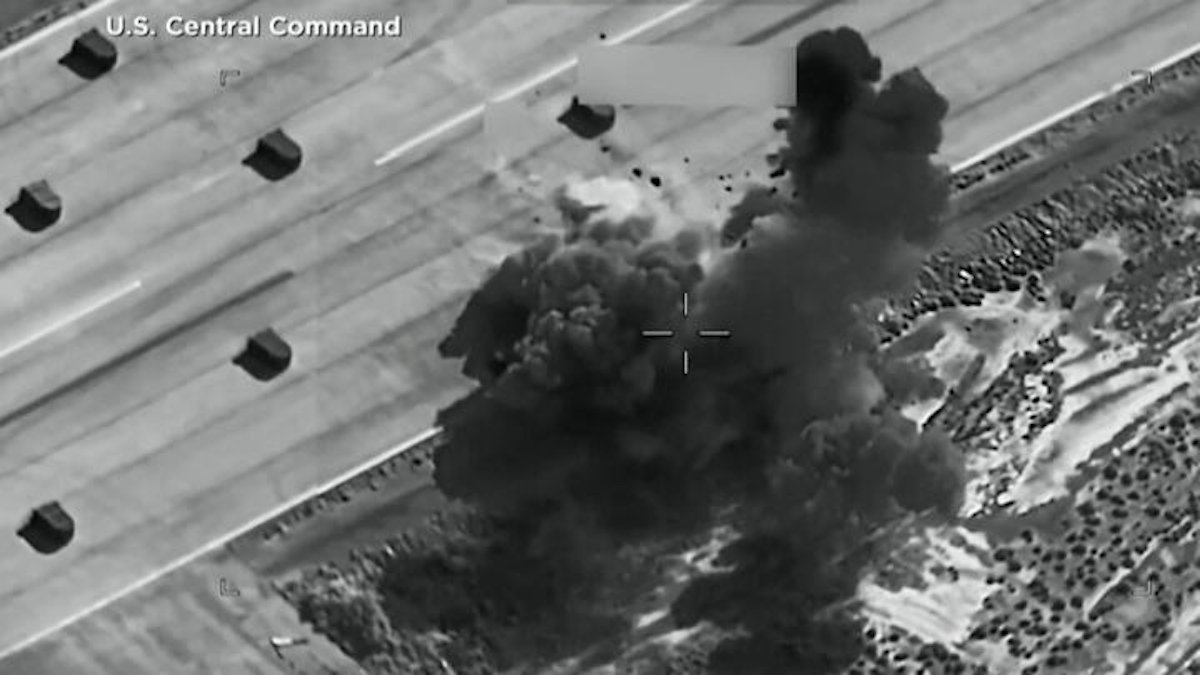
The rhythm of America's Middle Eastern wars has become almost liturgical: airstrikes, declarations of victory, ceremonial memorandums, and then the slow recognition that a piece of paper signed in a French palace cannot repeal the underlying logic of the conflict. Iran and the United States have now performed this cycle twice in a single year, and Washington's foreign policy establishment is once again mistaking a pause in fighting for its resolution.
President Donald Trump's recent declaration that the ceasefire is "over," followed a day later by his insistence that no "long-term" military action is intended, is not a contradiction but a symptom. It reflects an approach to Iran that has oscillated between maximalist rhetoric and tactical restraint for two decades, without ever settling on what Washington actually wants as an endgame. Is the objective regime change? Denuclearization? Freedom of navigation through the Strait of Hormuz? Each strike seems to answer a different question, which is another way of saying that no one in Washington has really decided.
Asia Bears the Cost of Indecision
Notice who is absorbing the costs of this brinkmanship. It is not principally Washington. It is Bahrain, sheltering the Fifth Fleet and now living under recurring air-raid sirens. It is Kuwait and Qatar, drawn into a fight over a waterway they did not start. It is the global economy, still paying down the largest oil-market disruption in modern history, months after the "ceasefire" was supposed to have ended it. For Asian economies heavily dependent on energy imports from the Gulf, this volatility is a direct threat to growth and stability.
The Gulf Arab states that Washington has spent decades cultivating as partners are discovering that proximity to American power in this region is not the same as protection by it — a lesson Iraq's neighbors could have told them in 2003, and Lebanon's could have told them more recently still. As Trump's Iran ceasefire reshapes Asian energy security, countries like Japan, South Korea, and India are forced to reconsider their reliance on a single chokepoint for oil supplies.
There is also the question, so rarely asked plainly in Washington, of what a de facto Israeli veto over American Iran policy is costing the US. Israeli leader Benjamin Netanyahu's public jabs at Turkish leader Recep Tayyip Erdogan this week, delivered from inside a NATO summit meant to showcase Western unity, and his lobbying against the sale of F-35s to a NATO ally, are a reminder that Jerusalem's regional priorities and Washington's alliance architecture do not always point in the same direction. American presidents have shown themselves consistently unwilling to let daylight show between the two, even when the strategic interests plainly diverge.
None of this is an argument that Iran's conduct in the Strait of Hormuz — attacking commercial tankers, threatening the arteries of global trade — is defensible. It plainly is not, and a regime willing to strangle its neighbors' economies to assert control over a waterway invites the consequences it is now receiving. But recognizing that Tehran's behavior is provocative is different from concluding that Washington's answer to it — a war without a defined objective, prosecuted in a country where the last two decades of American military intervention in the region offer little evidence that force alone produces durable settlements — is wise.
The strategic question American policymakers should be asking is not merely "how do we respond to the last attack" but "what does five more years of this look like, and is it one we can afford?" On present evidence, nobody in Washington has stopped long enough to answer it. Meanwhile, as Beijing emerges as a key beneficiary of the US-Iran tensions, Asian capitals watch with growing unease as the region's energy security hangs in the balance.



