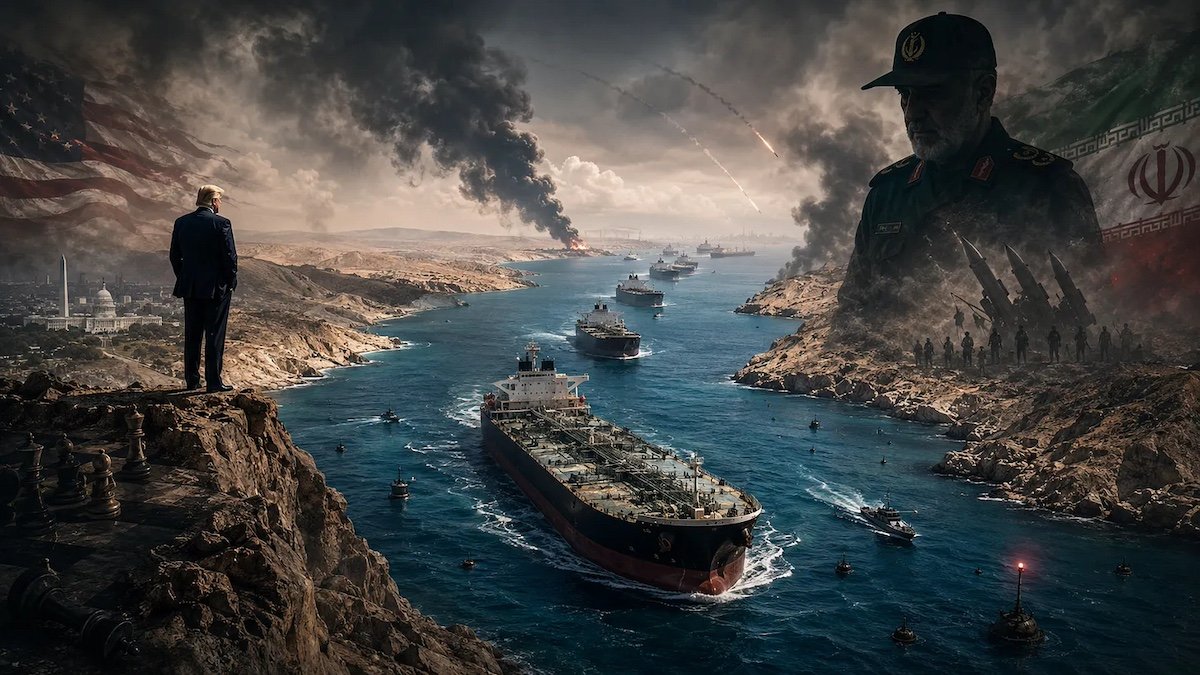
The ceasefire with Iran, which we had hesitated to analyze given its fragile foundations and the chaotic diplomacy surrounding the so-called framework agreement, has now collapsed under predictable pressure. This week, the United States and Iran resumed hostilities: Iran struck US military sites in Bahrain and Kuwait after American forces targeted Iranian positions in retaliation for attacks on LNG tankers in the Strait of Hormuz. President Donald Trump, speaking at the NATO summit in Ankara, declared the interim agreement "over," though he left the door open for continued talks.
Oil prices surged immediately, as markets priced in the renewed risk that the world's most critical energy chokepoint is no longer functioning normally. For Asian economies—from Japan and South Korea to India and China—this is not an abstract concern. The Strait of Hormuz is the artery through which much of the region's crude oil and liquefied natural gas flows. Any disruption directly impacts energy security and economic stability across the Indo-Pacific.
A Framework Built on Sand
The interim US-Iran framework, formally the 14-point Islamabad Memorandum of Understanding, was supposed to halt the war, reopen the Strait of Hormuz, create a 60-day negotiating window, provide a pathway to sanctions relief, and defer the hardest nuclear questions to a final deal. It postponed nearly every difficult issue, including how to wind down Iran's nuclear program—precisely the kind of problem the JCPOA had managed through years of negotiation, detailed verification, and enforcement mechanisms. Trump tore up that agreement in his first term, calling it the "worst deal in history." The current framework is thinner, weaker, and far more exposed to coercion. As we noted in our earlier analysis, the ceasefire was a ritual of failure that reshapes Asian energy security.
On paper, the arrangement looked like a ladder down from escalation, giving Trump a perceived victory as domestic pressures mounted. In practice, it was a rope bridge over a live volcano. The core terms were roughly as follows:
- A ceasefire across all fronts, including Lebanon: This immediately created an enforcement problem. Iran could point to Israeli actions against Hezbollah and occupation in Lebanon as a breach. The US could point to Iranian-linked activity. Israel was not going to suspend its threat assessments because Washington wanted a settlement with Tehran.
- A 60-day window for a final deal: The short timeline was supposed to generate momentum. Instead, it gave Iran 60 days to maximize leverage. Every delay in Hormuz, every tanker incident, every ambiguous IRGC move, and every oil market wobble increased pressure on Washington to offer relief in exchange for stability. That is not a position of strength; it is the geopolitics of "please stop making petrol expensive."
- The US would remove its naval blockade and reduce military pressure: Washington began giving up pressure early, while the most important Iranian concessions were pushed into future negotiations. This allowed Iran to sell oil—effectively sanctions relief that solidified the fragile position of the IRGC, which had been in economic dire straits. Iran could bank relief, test the edges of the deal, and argue later over what the words meant.
- Iran would allow commercial vessels through Hormuz without charge for 60 days: The phrase "without charge for 60 days only" was doing a lot of work. The agreement also gave Iran space to discuss "future administration and maritime services" in the Strait with Oman and other Gulf states. That is where the real danger sits. A toll does not need to be called a toll. Tehran is now floating different systems—permits, maritime safety fees, routing systems, demining charges, coastal-state services, or technical clearance requirements. Iran believed the agreement allowed it to retain control over which ships could pass and which route they must take.
- Iran reaffirmed that it would not develop nuclear weapons: Useful language, but hardly a victory. The enriched uranium stockpile was left for a future mechanism, with down-blending under IAEA supervision listed as a minimum approach. Enrichment itself was also left for future talks. In other words, the nuclear issue was not solved. It was placed in the basket marked "later," which is where it has existed since the JCPOA—while also being the underlying excuse for why Trump launched the war in the first place. As experts have warned, the ceasefire leaves the nuclear issue unresolved.
- The US placed sanctions relief, oil waivers, frozen assets, and a $300 billion reconstruction and development plan on the table: This was the largest political gift in the framework. Iran could present the war as proof that resistance works: absorb the strikes, close or threaten Hormuz, force Washington to negotiate, and then discuss sanctions relief and investment. For a regime under domestic economic pressure, that is a massive win. Prior to the war, the IRGC had been at their weakest since the 1979 revolution. Economic turmoil had led to massive internal unrest, culminating in mass protests earlier this year where reportedly tens of thousands of innocent civilians were killed. Now, the IRGC will have the funds to continue repression.
The constant stream of statements, threats, retractions, counter-threats, clarifications, late-night posts, and improvised press conferences suggests a strategy to track. There is not. There are events, reactions, missiles, drones, tankers, oil prices, NATO allies trying to work out what Washington means before Washington changes its mind, and Iranian hardliners testing how far they can push the Strait of Hormuz before the US decides it has had enough again. This is all down to the overall lack of direction and plan—the missing element from the beginning.
For Asian capitals, the lesson is clear: relying on a US-led framework that is both strategically incoherent and diplomatically fragile is a dangerous bet. The real danger is not just the collapse of a ceasefire, but the reshaping of energy security and regional stability in ways that will affect the Indo-Pacific for years to come. As we have argued, the real danger is what the deal leaves out.