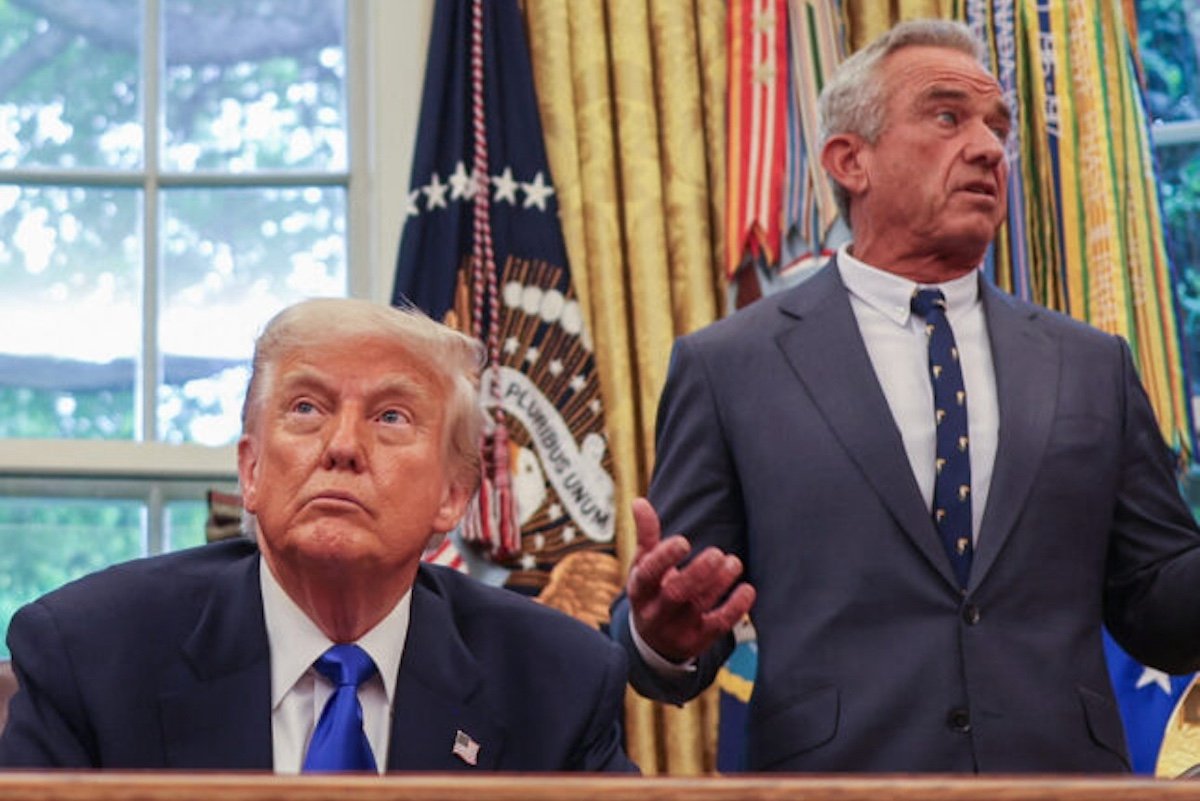
When Robert F. Kennedy Jr. campaigned in Michigan for Republican Senate candidate Mike Rogers, he dismissed the entire Arab world—some 500 million people—as a community that “don’t produce science, they don’t produce literature, and they don’t win Nobel Prizes or other prestigious international awards.” The remark was not only factually wrong but a stark reminder that anti-Arab and anti-Muslim prejudice now flows from the highest levels of the US government.
Kennedy’s claim ignores a long list of Arab achievements. Egyptian chemist Ahmed Zewail won the Nobel Prize in Chemistry; Egyptian novelist Naguib Mahfouz took the Nobel in Literature; Yemeni activist Tawakkol Karman received the Nobel Peace Prize. More recently, Palestinian-American chemist Omar Yaghi won the 2025 Nobel in Chemistry, and mathematician Michael Atiyah, of Lebanese descent, earned the Fields Medal. Arab scholars laid foundations in algebra, medicine, astronomy, and philosophy centuries before Europe’s Renaissance.
President Donald Trump has also targeted Abdul El-Sayed, the Democratic Senate candidate in Michigan, deliberately calling him “Mohammad” despite being corrected. When told the candidate’s name is Abdul, Trump replied, “I’m the president. I can call him whatever the hell I want.” He has accused El-Sayed of being a “Muslim Brotherhood Jihadist” who “hates Jews and Blacks and AMERICANS,” and suggested the candidate would need a metal detector to enter the Senate.
Senator Ted Cruz joined in, dubbing El-Sayed “the jihadist leprechaun” and warning that if elected, he could leak classified intelligence to terrorists. Cruz claimed that if El-Sayed is a “passionate supporter of the Muslim Brotherhood,” there is “a very real risk that Americans will die as a result.” El-Sayed has repeatedly denied any connection to the group.
Representative Nancy Mace went further, declaring that “Every single Muslim holding public office in America is a Trojan Horse, and a threat to both national security and our republic.” In March 2026, Tennessee Republican Andy Ogles said “Muslims don’t belong in American society” and advocated stripping naturalized Muslim Americans of citizenship. He also called New York Mayor Zohran Mamdani “little Muhammad” and demanded his deportation.
Senator Tommy Tuberville posted a photo of Mamdani celebrating Ramadan next to an image of the September 11 attacks, with the caption “The enemy is inside the gates.” Representative Elise Stefanik labeled Mamdani a “jihadist.” The Trump administration even raided the home of Representative Ilhan Omar without filing charges, while Trump repeatedly told her to “go back to Somalia.”
A double standard in Washington
These attacks have drawn far less official outrage than antisemitism. In the past two years, Congress has held 14 hearings on antisemitism but only two on anti-Arab hate and Islamophobia. The Council on American-Islamic Relations (CAIR) recorded 8,683 complaints of anti-Muslim and anti-Arab discrimination in 2025—the highest annual figure since it began tracking in 1996.
Jewish commentator Peter Beinart has argued that the key difference today is that Islamophobia is promoted by the state itself, while antisemitism is largely condemned across the political spectrum. He points to attacks on Muslim elected officials, congressional campaigns against Sharia law, and Trump’s Muslim immigration bans as evidence.
The silence from political leaders is telling. Where are the resolutions, the hearings, the bipartisan condemnations? The absence of accountability sends a message that anti-Muslim bigotry is acceptable in American public life.
This is not just a domestic issue. The United States’ treatment of its Muslim citizens reverberates across the Indo-Pacific, where many nations—from Indonesia, the world’s largest Muslim-majority country, to Malaysia and Bangladesh—watch closely. When Washington’s leaders demonize an entire faith, it undermines American credibility in a region where Islam is a daily reality for hundreds of millions. As Indonesia's largest Muslim group navigates its own leadership transitions, the contrast with US political discourse is stark.
Antisemitism is rightly condemned across the aisle. Islamophobia and anti-Arab racism deserve the same urgency, the same outrage, and the same commitment to justice. Until then, the silence is a scandal in itself.