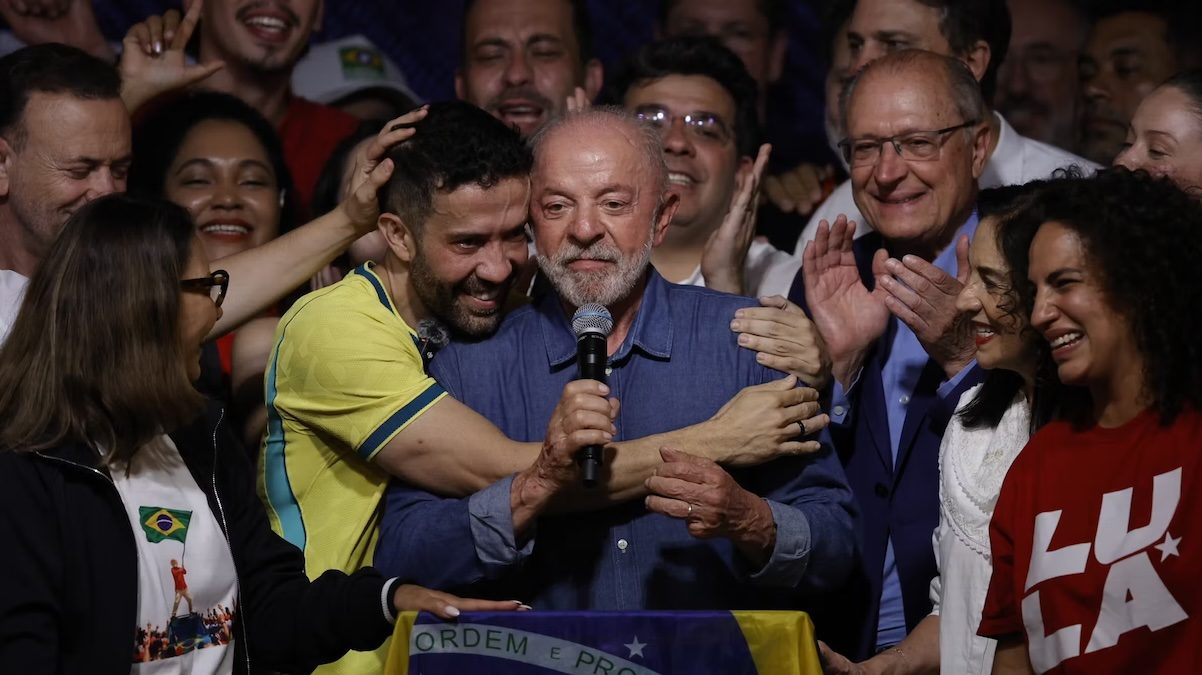
Pro-democracy advocates are pressing governments worldwide, including the Trump administration, to formally acknowledge Luiz Inácio Lula da Silva's victory in Brazil's presidential runoff on Sunday. The call comes as his far-right opponent, Senator Flávio Bolsonaro, refuses to concede and has demanded the election be annulled, raising concerns about a repeat of the unrest that followed the 2022 vote.
“It is impossible to recognize the results. I am going to request the annulment of these elections,” Bolsonaro declared, pointing to the Brazilian Supreme Court's decision to extend voting by two hours as grounds for dispute. Both Lula and Bolsonaro had supported the extension, albeit for different reasons, but the younger Bolsonaro now cites it as evidence of irregularities.
Flávio Bolsonaro is the son of former President Jair Bolsonaro, who was convicted last year for plotting to violently retain power after Lula's 2022 victory. The elder Bolsonaro, a close ally of US President Donald Trump, has yet to comment on Sunday's outcome.
International recognition and US silence
Leaders from across the Americas, including Mexican President Claudia Sheinbaum and Canadian Prime Minister Mark Carney, have congratulated Lula on his reelection. However, Trump, who hosted Flávio Bolsonaro at the White House in May, has remained silent. US Secretary of State Marco Rubio, whose department reportedly worked to tilt the election in Bolsonaro's favor, has also not publicly commented.
The Washington-based Center for Economic and Policy Research (CEPR), which had warned of US interference ahead of the vote, issued a statement urging immediate recognition. “Governments – including the Trump administration – should immediately recognize the outcome, to prevent a possible coup or further violence,” the group said.
Alex Main, CEPR's director of international policy, who was in Brazil for the election, noted that Flávio Bolsonaro is likely to follow his father's playbook. “It's likely that Flávio Bolsonaro will, like his father in late 2022, encourage his supporters to mobilize in order to try to overturn the election results, which could trigger a new wave of political violence,” he said. “The Trump administration, which has close relations with the Bolsonaro family, could help defuse this threat by joining other governments in recognizing the election outcome.”
A victory against the odds
Lula's win came despite significant obstacles. His campaign complained of bus shortages in key cities like Salvador and São Paulo, which disproportionately affected working-class voters who rely on public transit. The Supreme Court extended polling hours to 7 pm Brasilia time to accommodate the disruptions.
Mark Weisbrot, CEPR's co-director, called Lula's victory “a victory for democracy and independence in the Americas against the massive intervention from the Trump administration in favor of the Bolsonaro team.” He cited politically driven tariffs and other efforts to influence the campaign, as well as Trump's attempts to halt the trial of Jair Bolsonaro.
The election also saw Meta, the parent company of Facebook and Instagram, boost pro-Bolsonaro content over pro-Lula posts, according to reports. Despite these headwinds, Lula managed to overturn a first-round deficit, finishing two percentage points behind Bolsonaro in the October 4 poll before re-energizing his campaign by shortening the Brazilian workweek from six to five days.
“Lula has won despite the unfair practices his campaign has faced from Meta, interference from the Trump administration, and severe disruptions to public transportation on election day,” said Francesca Emanuele, senior international policy associate at CEPR. “These disruptions disproportionately affected working-class voters, who have historically been a key part of Lula's electoral base.”
Pennsylvania Democratic House nominee Chris Rabb, who was at Lula's campaign headquarters in São Paulo, hailed the result: “Lula won, Brazil won, democracy won, the Americas won.” He described the victory as a rebuke to “a raging fascist, rubber-stamped for Donald Trump.”
Analysts see Lula's win as a significant setback for the right-wing wave that has swept Latin America. “This is the first victory for democracy in this hemisphere since Trump took office,” Rabb said. Joseph Bouchard, a journalist focusing on Latin America, added that the right across the region remains deeply unpopular, “rightly seen as corrupt, autocratic, and uncommitted” to democratic norms.
The coming weeks will test whether Brazil can avoid the violence that followed the 2022 election. With Flávio Bolsonaro vowing to contest the results, the international community's response—particularly Washington's—could prove decisive in stabilizing the region's largest democracy.