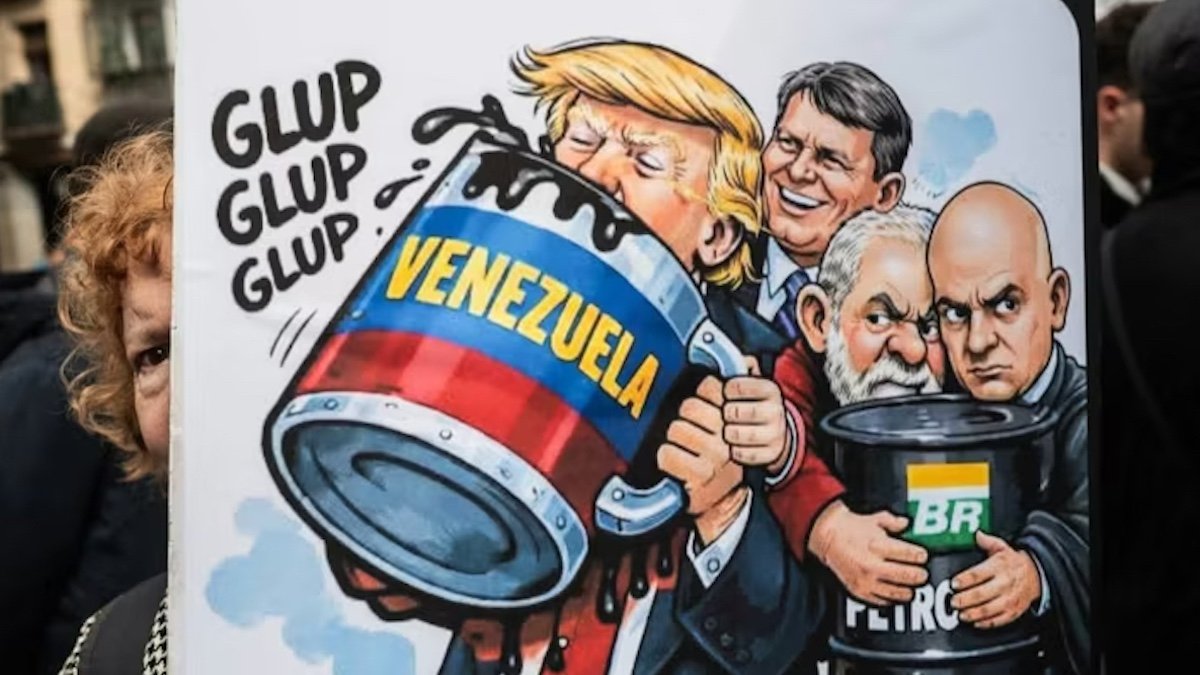
When Illinois Congressman Sean Casten asked Treasury Secretary Scott Bessent a straightforward question about the billions of dollars the Trump administration claims to be collecting from Venezuelan oil sales, the answer was a single, startling word: “No.”
Bessent, testifying before the House, could not confirm who controls the money, where it is held, or whether any of it has flowed to American citizens. His refusal to answer—repeated in February, March, and again this week—has turned a routine oversight hearing into a portrait of an administration that appears to be running an offshore slush fund with no accountability.
A pattern of secrecy and self-dealing
The saga began days after President Trump ordered the capture of Venezuelan President Nicolás Maduro. On his social media platform, Trump declared that Venezuela’s oil revenues would be controlled by him personally “as President of the United States.” Three days later, he signed an executive order declaring a national emergency over the oil, effectively shielding the funds from courts and creditors—including the bondholders and companies to which Venezuela owes roughly $150 billion.
The first cargo of seized oil, according to Reuters and Semafor, was sold to commodity traders Vitol and Trafigura for about $500 million. Both firms have histories of bribery schemes tied to oil sales, as the Washington Post has reported. But the proceeds did not go to the Treasury account named in Trump’s own executive order. Instead, they were routed to a bank account in Qatar—shortly after Qatari leaders gifted Trump a $400 million jet. A senior official told Semafor that Qatar was chosen as a “neutral location” where money “can flow freely” without risk of seizure.
Senator Elizabeth Warren called the arrangement illegal. “There is no basis in law for a president to set up an offshore account that he controls so that he can sell assets seized by the American military,” she said. “That is precisely a move that a corrupt politician would be attracted to.”
Where did the money go?
In January, Secretary of State Marco Rubio testified that $300 million had been sent to Venezuela for government payroll and that another $200 million was “still sitting” in Doha. He described the operation as “novel” and “a short-term mechanism.” But a month later, Energy Secretary Chris Wright told CNBC that the account had been closed and no more money would flow through Qatar. Since then, no one has identified where the funds went.
House Foreign Affairs Committee ranking member Gregory Meeks called it “an offshore slush fund.” Casten and Senator Chris Van Hollen have repeatedly demanded answers, only to be stonewalled. Meanwhile, the pile of money grows. Using Bloomberg tanker-tracking data, the Council on Foreign Relations estimated in April that in the first four months of US control, nearly 100 million barrels of oil worth about $8 billion had flowed through a process “marked by no transparency and minimal oversight.”
A State Department official testified in April that around $3 billion had gone back to Venezuela. But Trump boasted in July that the US had sold more than $13 billion in stolen oil and suggested he could divert the funds to the military or anywhere else he wanted.
Rubio has claimed that accounting firm KPMG “audits every disbursement.” Yet when Reason Magazine investigated in August, it found that neither the agreements nor the audits have been published. Even the Venezuelan government’s so-called “Transparent Sovereignty” website, set up to track oil transactions, lists only a single sale. Trump is not telling Caracas where their oil went or where the money is.
The pattern extends beyond oil. In March, Interior Secretary Doug Burgum flew a planeload of American mining executives to Caracas and returned boasting of a deal to sell over $100 million in gold—again to Trafigura, with proceeds going to an undisclosed destination.
This is an old script, one familiar to anyone who has watched corrupt petrostates. In 2014, Nigeria’s central bank governor, Lamido Sanusi, revealed that roughly $20 billion in oil revenue had never reached the national treasury. President Goodluck Jonathan fired him and called the money a “phantom.” A PriceWaterhouseCoopers audit later found at least $1.48 billion was simply gone.
As someone who has done international relief work in some of the most corrupt nations on earth, I recognize the pattern: they never announce the looting; they just stop telling you where anything went. Most people assume it must be okay because it’s not being reported. The conversation dies away.
But this is not a distant petrostate. This is the United States Treasury, and the money belongs to the Venezuelan people. The question—where is the money?—remains unanswered. And with Trump’s escalating confrontation with Iran, the oil revenues are only increasing. The administration’s refusal to provide basic transparency is not just a scandal; it is a warning about how far executive power has been stretched. As the Iran war grinds on, the stakes for accountability grow higher.