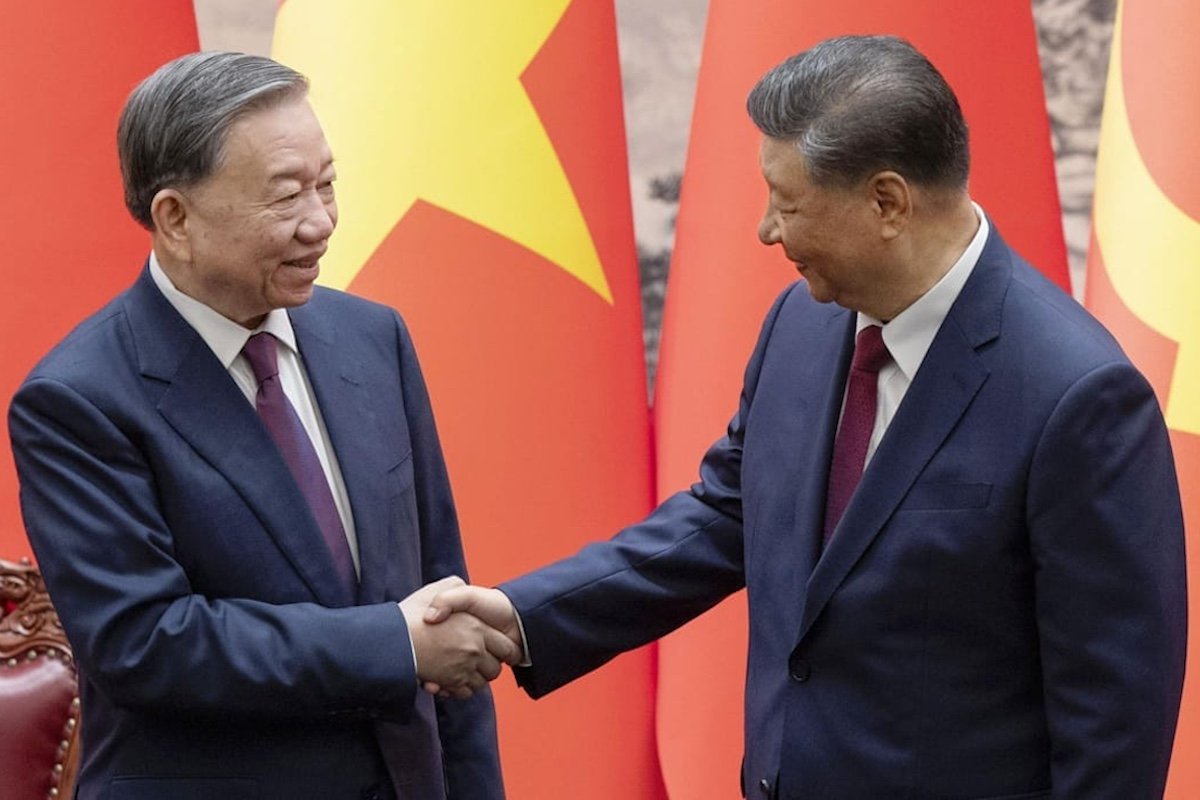
When the leaders of 21 APEC economies gathered in Shenzhen for the 33rd APEC Economic Leaders’ Meeting, the most consequential bilateral encounter may have been the one that took place away from the plenary hall. Vietnamese General Secretary and State President To Lam sat down with Chinese President Xi Jinping on the sidelines—a meeting that, given its timing, carries strategic weight for the future of Vietnam–China relations.
The encounter comes at a moment of notable flux in the international environment. US-China relations appear to be shifting from confrontation toward a more managed competition, with both sides committing to what they call “constructive strategic stability.” At the same time, a thaw in Japan-China relations remains elusive, and the outcome of the US midterm elections has raised fresh questions across the region. The new US Congress is unlikely to force major changes to the Trump administration’s tariff policy, much of which rests on executive authority. Meanwhile, the 49th ASEAN Summit, held in the Philippines in mid-November 2026, ended without agreement on the long-awaited Code of Conduct in the South China Sea.
All of these developments make sustained dialogue between Hanoi and Beijing particularly important. But understanding the meeting’s significance requires looking at China’s place in Vietnam’s broader foreign policy—one that is often misunderstood.
Strategic autonomy, not alignment
Hanoi’s approach centers on safeguarding its national interests at the highest level, with peace, independence, self-reliance and self-strengthening as its foundations. Closer ties with China should not be read as evidence that Vietnam is tilting toward Beijing. Nor does Hanoi’s expanding engagement with the US and Western partners necessarily signal an attempt to “escape China’s orbit.” Both interpretations oversimplify Vietnam’s foreign policy.
Vietnam is striving to broaden its strategic options by cultivating ties with various partners based on the specific strengths each side brings. China, for instance, has clear advantages in infrastructure, industrial capacity, geographical proximity, market size and logistics. The US and European partners can offer better opportunities in technology, high-quality investment, markets and security cooperation. Hanoi’s key question is not choosing between China and the West, but maximizing the benefits of cooperation with each while ensuring no single relationship unduly narrows its room for strategic maneuver.
That logic was on full display in Shenzhen. The meeting also served two immediate purposes. First, it allowed Hanoi and Beijing to coordinate on APEC hosting duties—Vietnam will take over the chair in 2027, and both sides have pledged to support each other in 2026 and 2027. For Hanoi, APEC 2027 is a chance to raise its international profile, demonstrate a more proactive role in regional governance, deepen economic integration and attract investment. It is also tied to Vietnam’s ambitious target of 10% GDP growth in 2027.
Second, the meeting offered a timely follow-up to the commitments made during To Lam’s state visit to China in April 2026. Roughly seven months later, the APEC encounter provided an opportunity to review progress and identify areas requiring further attention. Two issues stood out as particularly important in Hanoi’s discussions with Beijing.
Railway connectivity: slow progress
On railway connectivity, Vietnam has continued to urge China to accelerate cooperation on three railway projects. Initial steps have been taken on the Lao Cai–Hanoi–Hai Phong railroad, but overall progress is slower than expected. In August 2026, Vietnam’s National Assembly approved increasing the project’s total investment from 203.23 trillion VND ($7.72 billion) to 289.33 trillion VND ($11 billion). For the Dong Dang–Hanoi and Mong Cai–Ha Long–Hai Phong routes, both countries signed an agreement in March 2026 to support planning for standard-gauge railway lines.
Beyond serving domestic transport needs, these railway lines could facilitate freight transit to China and even provide convenient overland access to European markets. However, their tangible benefits will hinge on operational capacity, investment structures, seamless connectivity, and project efficiency. Contractor arrangements and financing models, particularly loan agreements with China, will remain critical factors to watch.
Trade imbalance: a growing concern
Narrowing the trade imbalance was another key priority in Vietnam’s bilateral talks with China. Official data shows that Vietnam imported approximately $187.34 billion worth of goods from China in the first nine months of 2026, while exports to the Chinese market amounted to around $65.86 billion. That left Vietnam with a trade deficit of approximately $121.48 billion, up 43% year on year.
By contrast, the US remained Vietnam’s largest export market, with exports reaching approximately $140 billion, while imports from the US stood at around $17.38 billion. Consequently, Vietnam recorded a trade surplus of approximately $122.62 billion with the US, up 23.8% from the same period last year.
If bilateral trade continues to expand with Chinese imports outpacing Vietnamese exports, widening the deficit further, economic ties could face growing structural imbalances and asymmetrical benefits. Hanoi is clearly keen to address this, even as it navigates the broader geopolitical currents. The Shenzhen meeting was a reminder that for Vietnam, diplomacy is not about choosing sides—it is about managing a complex web of relationships to serve its own interests.