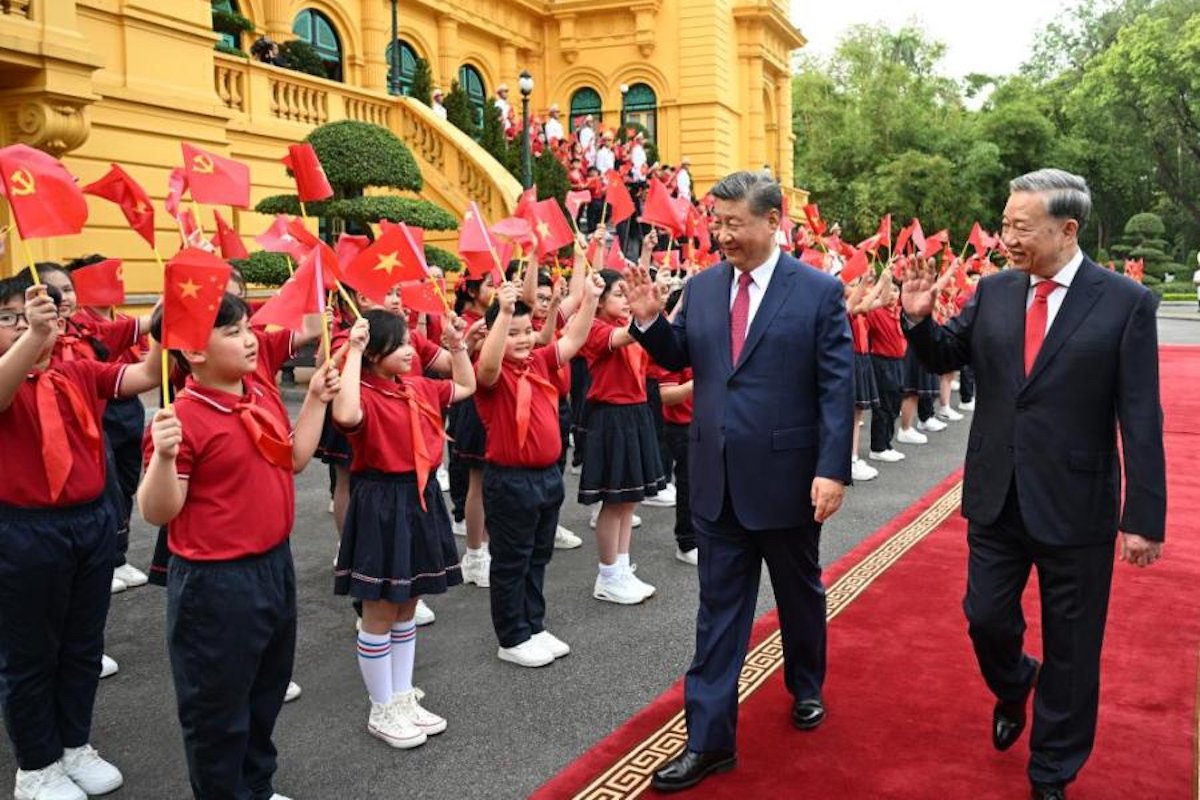
Vietnamese leader To Lam, having recently consolidated his position as both head of the Communist Party and President of the state, has confirmed his first overseas trip in the dual role will be to China. The state visit, scheduled for late April, follows a pattern he established after becoming General Secretary in 2024, when Beijing was also his initial foreign destination.
This move streamlines Vietnam's high-level diplomacy. Unlike his predecessor Nguyen Phu Trong, who visited the White House in 2015 without a formal state title, To Lam can now engage with counterparts like Chinese President Xi Jinping and U.S. President Donald Trump on equal ceremonial footing. The choreography is familiar: a visit to Beijing for strategic dialogue, likely followed by one to Washington to demonstrate balance.
An Unprecedented Security Mechanism
Early signals, however, suggest this balance is under strain. In mid-March, Vietnam and China held the inaugural meeting of a new "3+3" strategic dialogue. This ministerial-level mechanism brings together the foreign affairs, defense, and public security chiefs from both sides, a format unprecedented in Vietnam's bilateral relations.
The dialogue, which includes coordination on countering so-called "color revolutions," embeds security cooperation directly into the institutional architecture of the relationship. For To Lam, a former Minister of Public Security, this mechanism plays to his strengths. It also deepens Vietnam's institutional entanglement with Beijing in ways that may prove difficult to reverse.
The contrast with Vietnam's engagement with the United States is notable. While To Lam's meeting with Trump in February was symbolically significant, it yielded no major breakthroughs on persistent issues like the trade imbalance or the transshipment of Chinese goods through Vietnam. Engagements with Xi Jinping, by comparison, reliably produce new frameworks and commitments. The "3+3" mechanism itself was agreed upon during Xi's state visit to Hanoi in 2025.
The Gap Between Preference and Policy
Regional surveys reveal a tension in Vietnam's positioning. The ISEAS State of Southeast Asia 2026 survey found that while a slim majority of Southeast Asian respondents would now side with China if forced to choose, Vietnam and the Philippines remained notable exceptions, still expressing a preference for Washington.
Yet a separate analysis, the Anatomy of Choice Alignment Index, which measures actual policy behavior over three decades, places Vietnam in the China-leaning camp. Only the Philippines remains clearly aligned with the U.S. This gap between stated elite preference and revealed policy choices is significant, suggesting a structural tilt toward Beijing is advancing regardless of rhetoric.
This tension is rooted in Vietnam's complex circumstances. It faces the most extensive territorial disputes with China in the South China Sea. Its economic growth relies on being seen as a stable alternative for foreign investment—the "China plus one" logic that has driven manufacturing FDI from Japan, South Korea, and the West. Domestically, a deep historical wariness of Chinese influence persists, a political constraint that forces Hanoi to maintain at least the appearance of balance. In 2018, mass protests forced the shelving of a proposed economic zone law over fears it would grant excessive leverage to Chinese investors.
These factors have long underpinned Vietnam's "bamboo diplomacy," bending with geopolitical winds while staying rooted in independence. The question now is whether its room to maneuver is narrowing. Current pressures are acute: conflict in the Middle East has disrupted energy supplies, while export bans by China and Thailand have left Vietnam, which imports over two-thirds of its jet fuel, scrambling. Hanoi has sought crude oil assistance from Japan and South Korea, underscoring the practical need for diversified partnerships. The broader regional energy landscape is shifting, as explored in our analysis of how the Middle East conflict is accelerating a global shift from oil.
Compounding Risks of Alignment
Moving closer to Beijing carries immediate economic risks. The more Vietnam appears integrated into Chinese supply chains, the more vulnerable it becomes to U.S. tariff actions and transshipment investigations. In March 2026, the U.S. Trade Representative launched Section 301 investigations targeting Vietnam and 15 other economies over structural excess manufacturing capacity—a direct challenge often linked to Chinese industrial policy. Vietnam recorded a historic $178 billion trade surplus with the U.S. in 2025, making it a prominent target.
Beyond tariffs, the Japanese, South Korean, European, and American firms driving Vietnam's investment boom do so in part because they perceive it as distinct from China. Overt alignment could undermine this crucial competitive advantage. Furthermore, as China develops advanced military capabilities, such as the drone-launched mines that could encircle Taiwan, Vietnam's security calculus in the South China Sea becomes even more delicate.
To Lam's consolidation of power and his forthcoming trip to Beijing mark a pivotal moment. While the rituals of bamboo diplomacy continue, the institutional foundations of Vietnam's relationship with China are growing deeper and more security-focused. The balancing act remains, but the center of gravity is perceptibly shifting.