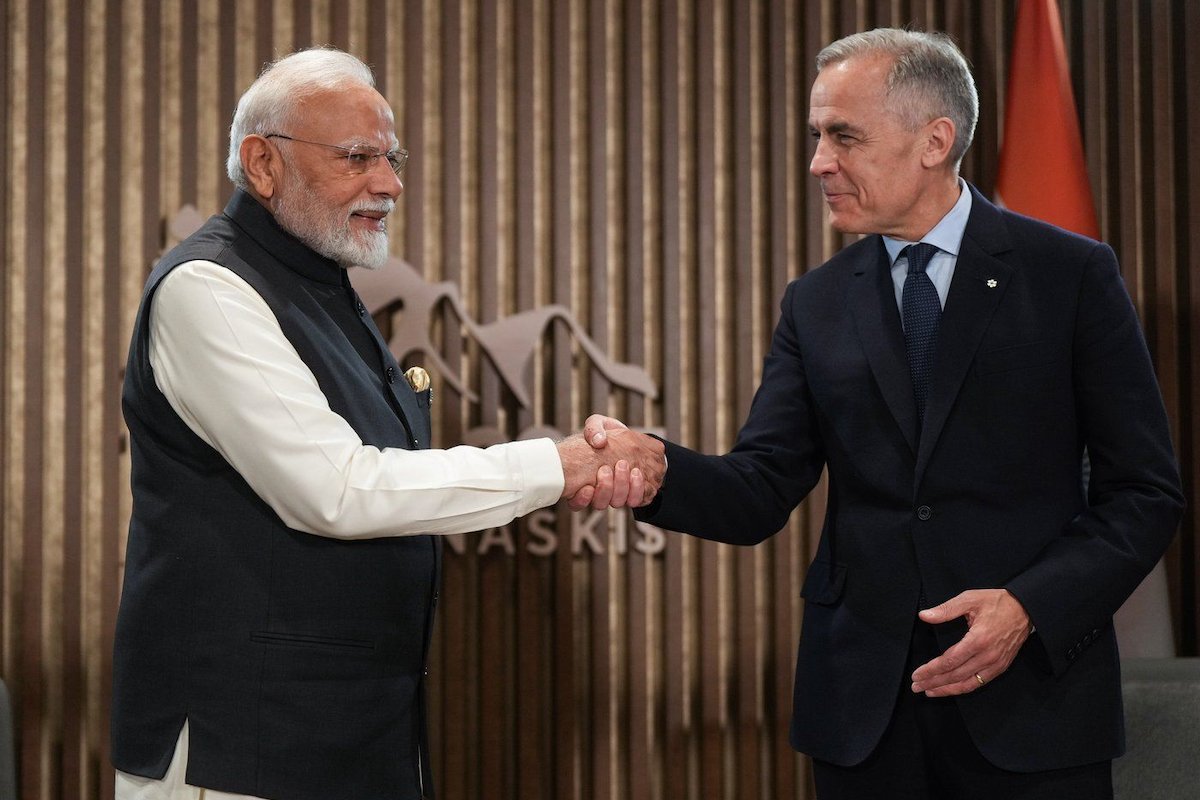
Western governments are walking a delicate line with India, rebuilding diplomatic and economic ties even as they publicly accuse New Delhi of running intelligence operations on their soil. The tension was on full display on October 13, when Canadian Prime Minister Mark Carney and Indian Prime Minister Narendra Modi reaffirmed plans to expand trade and security cooperation, despite unresolved security concerns.
This renewed engagement underscores a simple reality: strategic interests often blunt the diplomatic fallout from serious disputes. India's economic heft, military strength, and pivotal position in the Indo-Pacific give Western capitals compelling reasons to keep New Delhi close. Washington sees India as a counterweight to China's growing influence; Ottawa views it as a way to diversify trade and access one of Asia's largest markets; Canberra counts India as a key player in regional security.
These interests create a clear hierarchy of priorities. Intelligence allegations can trigger investigations, diplomatic protests, and security reviews, but they do not, by themselves, dictate the course of broader relations. Governments can pursue accountability through legal and intelligence channels while continuing trade talks and strategic partnerships. That separation helps explain why Western pressure on India has remained limited.
Canada's economic calculus
Canada offers the clearest example. In its 2025 public report, the Canadian Security Intelligence Service named India among the main state actors engaged in foreign interference and espionage in the country. The agency described past efforts to cultivate covert relationships with politicians, journalists, and diaspora communities, along with surveillance and intimidation of critics of the Indian government.
The findings followed the diplomatic rupture over the 2023 killing of Hardeep Singh Nijjar, a Sikh separatist, in British Columbia. Canadian authorities alleged Indian involvement, which New Delhi denied. The dispute badly damaged relations and raised hard questions about foreign interference and the safety of people on Canadian soil.
Even so, Ottawa has shifted toward re-engagement. During Carney's March visit to India, the two governments agreed to deepen cooperation on trade, energy, and national security. Their joint statement promised closer law-enforcement coordination, information-sharing, and regular talks between national security officials. On October 13, Carney and Modi reaffirmed their commitment to conclude negotiations on a Comprehensive Economic Partnership Agreement, part of an effort to double bilateral trade by 2030.
Carney's office also welcomed expanded cooperation on defense, artificial intelligence, and security. The leaders noted that dialogue between their national security advisers, held in India the previous week, and Modi's planned visit to Canada in December underscored their political commitment to repairing ties.
Canada's calculus is largely economic. As Ottawa looks to reduce its dependence on the United States amid American protectionism, India has become an increasingly important prospective trading partner. The aim is less about diplomatic reconciliation than about creating room to maneuver in an uncertain world. That logic explains why Canada is negotiating trade and security in parallel. Reopened diplomatic channels may help address unresolved concerns, but they do not show that the earlier allegations have been settled or that anyone has been held accountable.
US and Australia: separate tracks
The United States faces a similar, though slightly different, dilemma. In October 2024, the Justice Department charged Vikash Yadav, an Indian government employee, in connection with an alleged plot to assassinate a Sikh separatist and US citizen in New York. An indictment contains allegations, not a finding of guilt. Still, the case raised pointed questions about possible intelligence operations aimed at people inside the borders of a major security partner.
Washington's response shows how the two tracks can run apart. Criminal proceedings can go forward independently while American policymakers weigh India's value for regional security, technology cooperation, and the balance of power in the Indo-Pacific. The US wants partners that can help stabilize the region without joining a formal military alliance, and India's military scale, geography, and independent relationship with Moscow make it an important, if sometimes difficult, partner. Broad punitive measures could complicate defense cooperation, slow efforts to diversify supply chains, and make it harder to engage New Delhi on regional security.
Australia has faced similar concerns. In April 2024, ABC News reported that India was behind an espionage network that Australian intelligence authorities disrupted in 2020, whose reported activities included trying to obtain sensitive defense information, cultivate political contacts, and monitor diaspora communities. Canberra nonetheless maintains a robust strategic relationship with India, bilaterally and through the Quadrilateral Security Dialogue, which also includes the US and Japan.
The Canadian, American, and Australian cases differ in their evidence, legal status, and institutional response, and without further proof they do not establish a single coordinated Indian policy. But they present the same challenge: Governments must confront intelligence-related concerns while protecting relationships they regard as vital to their wider security.
India's foreign policy complicates matters further. New Delhi has cultivated strategic autonomy, balancing ties with Moscow, Washington, and others, which makes it a valuable but unpredictable partner. Western capitals have largely accepted this, prioritizing engagement over confrontation. As long as India's economic and strategic weight remains indispensable, the West is likely to keep its criticism measured and its doors open. For more on India's strategic ambitions, see this analysis of India's superpower rhetoric.