On October 9, fighters from two rival jihadist groups clashed near Gonadaouri, in Burkina Faso's Oudalan province, close to the Malian border. One side belonged to Jama'at Nusrat al-Islam wal-Muslimin (JNIM), al-Qaeda's Sahel affiliate; the other to the Islamic State Sahel Province (ISSP), formerly known as the Islamic State in the Greater Sahara. The two have been fighting along that frontier since August.
Three days later, ISSP claimed to have killed more than 400 JNIM fighters, including several commanders. AFP could not verify the figure, and specialist sources quoted by Radio France Internationale described heavy losses on both sides, including ISSP commanders killed by JNIM. JNIM made no statement.
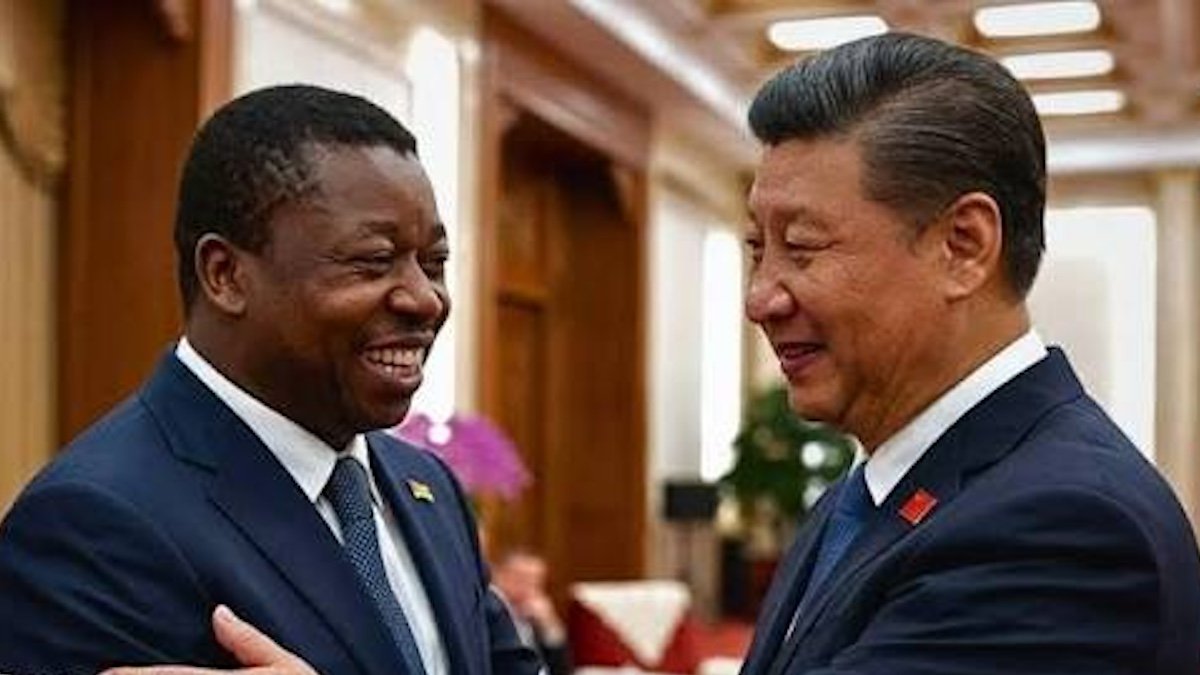
On October 13, Chinese President Xi Jinping received Togo's President Faure Gnassingbe in Beijing. Much of the meeting dealt with trade, from zero-tariff access for Togolese goods to Togo's wider use of the renminbi. Xi also set out four principles for how outside parties should help settle Africa's “hotspot issues,” and Gnassingbe endorsed them in full.
Xi named no conflict, and the principles should not be read as a comment on the Sahel. But they do invite a test, and the Sahel is a hard place to pass it.
Principles vs. reality
The principles themselves are straightforward. Africans, Xi said, are “the true masters of Africa” and should play the central role in regional affairs. Outsiders, he said, should respect the UN Charter and the sovereignty and territorial integrity of the states concerned. Consultation should replace hostilities, because wars and unilateral sanctions cannot fundamentally resolve conflicts between countries. Symptoms and root causes should be addressed together.
The phrase “between countries” matters more than it first appears. At Gonadaouri, neither side was a state. JNIM and ISSP both fight the Sahel's military governments, but they disagree on doctrine and compete for territory, and each runs areas where it imposes its own rules on residents. The Armed Conflict Location & Event Data (ACLED) project has recorded more than 2,100 deaths in fighting between the two since 2019, and in April the rivalry reached Niger's Tillaberi region for the first time. Xi's call for consultation is harder to apply when neither armed group answers to a government.
The states in question also control less ground than the principle assumes. A large part of Burkina Faso is reportedly beyond effective government control, and the country hosts about 2.1 million of the region's 2.8 million internally displaced people. In Mali, on October 6, Malian troops and Russia's Africa Corps re-entered Kidal without a fight, five months after losing it to a joint offensive by Tuareg separatists and JNIM. The separatists called their withdrawal temporary. Algeria, long at odds with Mali, appears to have helped arrange the handover.
China's growing footprint
China is already part of this picture. Chinese troops served with the UN mission in Mali from a base in Gao in the country's north, and one was killed there in 2016. That mission closed at the end of 2023, and China's presence since then has been bilateral. Beijing posted its first defense attaché to Niger last year, and Mali has taken delivery of Chinese short-range air defense systems. China National Petroleum Corp (CNPC) built Niger's oil export pipeline to Benin, while Chinese companies mine and build across western Mali.
That exposure has a price for China. Of the 89 foreigners reported abducted in Africa in 2025, 38 held Chinese passports, most of them working in Mali's gold-rich south-west. Mali's record also raises questions about Xi's emphasis on sovereignty. Its military government expelled the UN mission and, in January 2024, scrapped the 2015 Algiers peace agreement with northern armed groups, a decision that, by several accounts, contributed to renewed fighting in the north. As the fighting intensified, Beijing kept supplying equipment to Mali and doing business there, without public comment on how the war was being fought.
Chinese restraint has not always meant passivity, however. In 2024, when Benin blocked Niger's crude exports during a border dispute, it was China's ambassador in Cotonou who announced that loading would resume. The following year, Niamey ordered Chinese oil executives out of the country in a row over local hiring. In May this year, the two sides reached an agreement in principle for Niger to acquire a 45% stake in CNPC's pipeline subsidiary, after Niamey negotiated more favorable terms. That kind of bargaining is closer to what Xi described than any arms delivery.
Xi's appeal for African leadership raises another question: whose voices count? In the Sahel, leadership extends beyond the military governments of the Alliance of Sahel States. Algeria evidently retains channels into northern Mali. The African Union maintains a mission for Mali and the Sahel, and coastal West African states have watched the violence move towards their borders. China has working relations with all of them, and could route its support for humanitarian access and hostage talks through them.
The risk to Chinese citizens is more immediate. The Institute for Economics and Peace has cited a 2017 estimate placing ransoms at 40% of JNIM's revenue. Chinese nationals at unlicensed gold sites are among the easiest targets, as the Chinese embassy in Mali acknowledged last December when it warned that security at such sites was weak. Working with Malian authorities to license Chinese gold operators and improve local hiring and revenue-sharing in Kidal and other northern regions would be a concrete step toward the principles Xi outlined—but so far, Beijing has shown little appetite for such engagement.