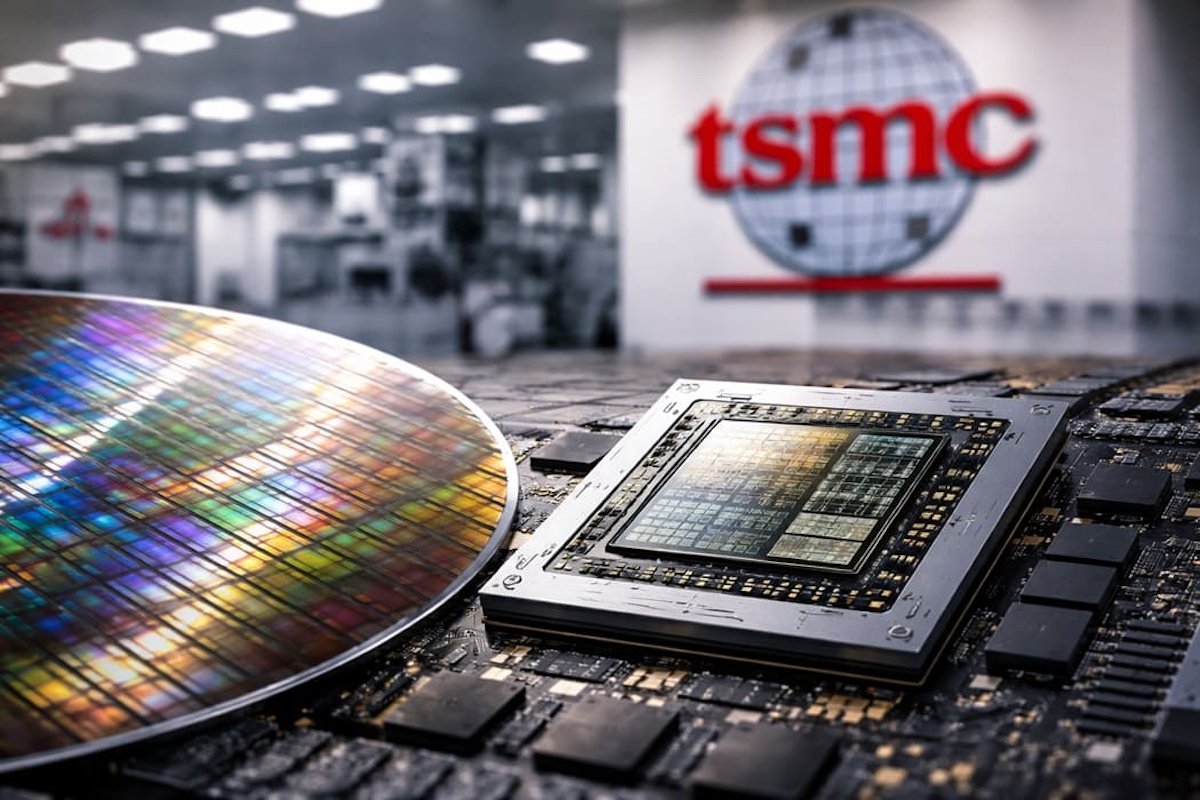
The financial narrative of the artificial intelligence revolution is being rewritten, and its most compelling chapter is being authored in Asia. While global attention remains fixed on Silicon Valley's software giants and their futuristic models, the tangible, realized profits are flowing to the region's advanced semiconductor manufacturers. A 58% year-on-year jump in quarterly profit announced by Taiwan Semiconductor Manufacturing Company (TSMC) on April 16 serves as a definitive signal of this shift.
This surge represents the fourth consecutive quarter of record revenue for the world's leading contract chipmaker. Crucially, advanced chips—the processors powering the most demanding AI workloads—now account for approximately three-quarters of TSMC's wafer revenue. These are not speculative gains based on projections; they are concrete earnings delivered in the present, driven by structural demand and formidable pricing power.
The Infrastructure Layer Where Value is Captured
The global conversation around AI remains disproportionately focused on the companies building large language models and consumer-facing applications, a domain where U.S. firms like OpenAI dominate headlines and valuations. However, capital chasing that visible layer of the story may be overlooking where value is actually being captured at scale. The monetization of AI is happening deeper in the technological stack, at the foundational level of advanced semiconductor production.
Every major AI initiative, whether from American, Chinese, or European firms, is fundamentally dependent on access to these high-performance chips. Without them, there is no scaling of models, no expansion of data centers, and no acceleration of commercial deployment. This dependency is absolute, granting the few companies capable of producing these components a position of immense strategic and economic leverage. They are not merely suppliers; they are the essential enablers of the entire AI ecosystem.
This dynamic creates a significant gap between market narrative and financial reality. The infrastructure enabling AI is less visible than the applications it powers, but it is already generating measurable, robust returns. TSMC's expanding margins in the most complex segment of the semiconductor market—where competition is limited and barriers to entry are astronomically high—demonstrate where the strongest pricing power currently resides.
Asia's Concentrated and Enduring Advantage
The production of leading-edge semiconductors is extraordinarily concentrated, both corporately and geographically. Taiwan sits at the epicenter of this system, supported by a wider Asian ecosystem that has cultivated decades of deep expertise in precision manufacturing, materials science, and complex engineering. This concentration is not incidental; it is the result of long-term industrial policy, immense capital investment, and accumulated technical refinement that cannot be quickly replicated.
Efforts to diversify semiconductor manufacturing capacity outside Asia, particularly in the United States and Europe, are underway but face long timelines and profound execution challenges. Building leading-edge fabrication capability is a multi-year endeavor requiring hundreds of billions of dollars and a seamless integration of cutting-edge technology and specialized talent. As seen in other critical technology races, establishing parallel, competitive supply chains is a formidable task.
In the interim, demand for high-end chips is surging with every new AI investment. This cycle is self-reinforcing: more computing power requires more advanced chips, which in turn strains the existing specialized production capacity. Each quarter of sustained growth further entrenches Asia's pivotal position in the global technology supply chain.
The implications extend far beyond corporate balance sheets. The concentration of such a critical capability in one region introduces urgent strategic considerations for governments worldwide. Questions of supply chain resilience, geopolitical stability, and guaranteed access to production capacity are now central to national and corporate planning. This reality grants Asia, and particularly key players like Taiwan, South Korea, and Japan, significant influence over the pace and direction of the global AI economy.
This is not to diminish the innovative role of software firms. Companies like OpenAI, which faces its own financial challenges despite rapid revenue growth, are vital drivers of AI capability. However, their path to profitability remains uncertain and dependent on the very hardware supply chain now proving so lucrative. The contrast is stark: while the AI boom is curated and narrated in Silicon Valley, it is being substantively monetized in the foundries of Hsinchu, Taiwan, and beyond.
Control over advanced chip production has evolved from an industrial advantage into a form of fundamental economic leverage. As global tensions simmer, this leverage carries weight in international relations, influencing everything from trade policy to security alliances. The AI narrative may continue to be shaped in California, but its financial and strategic bedrock is firmly anchored in Asia.