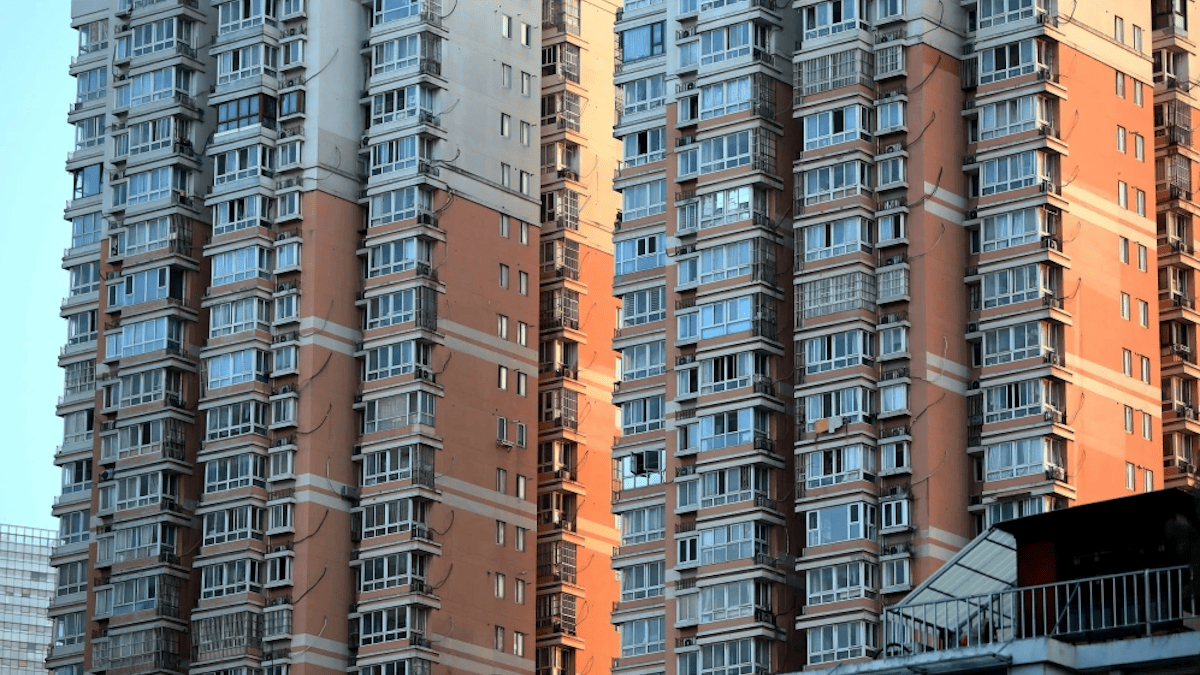
China's residential property market continues to struggle as a surge in court-ordered auction homes floods the market with steep discounts, deepening buyer caution and delaying any meaningful recovery in the world's second-largest economy.
Data from China Index Academy, a real estate research firm, shows that across 355 Chinese cities, the number of properties listed for court-ordered auction reached 539,000 in the first seven months of 2026, a 23.7% increase from the same period last year. This influx of discounted properties has dragged auction prices down by 9% year-on-year, as courts and asset managers rush to offload homes seized from defaulting borrowers.
Media reports indicate that only about one-third of listed auction homes have found buyers, with sales prices averaging roughly 30% below comparable secondary-market properties. In second- and third-tier cities, the discounts are even steeper—some auctioned homes have changed hands at 50% to 60% below secondary-market levels, while many others attract no bidders at all.
The steep discounts have cast a psychological shadow over the wider market, reinforcing the belief among prospective buyers that prices have further to fall before hitting bottom. With abundant inventory, buyers are now cherry-picking properties they believe can be resold easily, rather than settling for a discount alone. Demand is concentrated on well-located units in top-tier cities with strong transport links and good schools, leaving remote, aging, or rural properties largely untouched.
A two-speed secondary market
Home prices in the secondary market in China's first-tier cities fell 3.7% year-on-year in July, according to the National Bureau of Statistics (NBS). Guangzhou posted the steepest drop among the four top-tier cities at 4.7%, followed by Beijing at 4.5% and Shenzhen at 3.6%, while Shanghai fared best with a 2% decline. Second-tier cities fared worse, with prices down 5.1%, while third-tier cities saw the steepest declines at 5.8%.
Commentators say the gap illustrates why liquidity, not price alone, defines China's secondary housing market. Top-tier cities are cooling more slowly, as buyers still see enough scarcity and demand to step in, while smaller cities face years of oversupply, leaving sellers with far less room to negotiate.
“The secondary market has a shortage of good-quality listings, so some newer homes in good school districts or prime locations can still hold their value,” said Yan Yuejin, deputy director of the Shanghai-based E-house Real Estate Research Institute. “But overall, sellers in most cities are still cutting prices just to keep transactions moving, and further price adjustments are needed to draw buyers back in.”
Clearance rates in the auction home market—the share of listed properties that actually sell—also show how demand differs sharply across city tiers. Nationwide, 245,000 residential properties were listed for court auction in the first seven months of 2026, and 89,000 found buyers, a clearance rate of 36.2%. Clearance rates were far higher in top-tier and strong second-tier cities: Ningbo led at 80.8%, followed by Shanghai at 78.5%, Shenzhen at 71.3%, Hangzhou at 70.4%, and Guangzhou at 55.6%. Smaller cities fared far worse; in Luoyang, for example, only 12.87% of auctioned homes found buyers.
Auctioned homes nationwide sold for about 73% of their appraised value on average in 2026, a discount of roughly 27%. If a home fails to sell at its first auction, the starting price for the next round can be cut by up to 20%.
“Transactions of court-auctioned homes rose 42.7% year-on-year in the first seven months of 2026, which looks impressive,” says Jiang Xiaorong, a Shaanxi-based columnist. “But this looks more like sellers using price cuts to clear a growing backlog, not buyers suddenly turning bullish on housing again.”
“For ordinary secondary-home owners, the real pain usually is not that statistics show prices down a few percentage points,” Jiang adds. “It’s that they want to sell but simply cannot, especially for families trying to upgrade to better homes.” She cites the example of one such family needing a 3 million yuan (US$420,000) down payment for a new apartment, but their old home, valued at 2.5 million yuan, has sat unsold for three months despite two price cuts to 2.2 million yuan, leaving them unable to raise enough money before the transaction deadline.
Some families turn to consumer loans or dip into savings meant for elderly care and education, while others keep cutting prices to force a sale. For these families, liquidity matters more than paper value, and court-auction data shows an asset is only worth what it can quickly fetch in cash.
“As of April 2026, 8 million people nationwide were officially listed as loan defaulters after they missed mortgage payments,” says a columnist who writes under the pen name Property Observer. “About 60% of these mortgage defaulters are under the age of 35.”
“In one case, a person bought an apartment for 3.48 million yuan with a 2.8 million yuan mortgage,” he says. “A few years later, the property’s value fell to 1.2 million yuan, but the buyer has to keep paying the mortgage. If he stops paying, his home will be auctioned while he will bear a huge debt.” The columnist says about 45% of families who stopped paying their mortgages had lost their jobs, as industries once seen as safe bets, including catering, real estate, and private tutoring, cut staff in recent years. Giving up a home is rarely a choice—it’s a last resort.
The situation is especially brutal in Shijiazhuang, a second-tier city near Beijing, where many homeowners have lost their jobs, their homes, and their savings. As China's property slump continues, the flood of auction homes is likely to persist, keeping downward pressure on prices and prolonging the market's stagnation. For more on how China's economic challenges intersect with global dynamics, see China's uneasy calculus and Nvidia's financing plan.