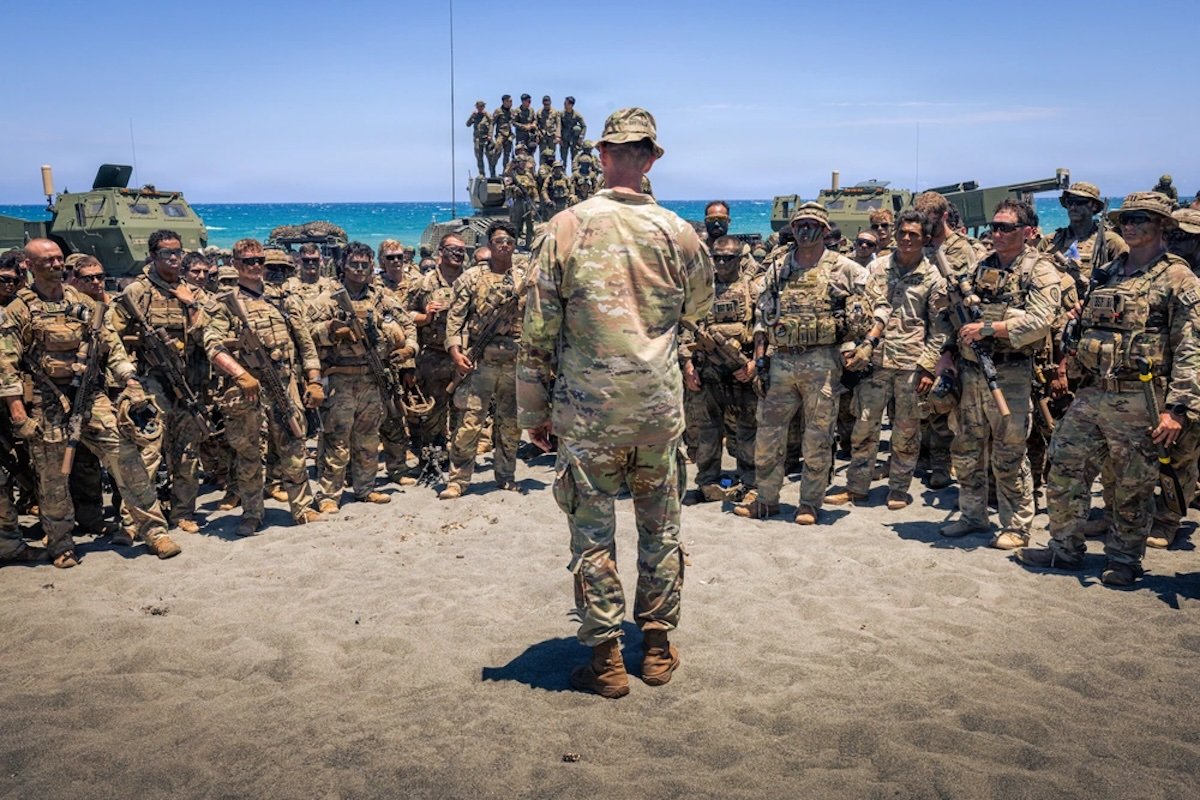
In the northern Philippines, troops from the Philippines, the United States, Japan, Australia, New Zealand, Canada, and France are conducting the annual Balikatan military exercise. The drills, held across Luzon and the Luzon Strait—also known as the Bashi Channel—are explicitly designed to prepare for real combat scenarios. While no official statement names China as the adversary, the geography and operational focus leave little doubt: this is training for a potential conflict over Taiwan.
The Luzon Strait is a strategic chokepoint. If the People's Liberation Army (PLA) were to move against Taiwan, it would need to secure this waterway to protect its right flank or conduct operations east of the island. Training where you might fight is a basic military principle, and doing so with partners ensures that allied forces are not strangers when the moment arrives.
Beyond the Battlefield: Psychological and Political Gains
Balikatan is not just about honing combat skills. The exercise delivers psychological and political benefits that are often overlooked. When militaries train together, they begin to view each other as more equal partners. This mutual confidence thickens political alliances and reduces the risk of imbalanced defense relationships—where one side feels burdened and the other resentful.
Japan's participation this year is a case in point. The Japan Self-Defense Force (JSDF) sent a large contingent to join combat drills for the first time. This marks a significant shift from the historically lopsided US-Japan defense relationship, where Japan was pathologically dependent on American protection. The development of Japan's amphibious capability, which began quietly in late 2011 with a small group of US and Japanese officers, was designed to address two weaknesses: the JSDF's inability to operate jointly across its three services, and its inferiority complex toward US forces.
As the JSDF gained confidence in complex operations, Japan's political class began to see the nation as capable of playing a more active role in its own defense and in alliance operations. The US side, in turn, started to view Japan as a more useful and less unequal ally. This strengthened the bilateral relationship, making it harder for China to exploit divisions—for instance, by sending lobbyists to Washington to argue that Japan expects Americans to do the dying.
The psychological effect on adversaries is equally important. A more capable target nation is bad enough; one that bands together with others is even more troubling. Chinese President Xi Jinping has repeatedly complained about 'blocs,' precisely because they undermine Beijing's strategy of bilateral pressure. Balikatan and similar exercises not only enhance the ability of free nations to resist Chinese aggression but also reinforce the belief that such resistance is possible—and that submission to inevitable Chinese domination is not the only option.
Looking ahead, the logic of inclusion suggests that Taiwan could be invited to participate in future iterations. For now, the drills in the Philippines serve as a reminder that hard power and psychological power are two sides of the same coin in the Indo-Pacific's strategic competition.