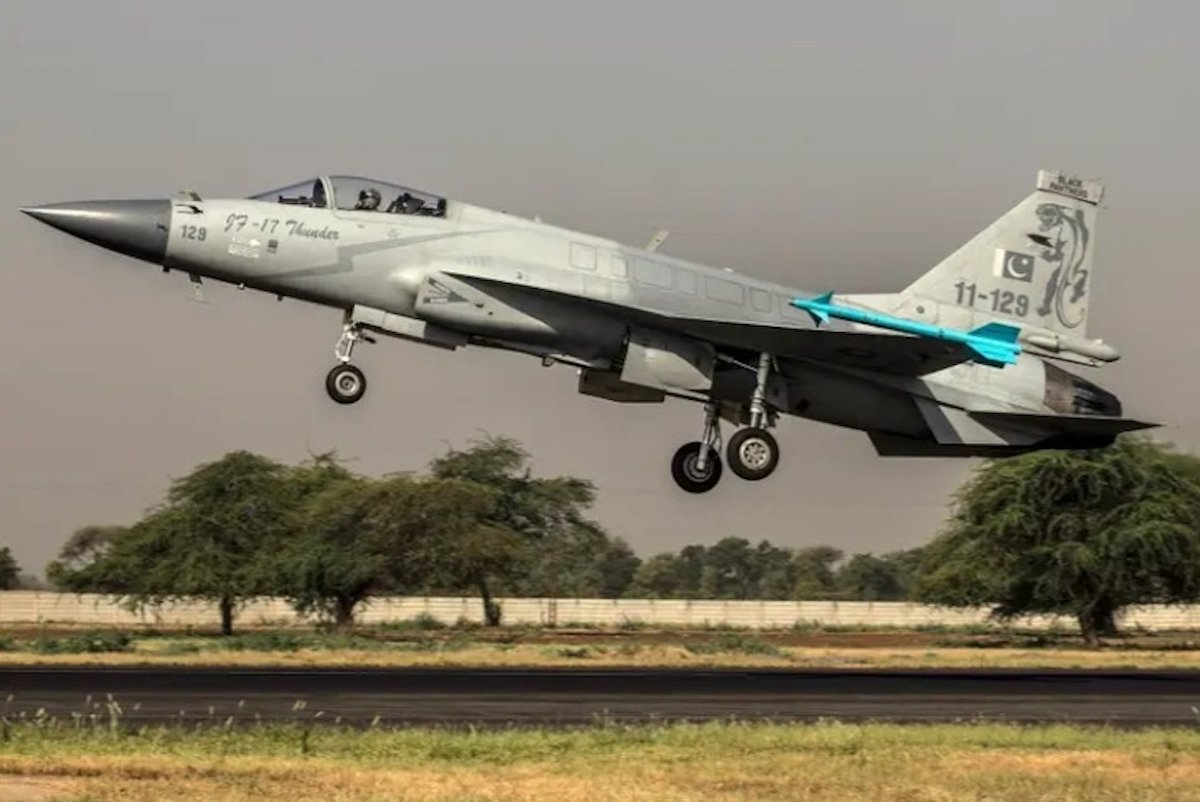
Bangladesh's potential acquisition of the JF-17 Thunder Block III fighter jet, developed jointly by Pakistan Aeronautical Complex and China's Chengdu Aircraft Corporation, is reshaping the strategic landscape in South Asia. What might appear as a routine fleet modernization for the Bangladesh Air Force is being viewed in New Delhi as a direct challenge to India's eastern flank, particularly near the Siliguri Corridor—a narrow 60-kilometer-long, 20-kilometer-wide strip that connects India's northeastern states to the rest of the country.
Reports from Pakistani media in early 2025 indicated that Islamabad had transferred a fully operational JF-17 flight simulator to Dhaka, a move analysts interpret as a strong signal that Bangladesh is preparing to procure the aircraft. The JF-17 Block III is a cost-effective multirole fighter equipped with beyond-visual-range missile capability and modern avionics, offering Bangladesh a viable replacement for its aging fleet of MiG-29s and F-7s. As of May 2026, the Bangladesh Air Force operates only 44 fighter aircraft—36 F-7s and 8 MiG-29s—a force that pales in comparison to the Indian Air Force's 29 squadrons, estimated at 522 frontline combat aircraft including Dassault Mirage, Rafale, Su-30 MKI, and HAL Tejas fighters.
While the JF-17 would not overcome India's regional air superiority, it could narrow the capability gap and complicate Indian military planning. The Siliguri Corridor, often described as India's 'chicken's neck,' is a critical vulnerability: a Chinese advance from the nearby disputed territory of Arunachal Pradesh could sever India's access to its northeastern states and the Bay of Bengal. Bangladesh's proximity to this corridor makes any enhancement of its air power a matter of strategic concern for India.
Geopolitical Shift After Hasina's Ouster
The JF-17 deal is unfolding against a backdrop of deteriorating India-Bangladesh relations following the ouster of former Prime Minister Sheikh Hasina in 2024. Hasina, who fled to India after mass protests against her increasingly authoritarian rule, had pursued a foreign policy of close cooperation with New Delhi while balancing ties with Beijing. Under her tenure, India-Bangladesh relations entered what was proclaimed a 'golden era,' with Dhaka dismantling camps used by Indian separatists, combating radical Islamic groups, and disrupting Pakistan's Inter-Services Intelligence (ISI) network in Bangladesh.
However, Hasina's departure has triggered a sharp reversal. As noted by P.K. Vijayakumar in a December 2025 article in the IOSR Journal of Humanities and Social Science, her ouster created strong anti-India and anti-Hindu sentiments in Muslim-majority Bangladesh, leading to violence against the Hindu minority and constituting a major setback for Indian diplomacy. The interim government in Dhaka has terminated agreements signed during Hasina's administration, delayed India-led regional initiatives, and reduced dependence on New Delhi. Instead, Bangladesh has strengthened ties with both Pakistan and China to safeguard its strategic autonomy.
Ashish Kumar Gupta, in a February 2025 report for the Center for Joint Warfare Studies (CENJOWS), argues that Bangladesh's potential acquisition of Chinese fighter jets could alienate India while giving Beijing strategic leverage to counter India's regional influence. Gupta warns that deeper Bangladesh-Pakistan defense ties could intensify Indian suspicions, trigger stronger military deployments, and heighten risks of strategic miscalculation, even if outright conflict remains unlikely.
China's Growing Arms Footprint in Bangladesh
The JF-17 deal would further cement Bangladesh's status as one of China's largest arms customers. Beyond its F-7 fighters, Dhaka operates two Type 035 Ming-class submarines, two Type 053H3 and two Type 053H2 frigates, four Type 056 corvettes, and substantial numbers of Chinese-origin armored vehicles, artillery, and air defense systems. This extensive reliance on Chinese weaponry gives Beijing significant long-term influence over Bangladesh's defense posture and procurement decisions. High-end Chinese systems depend on Chinese spare parts, maintenance, training, and software updates, potentially deepening that reliance over time.
Byron Chong, in an August 2024 article for the Lee Kuan Yew School of Public Policy, notes that Hasina had balanced relations with China while accommodating Indian sensitivities—scrapping the China-backed Sonadia port project and selecting India for the Teesta River project. Her ouster has removed those constraints, opening the door for deeper Bangladesh-China military cooperation.
The JF-17 acquisition also strengthens Pakistan's hand in the region. Islamabad has long sought to expand its influence in Bangladesh, and the fighter deal represents a significant step in that direction. For India, the prospect of a Bangladesh armed with Chinese-Pakistani fighters, operating near the Siliguri Corridor, forces a reallocation of military resources that could otherwise be deployed against China or Pakistan.
As the geopolitical landscape shifts, Bangladesh's strategic choices will have far-reaching implications for the entire Indo-Pacific. The JF-17 deal is not merely a routine arms purchase—it is a signal of Dhaka's evolving alignment and a test of India's ability to manage its eastern flank. For now, New Delhi watches closely, aware that even a modest enhancement of Bangladesh's air power could alter the calculus in one of Asia's most sensitive strategic corridors.