Bangladesh’s problem is not its geography. It is a geopolitical imagination too often confined by geography. So long as Dhaka views its foreign policy almost exclusively through the South Asian frame, India will remain the dominant power around which every Bangladeshi calculation revolves. Geography cannot be changed, but the diplomatic arena in which Bangladesh operates can be expanded.
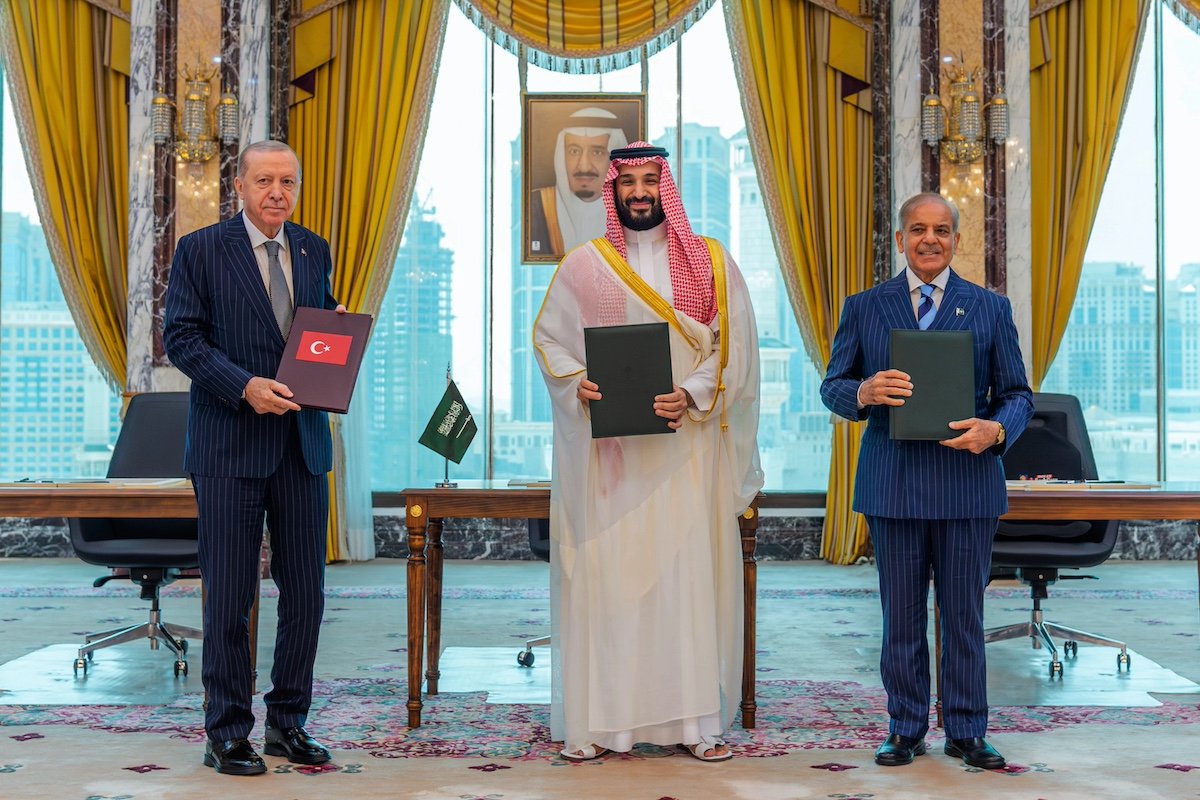
Dhaka is already looking east. It is seeking deeper engagement with Southeast Asia and has requested support to become an ASEAN Sectoral Dialogue Partner. Its interest in the Saudi Arabia-Turkey-Pakistan Mecca Joint Defense Agreement is another attempt to look beyond the traditional South Asian order. This emerging direction should be welcomed. It does not require hostility toward India. Rather, it represents an effort to prevent India from remaining the sole reference point of Bangladeshi strategy.
But changing direction is not the same as acquiring power. Geopolitics does not run on declarations, ceremonial visits or empty posturing. Alliances survive only when their members exchange benefits and accept costs in pursuit of mutual interests. Before Bangladesh joins the Mecca pact, its government must therefore answer two realist questions: What exactly is Bangladesh promising to give the three founding members, and what exactly will they be required to provide in return?
Far from empty-handed
Bangladesh should not approach the Mecca pact as a supplicant seeking protection from more powerful states. It possesses assets the founding members would value. Its location gives the pact an opening into the Bay of Bengal and the eastern Indian Ocean, extending an arrangement centered on the Middle East and Pakistan toward Southeast Asia. Bangladesh also has a large professional military with extensive multinational experience. The United Nations identifies it as the second-largest contributor of military and police peacekeepers.
Bangladeshi membership would also give the pact greater political legitimacy. It would demonstrate that the arrangement can expand beyond its three founders and attract a major Muslim-majority country with a growing economy and an established record of international peacekeeping. In return, the founding members may expect Bangladesh to participate in joint exercises, exchange intelligence, purchase defense equipment, coordinate diplomatically and contribute personnel or logistical support during regional crises. They may eventually seek access to Bangladeshi ports, airspace or military facilities. These would be valuable, game-changing concessions. Dhaka therefore must not provide them in exchange for symbolic membership and vague assurances of friendship.
What Bangladesh should demand
The agreement’s central provision declares that an armed attack against one member will be treated as an attack against all. If Bangladesh accepts an obligation to assist Saudi Arabia, Turkey and Pakistan, those three countries must accept precisely the same obligation toward Bangladesh. There can be no distinction between founding and later members. The guarantee should explicitly cover Bangladesh’s territory, airspace, territorial waters, armed forces and critical maritime infrastructure.
The accession agreement must define what qualifies as an armed attack, who determines whether the provision has been triggered, how quickly consultations begin and what forms of assistance members must consider. The public version of the pact currently provides few details about these obligations. Without operational planning, a collective-defense clause can become little more than diplomatic language.
Bangladesh should also demand measurable peacetime benefits. Turkey can provide drone, air-defense, electronic-warfare and naval technology. Pakistan can offer training, intelligence cooperation and operational experience. Saudi Arabia can finance modernization, support energy-security arrangements and facilitate investment. The pact already envisages joint exercises, unmanned systems, artificial intelligence, joint production and technology transfer. Dhaka should insist that some of this production, maintenance and training take place in Bangladesh. An arrangement that merely turns Bangladesh into a market for Turkish or Pakistani weapons would not constitute a strategic partnership. The real gain must be technology, domestic capacity and long-term interoperability.
India risk factor
This is the hardest question, and it cannot be answered through only sentimental references to Muslim solidarity. Pakistan would have the clearest incentive to support Bangladesh during a confrontation with India because Islamabad already views New Delhi as its principal strategic rival. But Pakistani involvement could also transform a limited dispute into a much more dangerous India-Pakistan confrontation. Turkey has demonstrated a greater willingness to bear diplomatic costs. Ankara expressed solidarity with Pakistan during the 2025 India-Pakistan conflict, a position that angered New Delhi and triggered an Indian backlash. Yet Turkey also maintains substantial commercial relations with India. Its support cannot be assumed in every future crisis.
Saudi Arabia would be even more cautious. India is Saudi Arabia’s second-largest trading partner, with bilateral trade reaching US$41.88 billion in fiscal 2024-25. The two countries also cooperate in energy, investment and defense. Riyadh is therefore unlikely to antagonize India over water-sharing, trade disagreements, border incidents or ordinary diplomatic disputes involving Bangladesh. Nor should Dhaka expect it to do so.
An unambiguous armed attack on Bangladesh would present a different test. If Bangladesh had full treaty protection, failure to respond would damage the pact’s credibility and raise doubts about Saudi, Turkish and Pakistani commitments to every member. The founding states would not necessarily need to attack India directly. They could provide Bangladesh with intelligence, logistics, diplomatic cover and financial support. But Dhaka must be certain that such support would be automatic, not conditional on the mood of Riyadh or Ankara.
Bangladesh’s interest in the Mecca pact is a sign of strategic maturation. But it must be pursued with the same realism that drives its defense diplomacy elsewhere. The pact is not a charity; it is a bargain. Dhaka should join only if the bargain is real.