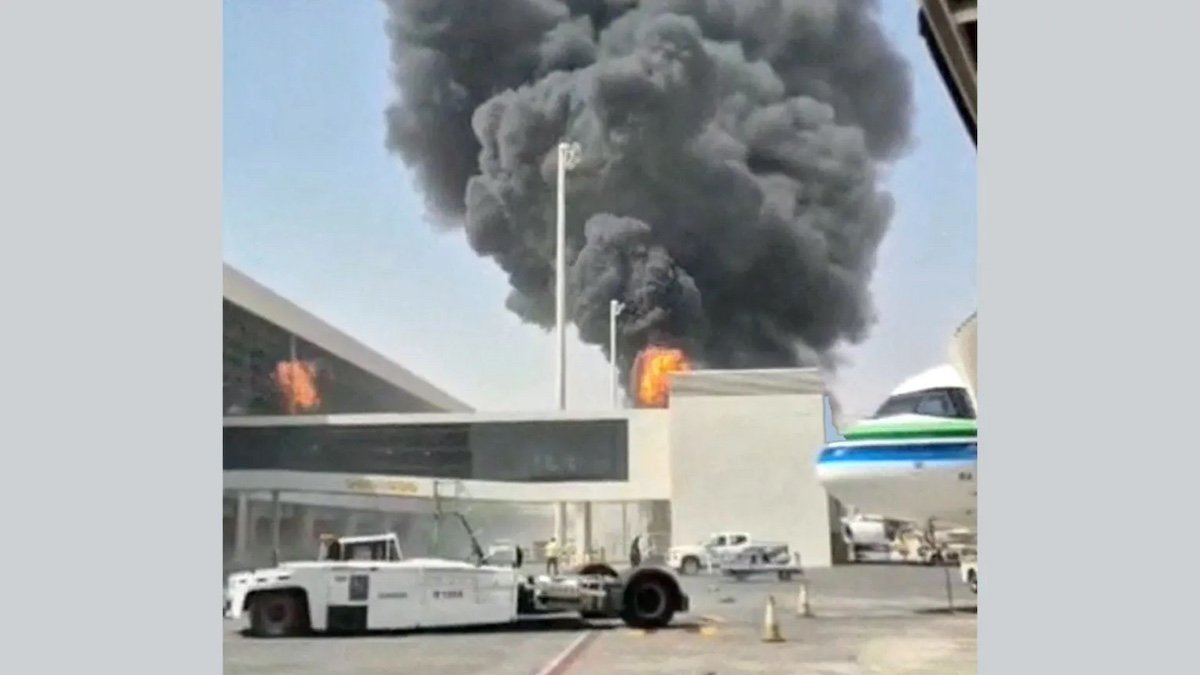
On October 10, a coordinated Houthi attack on Riyadh's King Khalid International Airport exposed significant vulnerabilities in Saudi Arabia's air defense network. The assault, which began around 3 PM local time and lasted roughly 45 minutes, combined suicide drones, cruise missiles, and ballistic missiles, overwhelming the kingdom's layered defenses.
The attack targeted Terminals 3 and 4, which are used for domestic and low-cost regional flights. The worst damage occurred at Gates 401 to 403, where Quds cruise missiles, each carrying a 150-kilogram warhead, struck first. Compounding the chaos, debris from Patriot interceptor missiles fell on the terminals, causing fires and generating shrapnel that added to the casualties.
Notably, there were no air raid sirens or early warnings before the strike. The airport lacks a civil defense system, shelters, or announced evacuation procedures. This suggests the Houthis deliberately chose a civilian target to maximize casualties and pressure Riyadh to end its support for Yemeni government forces.
Air defenses failed to detect the attack
Saudi Arabia operates a sophisticated air defense network, including five E-3A AWACS aircraft, two SAAB 2000 Erieye AWACS with modern AESA radars, and a central command linking Patriot, THAAD, and up to ten batteries of Korean KM-SAM Block-II (Cheongung-II) systems. Despite this, the Houthi launches went undetected. The drones and cruise missiles flew low and slow, exploiting terrain masking, while the ballistic missiles' separating warheads made them difficult to track.
The attack was a saturation strike, using a mix of weapons that traveled at different speeds. The Houthis launched the slower Samad-3 drones first, followed by Quds cruise missiles, and finally Burkan ballistic missiles. This sequencing was designed to complicate interception and saturate defenses.
The Samad-3 drone, an extended-range kamikaze, cruises at 148 to 185 km/h to conserve fuel, making it a challenging target for radar. The Quds-1 cruise missile, powered by a clone of the Czech PBS TJ100 turbojet, uses GPS and inertial navigation, allowing it to fly low and avoid standard radar coverage. The Burkan ballistic missile, a modernized version of the Iranian Qiam-1, features a detachable warhead that separates after boost, making it harder to intercept.
Western experts note that the Houthis have improved their weapons with Iranian assistance, possibly with help from Russia and China. The attack on October 10 was the fourth on the airport in less than a month, following strikes on September 19 and October 8-9. The Houthis had issued public warnings of their intent to shut down the airport, yet Saudi defenses failed to respond.
The attack also raises questions about the role of the United States and Israel. There are no reports that either country detected the launches or warned Riyadh. Washington's focus on Iran and the Strait of Hormuz, along with its desire to conserve smart weapons, may have reduced its willingness to help Saudi Arabia with the Yemen conflict. Additionally, Saudi Arabia's establishment of the Mecca Joint Defence Agreement with Pakistan and Turkey, which excludes the US, may have further dampened American interest.
The Houthi attack underscores the growing threat from non-state actors armed with advanced weaponry. As the Houthi Red Sea campaign continues to disrupt regional security, the effectiveness of Saudi air defenses is now in question. The kingdom may need to reassess its procurement and operational strategies, including the integration of new sensors and counter-drone systems.
For now, the airport remains operational, but the psychological impact is significant. The Houthis have demonstrated they can strike deep into Saudi territory, targeting critical infrastructure with impunity. This raises concerns not only for Saudi Arabia but for the entire region, as the conflict in Yemen shows no signs of abating.