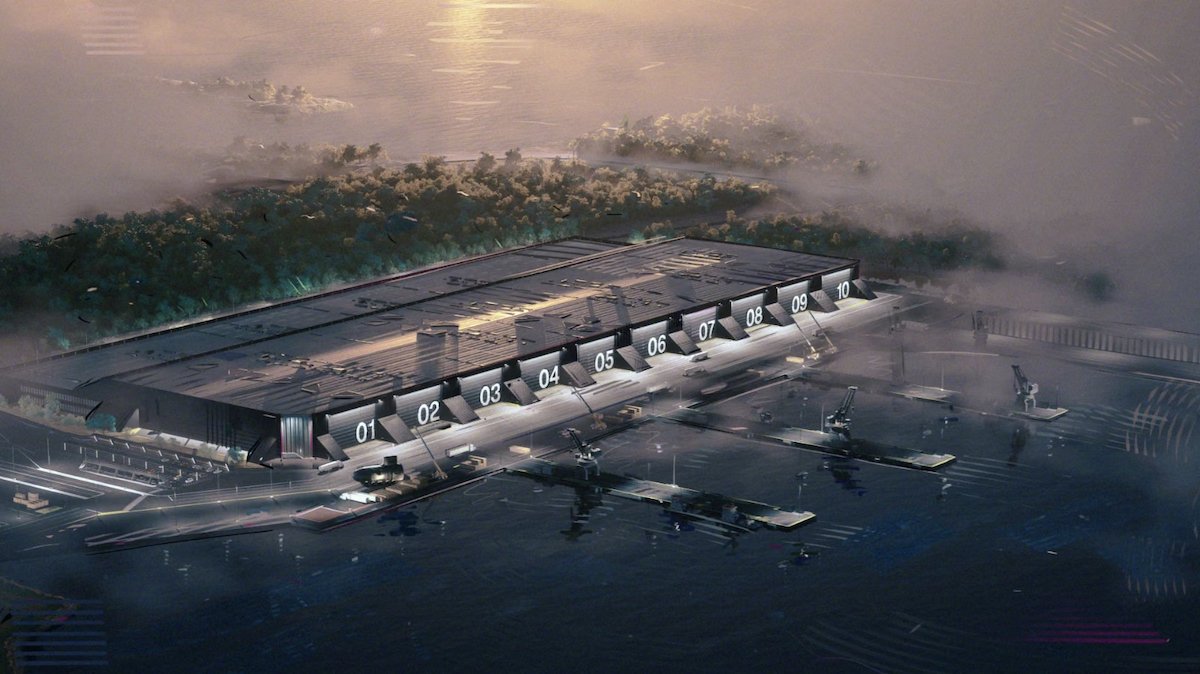
Defense technology firm Anduril Industries is committing $3.7 billion of its own capital to build a massive new submarine manufacturing facility in Maryland, part of a broader $6.6 billion public-private effort to reverse years of production shortfalls in the US Navy's nuclear attack submarine program. The initiative, dubbed "Arsenal-2," comes as the Pentagon struggles to keep pace with China's accelerating naval buildup in the Indo-Pacific.
The 2-million-square-foot shipyard at Sparrows Point in Baltimore County will include a 1,200-foot graving dock, direct rail access, and digitized workflow tracking. Anduril says the facility will create 3,100 direct manufacturing jobs and add roughly nine million annual labor hours—a 15% boost to the nation's strained nuclear shipbuilding industrial base. The project is backed by a complementary US Navy contract worth up to $2.9 billion, with payments tied strictly to demonstrated production outcomes.
Addressing a chronic bottleneck
The intervention targets a persistent problem: legacy builders General Dynamics Electric Boat and Huntington Ingalls Newport News Shipbuilding have repeatedly missed delivery milestones for Virginia-class submarines. A January 2026 Congressional Research Service report notes that the US Navy aims for a fleet of 66 attack submarines, but actual construction has averaged just 1.1 to 1.2 boats per year since 2022 due to workforce shortages, supplier bottlenecks, and component delays. The Navy now wants to raise production to 2.0 boats annually, eventually reaching 2.33 per year to clear backlogs and meet commitments under the AUKUS pact, which includes selling three to five Virginia-class boats to Australia.
Anduril will begin delivering critical components, such as torpedo tubes, from a certified Costa Mesa site by 2028, before Maryland operations start around 2030. The company plans to supply full hull modules in the long term, helping to meet both domestic fleet goals and AUKUS delivery schedules.
Strategic stakes in the Western Pacific
The industrial delays have direct operational consequences. A June 2026 report by the South China Sea Probing Initiative, a Chinese think tank, found that in 2025 the US operated at least 11 nuclear-powered submarines in three Western Pacific corridors—the South China Sea, East China Sea, and Java Sea—to signal deterrence against China. In a potential Taiwan conflict, these submarines would form the tip of the US spear. Seth Jones of the Center for Strategic and International Studies argues that US attack submarines provide an asymmetric advantage by exploiting China's persistent anti-submarine warfare (ASW) deficiencies. In simulated scenarios, they inflict heavy attrition on Chinese invasion forces and hunt high-value amphibious vessels, surface escorts, and logistics ships.
But China is not standing still. Rear Admiral Mike Brookes told the US Congress in March 2026 that Beijing frames ASW as a networked "systems confrontation," integrating air, surface, and seabed sensors with unmanned vehicles to control critical waters and compel adversary submarines to withdraw. This approach supports China's "Near Seas Defense, Far Seas Protection" doctrine, which prioritizes undersea warfare as a strategic enabler for naval operations, including ballistic missile submarine protection and sea-lane interdiction.
China's fleet is expanding rapidly. Brookes said it now numbers about 60 submarines and could reach 70 by 2027, with up to six new nuclear guided-missile boats and two ballistic missile submarines. By 2035, Beijing could field over 80 submarines, with nuclear-powered vessels making up half the fleet. China's massive state-funded shipbuilding base, supported by state-owned bank credits and infrastructure modernization, underpins this growth.
The Anduril initiative is a private-sector response to a national security challenge that has resisted public-sector solutions. Whether it can deliver on its ambitious timeline remains to be seen, but the stakes are clear: the undersea balance in the Indo-Pacific may hinge on the ability of US shipyards to finally match China's industrial output. As China's wartime narrative targets Japan-US ties, the pressure on Washington to maintain its undersea edge is only growing.