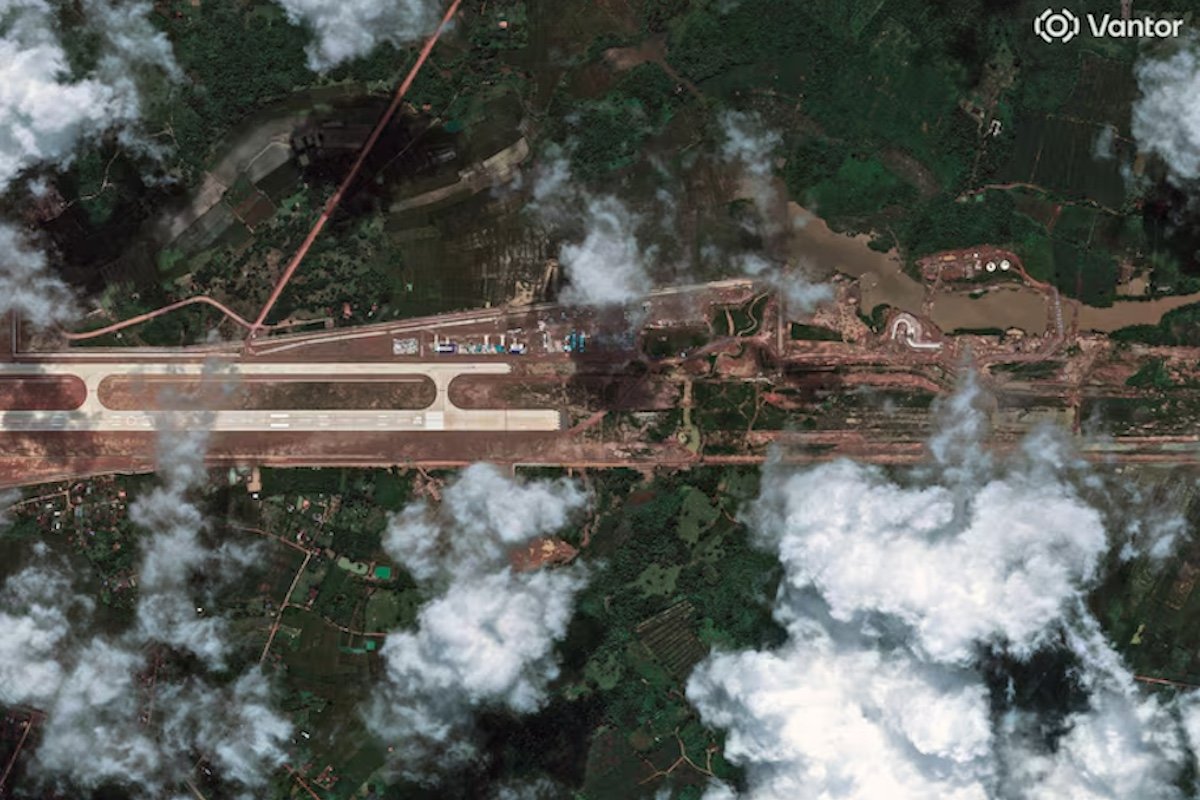
Satellite imagery from last week captured eight Chinese-made light attack jets parked on a partially completed runway at Ban Keun, about 50 kilometers north of Vientiane, with more than two dozen military support vehicles nearby. The rapid construction and earthmoving visible around the airstrip suggest China may have secured its first full-fledged military base in Southeast Asia, according to analysts.
The facility, officially inaugurated on September 29, 2026, as the China-Laos Joint Support and Training Center and a China-Laos Friendship Aviation Academy, is described by Beijing as a training hub for Lao air force pilots. China's Ministry of National Defense stated the center is "not directed against any third party" and aims to "enhance practical military cooperation." Lao Deputy Prime Minister and Defense Minister Khamlieng Outhakaysone attended the ceremony alongside a delegation from the People's Liberation Army.
However, the site's history and design raise concerns. Ban Keun was a CIA-operated airfield during the Vietnam War, known as "Lima Site 44," used to support Hmong fighters. Alexander Neill, an adjunct fellow at the Pacific Forum in Hawaii, told Reuters that the runway appears engineered for extension, potentially allowing larger aircraft, including signals intelligence and electronic-surveillance planes, to extend China's reach into Southeast Asia.
Belt and Road as leverage
China's Belt and Road Initiative, launched by President Xi Jinping in 2013, has not delivered the economic windfall promised to Laos. The US$6 billion high-speed rail connecting the two countries has largely facilitated Chinese migration rather than balanced trade. Instead, the initiative has given Beijing significant leverage over Laos, which is now firmly in China's economic orbit.
Chinese state-owned and private firms have financed and operate many of Laos's hydropower dams, which are central to its power export ambitions. Upstream dams on the Mekong River have altered water flows into downstream Thailand and Cambodia. Chinese companies also hold extensive mining concessions for copper, gold, and rare earths, and have converted large tracts of land into rubber, banana, and timber plantations serving the Chinese market.
This economic dependence leaves Laos with little choice but to accommodate Chinese military requests, analysts say. The pattern mirrors Cambodia, where years of Belt and Road financing for ports, roads, and special economic zones have deepened Phnom Penh's reliance on Beijing. That dependence culminated in the renovation of Ream Naval Base on the Gulf of Thailand, completed in 2025 with a new pier capable of berthing larger warships. Cambodian Prime Minister Hun Manet inaugurated the base in April 2025, insisting Cambodia had "nothing to hide," but Chinese warships have docked there for months at a time.
The naming of the Laos facility—identical to the China-Cambodia Joint Support and Training Center—suggests a Beijing-scripted template: a "joint" training center that provides cover for a permanent military foothold. Cambodia's constitution forbids foreign bases, yet the arrangement has allowed China to establish a de facto presence.
The United States and its Western allies have offered little counterweight beyond working through ASEAN, which operates on principles of non-interference and consensus, making it ill-suited to geopolitical rebalancing. As China's military footprint expands in Laos and Cambodia, neighboring Thailand and Vietnam are likely to view the developments with unease.
For now, the Ban Keun facility may appear modest, but diplomats and analysts will be watching for the introduction of air defenses, fuel and ammunition storage, and surveillance installations—any of which would signal that the base is meant for much more than training. China's Belt and Road Initiative, once touted as a development program, is increasingly revealing its strategic military dimension.