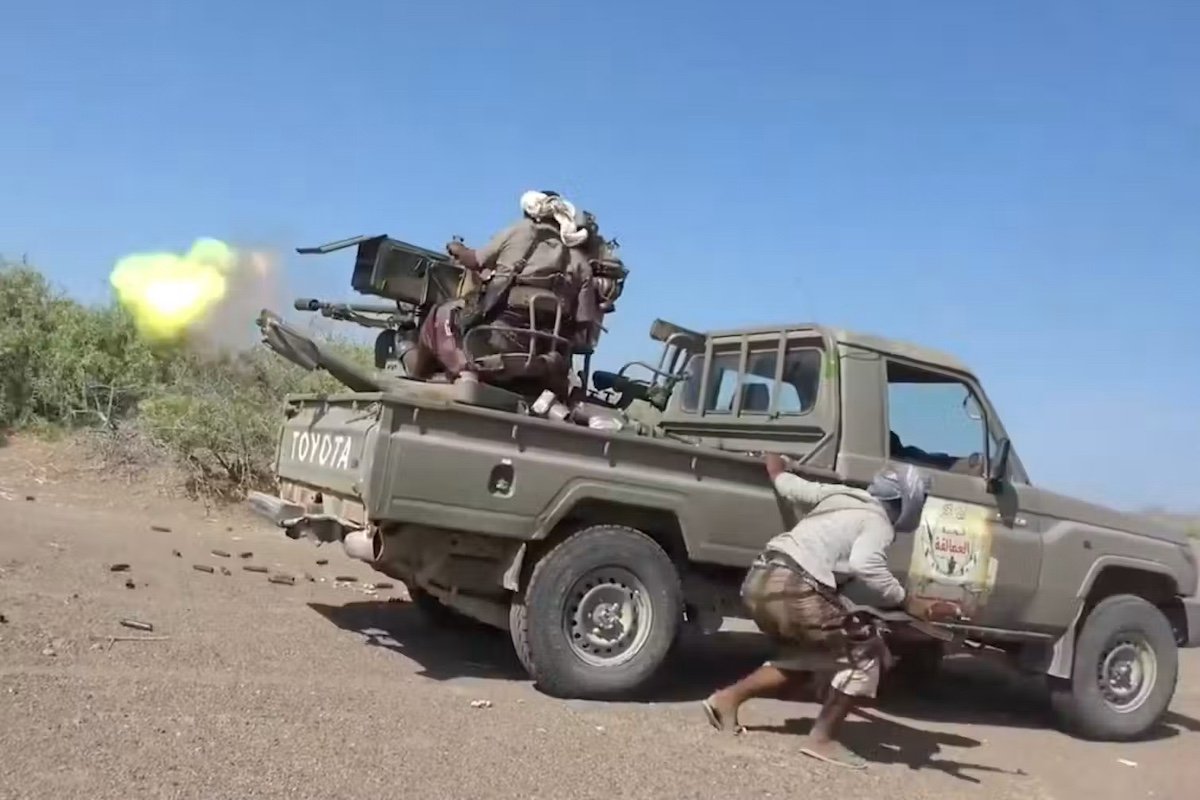
The Middle East has long been a crucible of conflict, but the recent escalation in Yemen's civil war threatens to become one of the most consequential crises of the decade. While the US-Iran confrontation has dominated headlines, the renewed fighting between the Houthi movement and Yemen's internationally recognized government—backed by Saudi Arabia—has the potential to ignite a broader regional conflagration.
A proxy war with global stakes
Yemen's internal strife is inseparable from the wider rivalry between Iran and Saudi Arabia. Tehran provides military and financial support to the Houthis, also known as Ansar Allah, while Riyadh backs the Presidential Leadership Council (PLC), Yemen's internationally recognized government. The United States, despite its public distance from the conflict, supports the Saudi-led coalition, while Russia and China have aligned with Iran.
This alignment has drawn in other regional actors. Turkey and Pakistan, both signatories to a mutual defense pact with Saudi Arabia, have agreed to deploy troops to help defend the kingdom against further attacks. This expansion of foreign involvement raises the specter of a conflict that spirals beyond Yemen's borders, destabilizing the entire region and threatening global energy supplies.
Houthi advances and the strategic chokehold
The Houthis, who control roughly one-third of Yemen including the capital Sanaa, have capitalized on the US-Iran standoff to tighten their grip on the Bab el-Mandeb Strait, a vital maritime chokepoint linking the Red Sea to the Gulf of Aden and the Indian Ocean. Since July, they have made territorial gains, aiming to seize the entire country, while also launching attacks on Saudi oil infrastructure, tankers, and even Riyadh's main airport.
These attacks have disrupted Saudi Arabia's oil exports through the East-West Pipeline, a critical alternative route since the Strait of Hormuz has become partially inoperable due to the threat of Iranian attacks. The Houthis have also declared a blockade of Saudi ports, further tightening the noose on global oil supplies.
In response, Yemeni and Saudi forces have launched a counteroffensive to reclaim lost territory, raising the prospect of a full-scale civil war and a humanitarian catastrophe. The UN estimates that over 800 people have been killed, 3,000 injured, and 158,000 displaced in the recent escalation, on top of the hundreds of thousands who have died since the conflict began in 2014–15.
Washington's reluctance and Riyadh's new allies
Despite Saudi requests for US airstrikes against the Houthis, President Donald Trump has declined to expand American involvement, offering only intelligence and advisory support. Trump's reluctance stems from a desire to avoid another Middle East quagmire, as well as domestic political considerations ahead of the midterm elections, with rising fuel prices already hurting American consumers.
Riyadh has therefore turned to its new security partners, Pakistan and Turkey, who have agreed to deploy forces. However, both countries have been cautious, balancing their commitment to Saudi Arabia against the need to maintain relations with Iran and its allies, Russia and China. This delicate balancing act underscores the complexity of the regional dynamics.
The global economic fallout
The escalating conflict in Yemen has direct implications for the world economy. The Strait of Hormuz, through which a fifth of global oil and liquefied natural gas passes, remains partially closed, with Iran's parliamentary speaker Mohammad Bagher Ghalibaf stating that it will not fully reopen until the US meets Tehran's demands, including a ceasefire and the lifting of sanctions.
Meanwhile, the Houthi blockade of Saudi ports and attacks on shipping in the Red Sea have further disrupted supply chains. The US energy secretary, Chris Wright, has claimed that 13 million barrels of crude oil are still transiting the strait daily, but this figure is disputed by Iran.
At the heart of this crisis is the US war of choice against Iran. If Washington escalates, Tehran has warned it will retaliate against US allies in the Gulf. The situation remains explosive, and a negotiated settlement between Washington and Tehran seems distant but not impossible.
For the Indo-Pacific, the stakes are equally high. Energy security is a lifeline for economies like Japan, South Korea, and India, all of which depend heavily on Middle Eastern oil. A prolonged conflict could send oil prices soaring, exacerbating inflation and economic instability across Asia. As the region watches, the need for diplomatic de-escalation has never been more urgent.