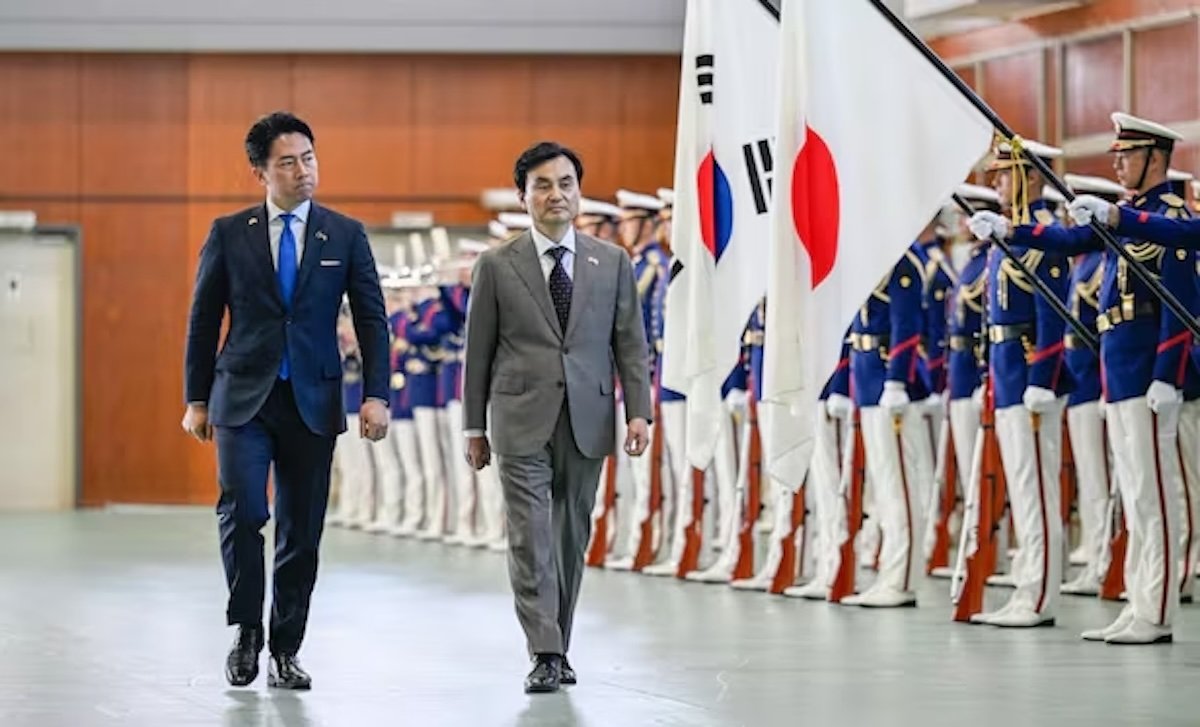
Operational planners in Washington, Seoul, and Tokyo have made historic progress in institutionalizing trilateral security cooperation. Joint exercises have expanded, real-time missile warning data is shared, and ministerial consultations are routine. Yet the credibility of deterrence ultimately rests on a more punishing variable: the ability to sustain forces in a prolonged conflict.
Interoperability—the capacity of allied systems to communicate and execute coordinated tactical actions—is not interchangeability. A coalition that can track an incoming hypersonic glide vehicle on day one may still fail if it cannot replace expended interceptors, repair battle-damaged warships, or refuel dispersed forces two months into an enduring campaign. The fundamental dilemma is coalition logistics under national sovereignty.
The tyranny of distance and precision interdiction
Northeast Asia presents a severe sustainment geography. Operations spanning the Korean Peninsula, the Japanese archipelago, and surrounding maritime approaches rely on concentrated nodes: deep-water ports, air depots, rail junctions, and fuel bunkering sites. Under modern anti-access and area-denial envelopes, these hubs face constant risk from long-range precision-guided munitions, submarine blockades, electronic warfare, and cyber disruptions.
The operational solution cannot rely solely on extreme tactical dispersion, which dramatically inflates fuel consumption, transport requirements, and coordination friction. Instead, allied planners must transition toward distributed logistics architectures characterized by redundancy, modular field repair, and rapid reallocation. To ensure continuous combat power, the coalition must eliminate single points of failure across its distribution network before hostilities commence.
Sovereign silos and munitions exhaustion
Recent conflicts have underscored how rapidly high-end warfare depletes magazines. The unprecedented burn rates of precision munitions in Ukraine and surface-to-air interceptors during Red Sea counter-drone and counter-missile operations are stark reminders. Possession of advanced fifth-generation platforms is meaningless if magazines run empty within weeks.
Although the US, the ROK, and Japan operate complementary platforms—including advanced stealth fighters, Aegis-equipped destroyers, and Patriot missile batteries—their inventories remain largely non-interchangeable. Discrepancies in fire-control software, cryptographic standards, technical documentation, and safety certifications prevent allied units from cross-loading identical ordnance.
Above all, this is a political obstacle rather than an engineering barrier. In the opening stages of a conflict, national leaders may hesitate to release scarce interceptors to an ally while facing threats to their own homeland. If ammunition transfers require ad-hoc diplomatic negotiations during an escalating crisis, the coalition trades operational velocity for bureaucratic paralysis. Rather than chasing an unrealistic, unified stockpile, partners should establish pre-authorized national reserve pools, outlining in advance which precision munitions and subcomponents can be released automatically under defined operational contingencies.
The ROK-Japan bilateral fault line
The most delicate vulnerability in this operational architecture lies in ROK-Japan bilateral relations. Trilateral momentum often relies heavily on Washington serving as a diplomatic hub, leaving direct Seoul-Tokyo operational ties brittle. Historical grievances, domestic political polarization, and territorial friction over disputed islets have repeatedly spilled into national security ties. While the resumption of the General Security of Military Information Agreement restored basic intelligence sharing, structural gaps persist across several operational areas.
The most glaring gap is the total absence of a mutual logistics agreement. The ROK and Japan maintain acquisition and cross-servicing agreements with the US, and Japan has established bilateral agreements with Australia, the United Kingdom, Canada, and France. However, Tokyo and Seoul have never concluded a mutual pact. Consequently, there is no direct legal framework governing reciprocal logistics transfers, refueling, ammunition supply, or shared medical and depot support between the ROK Armed Forces and the Japan Self-Defense Forces.
Compounding this legal void are acute sensitivities regarding sovereignty and territorial access. Seoul’s domestic politics remain hypersensitive to any physical Japanese military presence on or near the Korean Peninsula. Current ROK policy requires explicit presidential and parliamentary authorization before Japanese ships or aircraft can enter ROK territorial waters or airspace, even for humanitarian non-combatant evacuation operations or rear-area support during a northern invasion. Conversely, Tokyo faces constitutional constraints under its pacifist legal charter and complex statutory criteria governing survival-threatening situations before authorizing collective self-defense operations in support of peninsular contingencies.
Divergent strategic priorities further complicate bilateral cooperation. While Seoul prioritizes deterrence and defense against the immediate existential threat posed by Pyongyang, Tokyo’s security architecture is increasingly oriented toward maritime and island defense, with a focus on the East China Sea and the broader Indo-Pacific. These differing threat perceptions can lead to different operational priorities and resource allocations, making it harder to align logistics planning.
Despite these hurdles, the imperative is clear. As Japan's evolving deterrence posture and China's hypersonic advances reshape the regional balance, the trilateral alliance must address its logistics gap. The US, ROK, and Japan have made historic strides in cooperation, but without a robust sustainment architecture, deterrence remains a paper tiger. The next step is not more exercises or data-sharing agreements—it is a political commitment to pre-authorize logistics support and to bridge the Seoul-Tokyo divide. As the Pacific 'Ocean of Peace' remains an aspiration, concrete logistics cooperation is a tangible way to strengthen regional security.