For the People's Liberation Army, the war in Ukraine has become an open-air laboratory. A new report from the Center for Strategic and International Studies (CSIS) details how China is mining the conflict for tactical innovations, fielding new weapons and restructuring training at a pace that surprises many observers. Yet the same study points to a stubborn bottleneck: a command system built for centralized control that struggles to empower the kind of frontline initiative the war has shown to be decisive.
Drawing on more than 90 Chinese military and defense-industry publications from mid-2022 to mid-2026, CSIS analysts found that Chinese defense institutes typically identify emerging frontline tactics within four months and convert them into specialized hardware and training within a year. That speed reflects a deliberate strategy to learn from Russia's missteps and Ukraine's improvisations without committing Chinese forces to combat.
Defensive priorities shape procurement
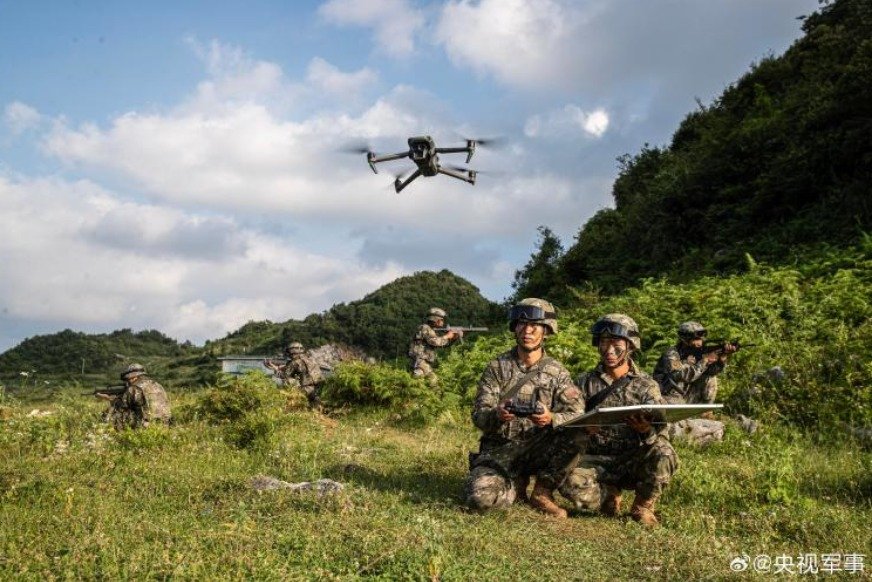
Beijing views the conflict primarily through a defender's lens. The PLA has prioritized countermeasures against Ukrainian-style sea drone ambushes and deep airfield raids, treating them as templates for potential attacks on Chinese bases. In response, it has accelerated fielding of interceptor drones, directed-energy weapons, and electronic jamming suites. It has also copied Russian reconnaissance-strike integration and adopted fiber-optic first-person-view (FPV) drones, which are immune to electronic warfare because they are guided by physical cables.
To support mass uncrewed warfare, China restructured its military academies in 2025 to train specialized drone commanders. It is leaning on its dominant commercial manufacturing base for components, a logistical advantage that Russia lacks.
Sea drones and the Taiwan scenario
The Black Sea has become a case study in asymmetric naval warfare. Ukraine's explosive, low-profile sea drones and unmanned minelayers, combined with anti-ship missiles, systematically dismantled Russia's naval dominance. They forced Russian warships to withdraw from Sevastopol to Novorossiysk and reopened grain export routes from Odesa.
Chinese planners are watching closely. In a conflict over Taiwan, US and allied forces could deploy sea drones to wage low-cost campaigns against Chinese naval vessels and amphibious transports. Taiwan's Endeavor Manta sea drone, for instance, could provide affordable denial in the Taiwan Strait, while mothership-launched drones extend reach into contested waters. Constant tactical friction from drone swarms would restrict China's naval maneuver and make amphibious landings prohibitively risky.
Deep strikes challenge rear bases
Ukraine's Operation Spiderweb, in which operatives infiltrated deep inside Russia and launched over 100 FPV drones from civilian trucks, striking strategic bomber bases and damaging dozens of irreplaceable Soviet-era aircraft, has also captured PLA attention. The lesson is stark: sovereign rear bases are no longer sanctuaries. Defense planners worldwide are now mandating hardened aircraft shelters, tighter physical perimeter security, and counter-drone electronic warfare suites.
China has fortified its airfields extensively since the 2010s, doubling hardened aircraft shelters to over 800 and building 2,300 unhardened shelters, according to a January 2025 Hudson Institute report. But its forward island airfields in the South China Sea remain vulnerable. These artificial features sit beyond the immediate umbrella of mainland fighter sweeps and surface-to-air coverage, lack strategic depth, and rely on lighter steel hangars rather than subterranean bunkers. With limited apron space, aircraft must park intermittently in the open, creating prime targets for saturation drone and missile raids.
Command culture as the weak link
Beyond hardware, China is studying Russia's specialized drone units, particularly the Rubicon Center for Advanced Unmanned Technologies. An April 2026 Institute for the Study of War (ISW) report notes that PLA Daily commentaries praise Rubicon's centralized control, battlefield successes in Kursk, and rapid feedback loops between frontline operators and developers. Chinese sources stress that dedicated unmanned warfare units are an inevitable trend, and the PLA is considering creating similar units.
Yet the ISW also cautions that China's politicized military, centralized command structure, and risk-averse leadership may hinder the bottom-up initiative that made Rubicon successful. The tension between political imperatives for centralized control and battlefield initiative is fueling an internal debate over adopting a version of Western mission command, which delegates authority to lower-level commanders.
An October 2025 RAND report frames the central issue: how the PLA could adopt mission command to survive future “intelligentized” warfare, where rapid, data-intensive operations outpace centralized command capabilities. Proponents argue that delegating authority to frontline units preserves operational speed, flexibility, and communication resilience while maintaining political control through commander's intent. Skeptics worry that such delegation could erode the party's grip on the military.
The outcome of this debate will shape not only the PLA's effectiveness in any future conflict but also its broader strategic posture in the Indo-Pacific. As China continues to modernize its forces, the gap between its tactical agility and its institutional rigidity remains the most significant obstacle to military transformation.