When Chinese scholars recently argued that Batanes, a northern Philippine province, is a natural extension of Taiwan—and therefore part of China's territorial claim—they demonstrated how Indigenous history and cultural ties can become entangled in contemporary geopolitical competition. Although the argument has not been adopted as official Chinese policy, it highlights how long-standing relationships between communities can be reframed through the lens of strategic rivalry.
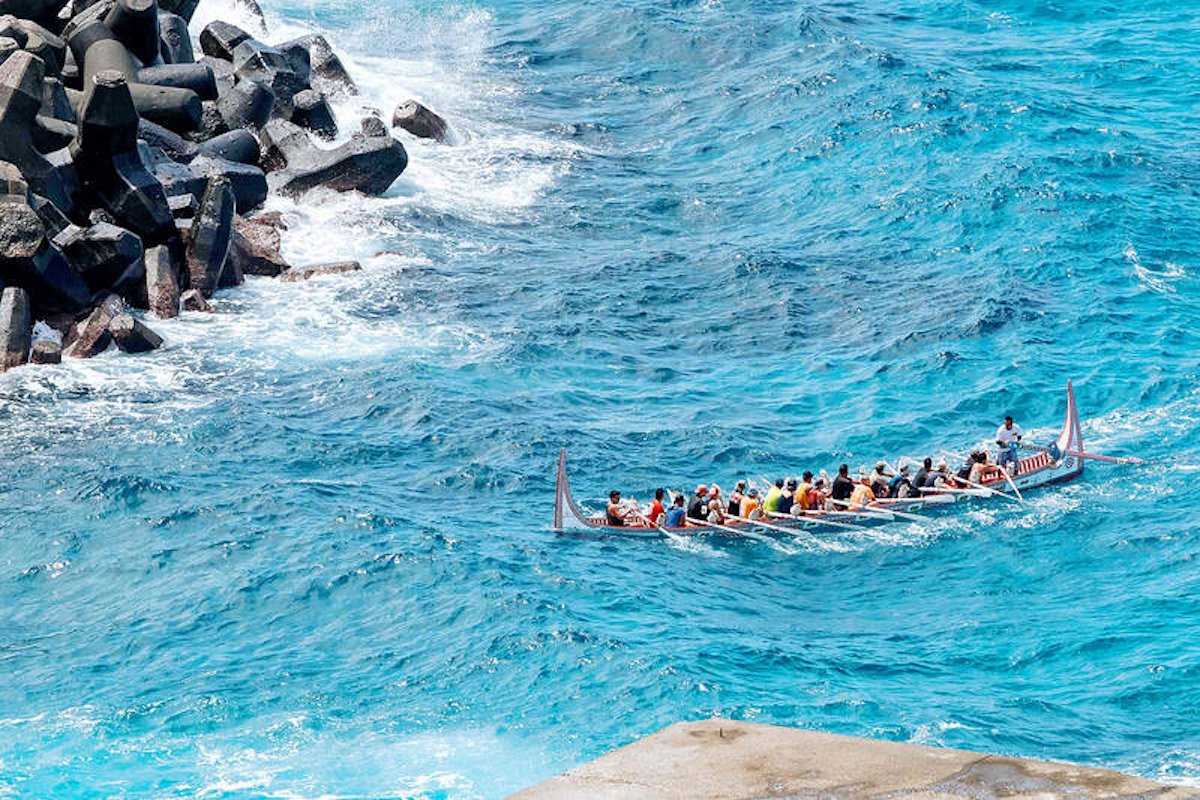
That possibility was far from anyone's mind during the recent Lanyu–Batanes seafaring voyage, which sought to reconnect the Tao people of Taiwan's Lanyu (Orchid Island) and the Ivatan people of the Philippines' Batanes through a traditional crossing of the Bashi Channel. As part of the project, I helped coordinate preparations, while rowers trained and organizers worked with government offices and communities on both sides.
Throughout the preparations, communities in Lanyu and Batanes looked forward to welcoming people they regarded as relatives and neighbors across the Bashi Channel, rather than as strangers separated by an international boundary. Many Ivatans asked whether their cultural exchanges with the Tao people could continue beyond the voyage. Their concern was not geopolitics, but whether the crossing could mark the beginning of a renewed relationship.
Geopolitical Entanglement
A few weeks after the voyage, that relationship became the subject of an unexpected territorial argument. At a symposium in China, several scholars claimed that Batanes was a natural extension of Taiwan and, because Beijing claims Taiwan, should also fall under Chinese sovereignty. Their reasoning drew in part on cultural and linguistic ties between the Tao and Ivatan peoples. The scholars did not appear to cite the voyage, and their position has not been formally adopted by the Chinese government.
The Philippines immediately rejected the argument. Shared ancestry does not determine national borders, and cultural similarity does not transfer sovereignty. The Tao and Ivatan peoples can recognize a common history without belonging to the same state. But disproving the scholars' claim should not be the end of the Philippine response.
The controversy raises a more immediate question for the Philippines: whether it will protect locally led cultural and educational cooperation between Batanes and Lanyu or allow political caution to narrow a relationship that communities are trying to rebuild. Some people involved in these exchanges already worry that future activities could become harder to organize as Batanes attracts greater strategic attention.
As the Department of Foreign Affairs maintains the Philippines' one-China policy, activities involving Taiwan can draw scrutiny when government institutions are involved. Some caution is reasonable. The Philippines recognizes the People's Republic of China and does not maintain formal diplomatic relations with Taiwan. Yet the policy should not be interpreted so broadly that cultural contact is treated as a diplomatic threat. The Philippines has maintained unofficial relations with Taiwan for decades through the Manila Economic and Cultural Office (MECO), and locally led cultural and educational exchanges can continue without altering the country's formal position.
For people in Batanes, Lanyu is not primarily a foreign policy question. It is a neighboring island whose Indigenous community shares parts of their maritime history. The Ivatans' wish for exchanges to continue were not challenging Philippine sovereignty or taking a position on Taiwan's political status. They wanted to meet again and learn more about people across the channel.
That relationship now exists within an increasingly strategic space. Batanes lies between northern Luzon and Taiwan, near the Luzon Strait and along the First Island Chain. As tensions around Taiwan increase, the province has drawn greater attention from Philippine and allied defense planners. Military exercises and new facilities have made that attention more visible. But reducing Batanes to military geography leaves out the relationships that already connect communities across the channel and the role those connections can play when formal systems come under pressure.
The seafaring project gave me a close view of how those relationships work. Approvals and frameworks were necessary, but they could not resolve every problem. Conditions changed repeatedly, and government offices did not always receive the same information at the same time. When difficulties arose, progress depended on individuals who trusted one another enough to communicate directly and find practical solutions. These relationships were created for a cultural voyage, not a defense operation.
Still, the project showed that communication across the Bashi Channel depends on people as much as formal agreements. During a typhoon, maritime accident, or transport disruption, familiarity between local institutions may help information move when official channels are slow. This is where the voyage touches on maritime security. A cultural exchange will not deter incursions or defend Philippine territory, and Tao and Ivatan communities should not have to justify their relationship in those terms. At the same time, maritime security is not only about military capability. It also depends on how well local institutions communicate when formal systems are strained. Relationships between Batanes and Lanyu may strengthen local resilience without turning Indigenous communities into instruments of military policy.
The larger foreign policy issue is whether the Philippines will allow communities to shape relationships that already carry geopolitical consequences. Restricting exchanges because that relationship has become politically sensitive would cede ground to those who see Batanes only as a strategic asset. For more on how China's rise is reshaping regional dynamics, see How China's Rise Redefined Globalization's Purpose and Perils. The challenge for Manila is to maintain its one-China policy without sacrificing the cultural ties that make Batanes more than a military outpost.