When Nikolai Patrushev, a close adviser to Russian President Vladimir Putin, visited Beijing in October, the agenda went beyond the usual diplomatic pleasantries. Moscow is seeking to turn its maritime partnership with China into concrete infrastructure, technology, and logistics that can withstand Western sanctions and geopolitical pressure.
The proposals floated during the October 8–13 visit include linking China's Maritime Silk Road with Russia's Trans-Arctic Transport Corridor, developing Russian port facilities, exchanging container-terminal automation technology, and conducting joint maritime research. These are still largely blueprints, but they sit at the intersection of three global trends: the securitization of supply chains, the opening of the Arctic, and the fragmentation of maritime globalization.
Commercial pitch, strategic undertones
Patrushev's pitch was framed in commercial terms. Russia wants Chinese companies to participate in the Northern Sea Route (NSR) and related corridors, establish direct container links between Shanghai's Yangshan port and Russian ports, and invest in terminal upgrades. Moscow also seeks Chinese expertise in port automation and cooperation in shipbuilding, maritime education, and research. Beijing, for its part, has described maritime cooperation as a “blue driving force” for bilateral ties.
The economic logic is clear. China is Russia's largest trading partner, and Moscow has become a key supplier of energy and raw materials to Beijing. Two-way trade exceeded US$200 billion for a third consecutive year in 2025, according to Chinese government data. Maritime transport is thus becoming a strategic extension of the relationship, not just a cargo route.
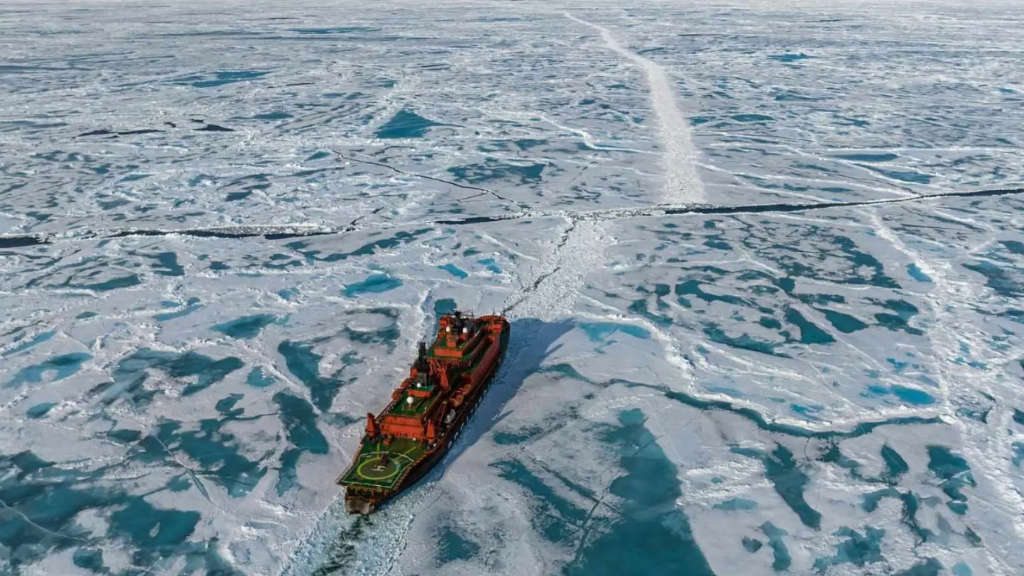
The Arctic adds a distinctive dimension. Russia reported a record 37.9 million tonnes of cargo on the NSR in 2024, including 3.09 million tonnes of transit cargo. These numbers are minuscule compared with Suez Canal flows, and the NSR faces ice, high insurance premiums, specialized vessels, thin infrastructure, and a short operating season. Yet its geopolitical and geoeconomic significance is growing.
In October 2025, a Chinese container ship completed a 20-day voyage from China to Britain via the Arctic, compared with 40–50 days on traditional routes, according to Reuters. That does not make the Arctic a substitute for Suez, but it does offer a potentially valuable second network.
Strategic resilience for Beijing, a lifeline for Moscow
For China, redundancy is key. Beijing has spent years diversifying trade routes, ports, and energy supply chains. A stronger northern corridor could reduce exposure to chokepoints like Suez, Bab el-Mandeb, and Malacca, while giving Chinese firms access to Russian Arctic resources and infrastructure. For Moscow, Chinese capital, shipping demand, and technology could turn an ambitious Arctic strategy into a functioning logistics system.
Washington is watching closely. The US already views the Arctic as an arena of intensifying competition. In 2025, the US Coast Guard reported five China-affiliated research vessels operating in or near the US Arctic and increased its own patrols. In 2024, it encountered a joint Chinese Coast Guard–Russian Border Guard patrol in the Bering Sea, the northernmost such Chinese presence observed.
A Sino-Russian maritime network is not ipso facto a military alliance, and Washington should not treat every commercial port project as a cloaked naval base. The more critical question is cumulative strategic resilience. Joint work on ports, digital systems, shipbuilding, research, navigation, and logistics could give both countries maritime infrastructure with economic value in peacetime and strategic utility in a crisis.
Japan and Taiwan watch closely
Japan has particular reason to pay attention. Its security environment already includes increasingly frequent Chinese-Russian military activity around its territory, which Tokyo has explicitly highlighted. A more integrated Russian-Chinese maritime system stretching from Shanghai through Vladivostok and into the Arctic would complicate Japan's strategic picture, especially around the Sea of Japan, the Kuril Islands, and the approaches to the Bering Strait.
For Taiwan, the significance is indirect but perhaps greater. Beijing's maritime pressure on Taiwan already includes naval activity, coast guard operations, legal measures, and gray-zone coercion. Taiwan's defense ministry has warned that Chinese exercises are increasingly threatening a blockade and control of the island's maritime approaches. Russia's contribution to a broader Chinese maritime ecosystem may not tip the balance in the Taiwan Strait, but it could encourage China to believe that disruption in one theater need not cripple its broader trade and energy flows.
Over 80% of global goods trade is carried by sea. UNCTAD forecasts a sharp slowdown in seaborne trade growth due to geopolitical disruption and rerouting from the Iran war and the Strait of Hormuz blockade. The Russia-China initiative is part of a larger global movement toward securing vulnerable supply chains. There is an irony: the two countries describe the project as a contribution to cheaper, safer, and more stable shipping, even as it deepens the strategic divide with the West.
As the Arctic ice melts and global trade routes shift, the quiet work of engineers, port operators, and maritime researchers may prove as consequential as any summit declaration. For the Indo-Pacific, the emergence of a new Arctic axis is a development worth watching.