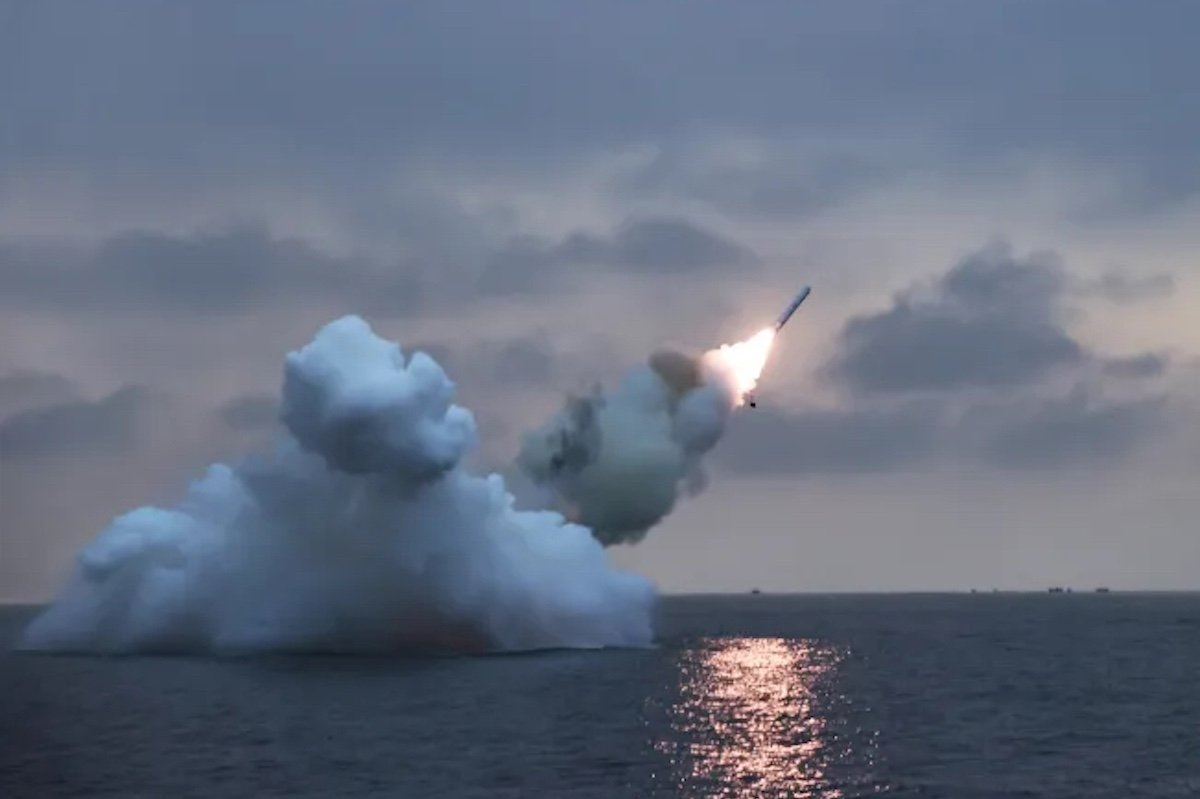
North Korea's latest underwater launch of strategic cruise missiles into the Sea of Japan has been touted by Pyongyang as proof of a growing nuclear deterrent. But a closer look at the test, the platform used, and the broader program suggests that while progress is real, the capability remains a work in progress.
According to state media and regional military officials, the drill involved two types of submarine-launched strategic cruise missiles, marking the first public underwater cruise missile test in nearly three years. The exercise was overseen by senior defense officials Kim Jong Sik and Jang Chang Ha, and was intended to verify the operational readiness of naval combat systems and demonstrate the reliability of North Korea's nuclear war deterrent, the Korean Central News Agency (KCNA) reported.
Photographic evidence indicates the weapons were deployed from the 3,000-ton Hero Kim Kun Ok, a modified diesel-electric submarine unveiled in September 2023. South Korea's Joint Chiefs of Staff, which tracked the projectiles, assessed that one missile was fired from a vertical launch system while the second was deployed horizontally from a torpedo tube—a staggered tactic that could complicate air defense radar detection.
What the test does and doesn't prove
While firing a cruise missile from a submerged submarine is a notable milestone, it is only one component of a fully functional sea-based nuclear deterrent. The submarine must operate reliably, maintain its weapons, avoid detection, and perform missions under realistic conditions. Nuclear command and control—especially communicating with submerged submarines—must also be validated. The test, therefore, is not conclusive evidence that North Korea already possesses a credible sea-based nuclear force.
North Korea has not relied solely on undersea hulls. In April 2026, leader Kim Jong Un oversaw the launch of two nuclear-capable strategic cruise missiles alongside three anti-ship missiles from the country's largest 5,000-ton destroyer, the Choe Hyon, off Nampo. This followed an August 2023 test where purported Hwasal-2 strategic cruise missiles were fired from an Amnok-class corvette off Munchon. By dispersing launch platforms across both eastern and western coastal areas, North Korea aims to stretch allied tracking networks and present multi-axis strike threats during crises.
However, surface warships are relatively vulnerable to attack, making them interim solutions at best. The ultimate goal is a survivable undersea deterrent, and North Korea may be preparing to test a submarine-launched ballistic missile (SLBM) to complement its cruise missiles. A recent US Congressional Research Service report notes that North Korea demonstrated operational capability in 2019 by flight-testing the nuclear-capable Pukguksong-3 (KN-26) and later displayed the Pukguksong-4, -5, and -6.
Engineering hurdles and the dual-track strategy
Despite advances in missile technology, the development of operational submarines capable of effectively deploying them has lagged. Hong Min, in a September 2023 report for the Korean Institute for National Unification (KINU), describes a dual-track naval strategy. The short-term track involves retrofitting approximately 20 aging diesel-electric Romeo-class submarines with vertical launch systems (VLS) to deploy tactical nuclear-armed ballistic missiles, cruise missiles, and nuclear torpedoes—exemplified by the Hero Kim Kun Ok.
Joseph Bermudez Jr. and colleagues, in a September 2023 Beyond Parallel report, note that the Hero Kim Kun Ok is a heavily modified Soviet-era Romeo-class vessel with a reshaped bow, relocated diving planes, and an aft-sail missile compartment housing ten vertical launch tubes—four large and six smaller cells intended for Pukguksong-series and modified KN-23 ballistic missiles.
Yet the modifications come with trade-offs. Sukjoon Yoon, in an October 2023 report for the S. Rajaratnam School of International Studies (RSIS), points out that the Hero Kim Kun Ok breaks the standard 10:1 length-to-width ratio of the Romeo class, reducing hull strength for underwater launches. The elevated center of gravity impedes submerged maneuverability, the unreliable superstructure makes cold launches risky, and added conning-tower stabilizers make the submarine considerably noisier and easier to detect.
Given these design flaws, North Korea may be designing a follow-up. Hong Min notes that the long-term aim is to develop true nuclear-powered attack and ballistic missile submarines (SSN/SSBN). In December 2025, state media released images of what appears to be the completed welded hull of an 8,700-ton “nuclear-powered strategic guided missile submarine,” suggesting that work is underway on a more capable platform.
For now, the underwater cruise missile test is a demonstration of intent and incremental progress, but it does not yet translate into a robust sea-based nuclear deterrent. As South Korea's hypersonic test shows, the region is locked in a technological arms race. The gap between North Korea's aspirations and operational reality remains significant, and allied forces are likely to continue tracking these developments closely.