China's accelerated construction of amphibious warships has sharpened a core strategic question: can industrial output and converted civilian vessels overcome the lethal bottlenecks of a Taiwan invasion? Recent satellite imagery and shipyard reports indicate a significant expansion of the People's Liberation Army Navy's (PLAN) Type 071 landing platform dock fleet, a move aimed at addressing long-standing lift shortfalls.
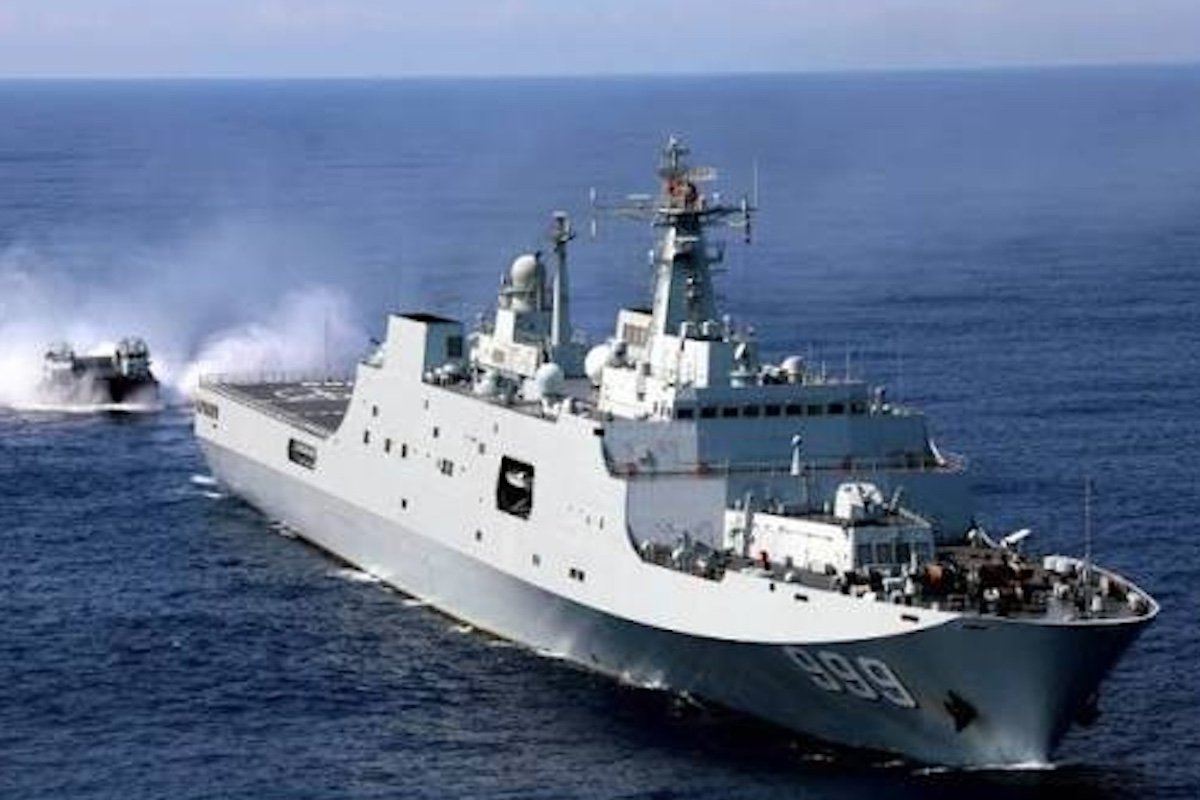
Commercial satellite photos analyzed by the South China Morning Post reveal six new Type 071 hulls under construction or fitting out—four at Hudong-Zhonghua on Changxing Island in Shanghai and two at CSSC Offshore & Marine Engineering's Longxue yard in Guangzhou. Once commissioned, these vessels will raise the PLAN's Type 071 inventory from eight to fourteen, a 75% increase. Each 25,000-tonne ship can carry a battalion of 500 to 800 marines, four transport helicopters, and either four Type 726 air-cushion landing craft or ten armored vehicles like the ZBD-2000 or ZTD-05.
This procurement push directly challenges U.S. Department of Defense assessments that China lacks sufficient dedicated amphibious lift for a large-scale assault. However, quantifying the impact requires measuring the new hulls against existing capacity and Taiwan's formidable shore defenses.
Capacity Gains and Persistent Gaps
A December 2024 report from the China Maritime Studies Institute (CMSI) estimated that the PLAN's dedicated amphibious fleet could land only about one division—roughly 20,000 to 25,000 troops and 1,000 vehicles—in a single initial lift. With the six new Type 071s, that first-wave capacity grows to approximately 23,000 to 29,800 troops and up to 1,120 armored fighting vehicles, depending on deck configurations.
Yet Jay McVann, writing for War on the Rocks in July 2026, argues that such an assault echelon remains dangerously understrength. Taiwan could field 85,000 to 110,000 soldiers and about 1,000 tanks to oppose a landing. Moreover, Taiwan's fewer than 20 viable landing beaches allow defenders to concentrate forces rather than spread thin, making a beachhead extremely difficult to establish.
Given these constraints, China's true mass may lie in its civilian ferry fleet. Thomas Shugart, also writing for War on the Rocks, contends that roll-on/roll-off (RoRo) ferries can deliver first-echelon forces at a scale dwarfing the naval amphibious fleet. China's large RoRo ferries provide roughly 750,000 displacement tons, and vehicle carriers add 425,000 tons—over 1.1 million tons total, more than three times the naval fleet's capacity. Shugart argues that civilian shipping alone could deliver about 300,000 troops and their vehicles within ten days, once initial tactical stability is achieved.
Civilian Ferries: Vulnerable Lifeline
Skeptics, however, point to fatal operational flaws. In a February 2024 CMSI report, J. Michael Dahm assesses that China's civilian RoRo ferries cannot support an initial assault wave against Taiwan through at least 2030. During drills, these ferries anchor for hours in calm waters to deploy armor, lacking combat damage control, structural survivability, or escort protection. Exercises fail to simulate active resistance, port sabotage, or adverse sea states that could swamp open-vented vessels. Furthermore, deep-draft ferries cannot perform over-the-shore landings independently, relying on undamaged quays or fragile floating causeways.
China has taken steps to mitigate these vulnerabilities. According to The War Zone, massive jack-up barges act as ship-to-shore connectors, linking RoRo ferries directly to beachheads. Seabed-anchored struts turn these barges into stationary piers that withstand heavy seas better than conventional causeways, enabling continuous offloading. When coupled into an 850-meter causeway reaching deep water, or using integrated ramps to interface with ferry ramps, they create a more robust logistics bridge.
Despite these innovations, the fundamental math remains daunting. The PLAN's dedicated fleet, even with the new Type 071s, can lift only a fraction of the forces needed to overwhelm Taiwan's defenders. Civilian ferries offer scale but introduce severe tactical risks. As Taiwan's defense posture evolves, the island's ability to concentrate forces on key beaches remains a critical counter to China's numerical advantages.
China's industrial surge reflects a long-term commitment to closing the lift gap, but the hard realities of amphibious warfare—defended beaches, limited landing zones, and vulnerable logistics—mean that mass alone may not decide the outcome. The coming years will test whether Beijing can translate shipbuilding prowess into operational capability, or whether Taiwan's geography and preparation continue to hold the line.