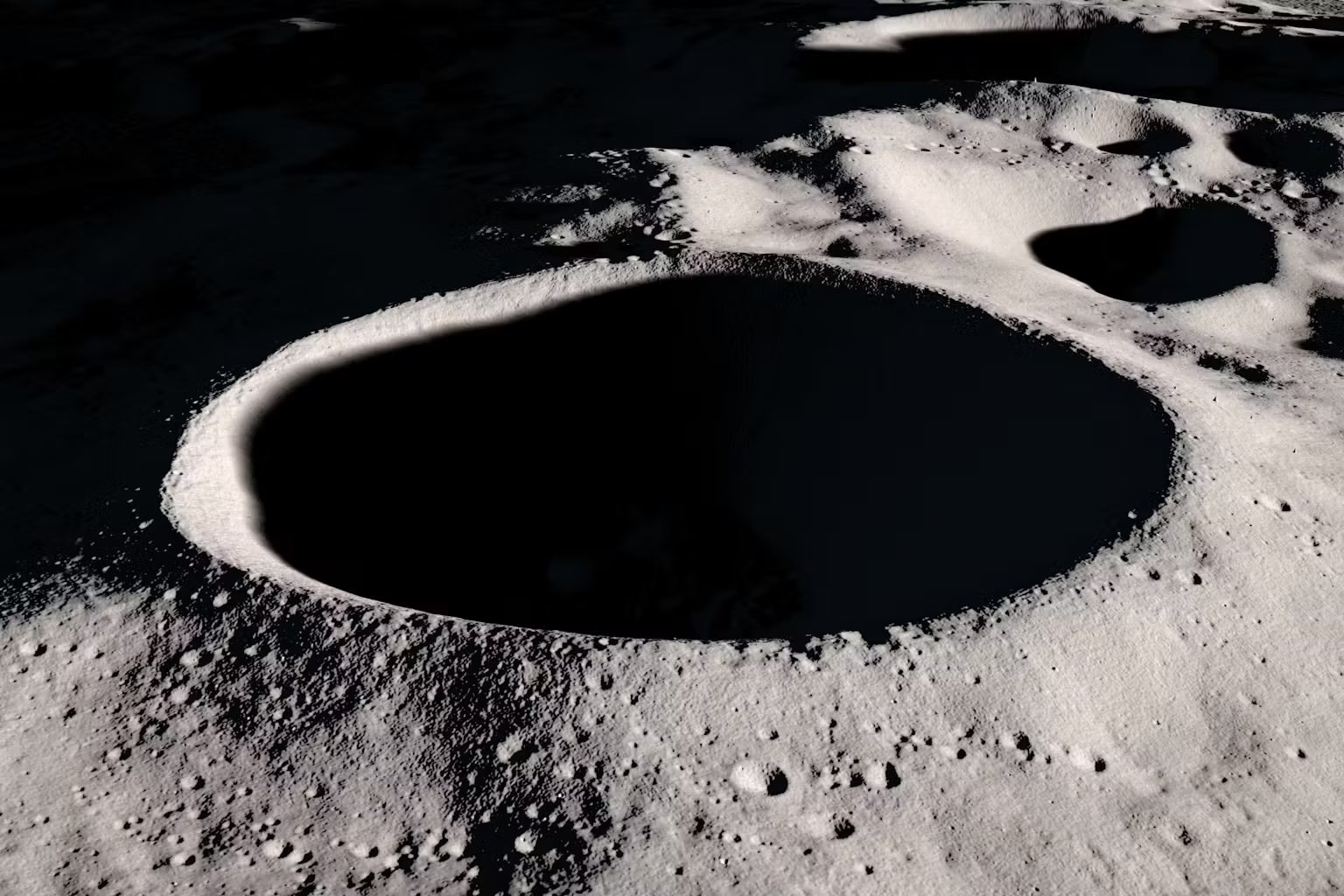
How do you explore a place where the Sun never shines? That is the challenge facing China's space program as it prepares to launch Chang'e-7, one of the most ambitious lunar missions in recent years. For nearly two decades, scientists have known that water exists on the Moon, but the exact quantity, depth, and form of water ice in permanently shadowed craters remain a mystery. These craters, some of the coldest places in the solar system at temperatures below –200°C, have remained untouched for billions of years, making them both scientifically invaluable and extremely difficult to reach.
Lunar exploration has evolved dramatically since the Soviet Union's Luna-1 probe flew past the Moon in 1959. The Apollo missions proved that reaching the Moon was possible; the new challenge is exploring terrain that humans and conventional rovers cannot easily access. The ultimate goal is to determine whether the Moon itself can supply resources for future explorers, a question that has driven China's two-decade-long Chang'e program, named after the ancient Chinese goddess of the Moon.
Chang'e-7: A multi-element mission
Chang'e-7, expected to launch later this month, will consist of an orbiter, a lander, a rover, and a hopper—a novel vehicle designed to leap over broken terrain and descend into craters where sunlight never reaches. The mission will rely on the Queqiao-2 relay satellite, already in orbit since March 2024, which supported the Chang'e-6 mission and will ensure communication between Earth and the lunar surface. While the exact landing site has not been confirmed, a ridge near Shackleton crater in the lunar South Pole's Aitken region is a prime candidate.
The hopper is the mission's centerpiece. Unlike wheeled rovers, it can navigate steep crater walls and rugged landscapes, autonomously descending into permanent shadow. This capability is essential, given the extreme conditions and the need for self-navigation and communication. Chinese scientists are not looking for signs of water—they already have compelling evidence of lunar polar water. Instead, the mission aims to pinpoint where that water is, in what form and concentration, and whether it can realistically be extracted. This marks a transition from exploration to resource utilization.
NASA's different approach
While China is executing a coordinated state mission, NASA is taking a contrasting path. The American space agency is building a lunar marketplace through its Commercial Lunar Payload Services (CLPS) program, buying delivery and technology services from private companies. NASA currently has 17 contracted deliveries carrying more than 60 instruments. The approach has already yielded lessons, though not all successful: Intuitive Machines' IM-2 mission, Athena, which carried a drill, a mass spectrometer, and a small hopper, tipped over at the landing site and was powered down after just one day.
Both programs face the same physical challenges—permanent shadow, extreme cold, and broken terrain—but they are experimenting with different solutions. As one analyst put it, "The destination dictates the problems; different space programs are experimenting with different ways to resolve them."
Toward sustainable lunar operations
Finding resources is only the first step. Chang'e-7 will characterize the nature and distribution of water ice near the South Pole. Its successor, Chang'e-8, slated for a potential 2028 launch, will demonstrate how those resources might be used. Crewed missions are expected to follow, leading to the construction of the International Lunar Research Station, jointly led by the China National Space Administration and Russia's Roscosmos.
On the other side of the Pacific, CLPS will feed technology and science into NASA's Artemis program, which aims to establish a sustained lunar presence. The lunar South Pole, however, is indifferent to national flags. Any explorer entering its shadowed craters faces the same darkness, cold, and communication hurdles. As the 20th century's challenge was reaching the Moon, the 21st century's may be learning to live and work there.
China's lunar ambitions are part of a broader push in space exploration, which also includes strategic calculations amid a fraying global order. The success of Chang'e-7 could reshape the timeline for lunar resource extraction, with implications for future international cooperation and competition.