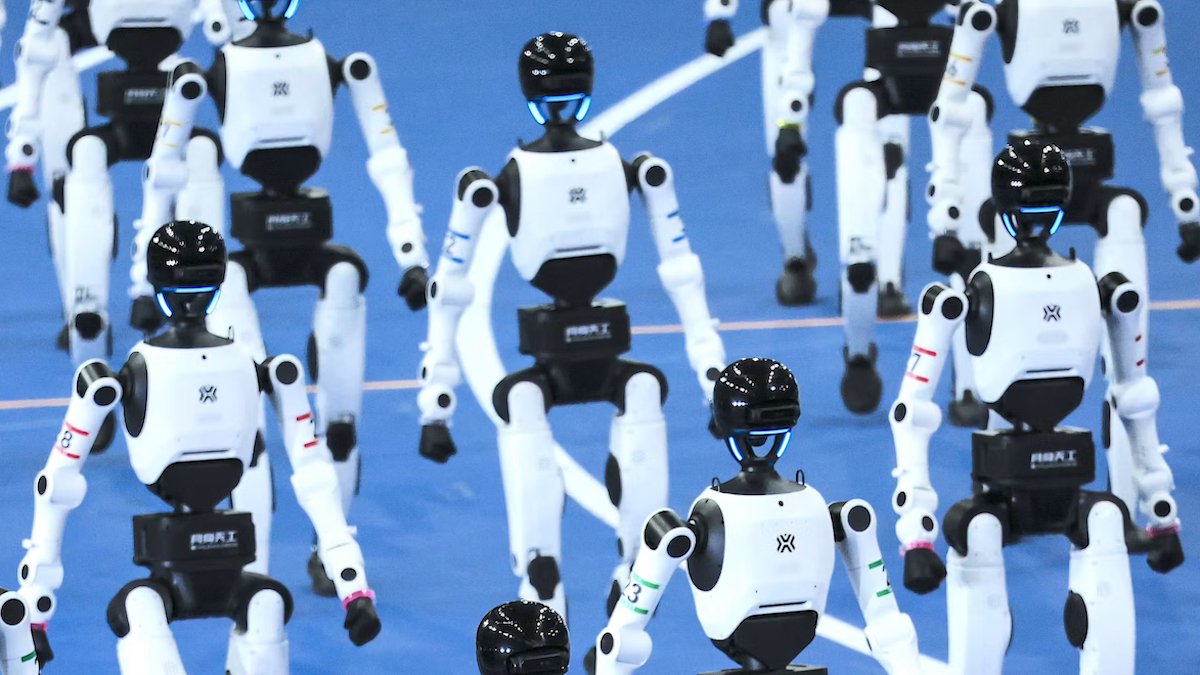
At the World Humanoid Robot Games in Beijing, a bipedal machine named Tiangong Ultra crossed the 100-meter finish line in 8.64 seconds—beating Usain Bolt's human world record of 9.58 seconds. The internet chuckled at the robots' clumsy strides and spectacular tumbles, but the laughter may be premature.
Two days after the event, the official newspaper of China's People's Liberation Army (PLA) published a call for researchers to fast-track these machines from lab to military training grounds—referring to them not as experiments but as "combatants."
As a robotics researcher who works daily with simulation, reinforcement learning, and open-source tools like ROS 2 and Gazebo, I watch these developments with a mix of awe and concern. The hardware is already formidable; the software is advancing at breakneck speed.
Beyond the sprint: what the 8.64 seconds really means
The sprint is not just a stunt. At high speeds, each foot strike generates violent ground reaction forces. Balance corrections must happen in milliseconds, or the machine crashes. For decades, the mechanical challenges—actuators, sensors, and the physics of bipedal balance—were the main hurdles. Today, those problems are largely solved.
Carbon fiber and aluminum bodies keep mass low. Advanced actuators deliver torque up to 400 Newton-meters in humanoid joints, offering a combination of power and agility that was unthinkable a decade ago. But the real breakthrough is in software.
Robots are trained in virtual environments, running millions of trial-and-error scenarios through reinforcement learning before taking a physical step. This allows them to recover from trips, adapt to uneven ground, and process chaotic surroundings in real time. The gap between controlled labs and the unpredictable real world is closing fast.
Why a military would want a humanoid
In open-field combat, tracked or wheeled drones are superior—they carry heavier payloads, offer better armor, and are far more energy-efficient. But modern conflict increasingly moves into cities, which are built for humans. A tracked robot cannot climb a fire escape, turn a standard door handle, squeeze through a debris-filled stairwell, or sit in the driver's seat of a captured supply truck.
A humanoid robot acts as a "drop-in replacement" for a soldier. If a building is designed for a human to navigate, a humanoid can navigate it without custom redesigns or specialized ramps. This utility is not lost on militaries worldwide, and China is pushing hard.
China's broader push into multidomain drone swarms shows a similar pattern: integrating cutting-edge tech into military doctrine. The humanoid sprint is another piece of that puzzle.
Dual-use dilemma
The technology is inherently dual-use. The same capabilities needed to rescue a hostage or clear a booby-trapped room can be used to kill enemy soldiers. The US government's DARPA Robotics Challenge, which funded bipedal robots for disaster response after Fukushima, inadvertently laid the groundwork for military applications.
Many in the robotics community do not endorse offensive warfare. But the machines have undeniable defensive value—sending a humanoid into a building to neutralize a threat saves human lives. Yet the line between defense and offense is razor-thin.
Perhaps most alarming is how accessible this technology is. Unlike nuclear weapons or stealth aircraft, modern robotics thrives on open-source frameworks. Military-specific ecosystems like ROS-M, along with simulation tools and training datasets, are largely public and shared across global academic communities. A dedicated adversary can replicate advanced robotic behavior with relative ease.
We can no longer treat humanoid robotics as a purely academic pursuit or a commercial novelty. The international community needs an urgent conversation about controlling these advances—just as we regulate the export of certain microchips and aerospace components. The question is not whether humanoids will enter the battlefield, but who will set the rules.