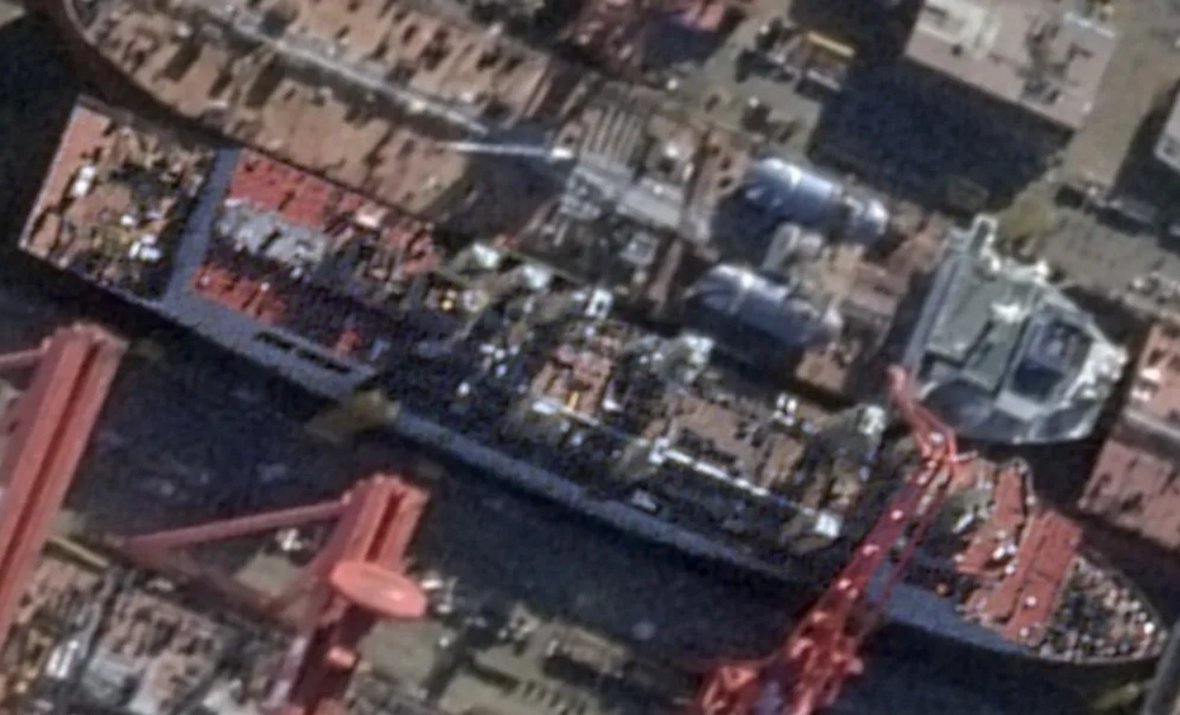
China's construction of what may be the world's largest naval replenishment ship signals a strategic shift in its expeditionary ambitions, directly challenging the US model of power projection that relies on a global network of bases. The vessel, under rapid assembly on Longxue Island near Guangzhou since February 2026, measures approximately 270 meters in length with a 37-meter beam, surpassing China's existing Type 901 replenishment ship and the US Navy's John Lewis-class oilers.
The ship's design features a broad, slab-sided hull optimized for volume, dual-aperture hangars, and a stern flight deck for vertical helicopter replenishment, along with midship pillar-like structures for transferring fuel, munitions, and dry stores at sea. This logistics asset appears tailored to sustain the People's Liberation Army Navy's (PLAN) expanding carrier strike groups, including the conventionally powered aircraft carrier Fujian and advanced amphibious vessels like the Type 076, during prolonged blue-water operations far from mainland ports.
Logistics Gap and Strategic Implications
China's reliance on a single foreign military base at Djibouti, compared to the US's approximately 750 bases worldwide, has historically constrained its power projection. While the Belt and Road Initiative (BRI) provides dual-use infrastructure at locations like Gwadar, Hambantota, Kyaukpyu, and Honiara, these facilities are vulnerable to attack and political instability. The new replenishment ship could partially mitigate these vulnerabilities, enabling more self-sufficient expeditionary operations.
This development echoes the US experience during World War II, when it projected power without a global base network. In contrast, the post-Cold War US Navy has become a "garrison force" dependent on foreign bases, which are now increasingly threatened by China's long-range missiles such as the DF-21 and DF-26. Recent conflicts in the Middle East, including the Iran war, have demonstrated how sustained missile and drone attacks can render forward bases uninhabitable, destroying equipment and inflicting casualties.
For the Indo-Pacific, these lessons are stark. Major US hubs like Guam and Okinawa, along with smaller "lily pad" facilities on remote Pacific islands, face growing vulnerability. China's economic and political influence in the region, coupled with military overmatch against regional states, could prompt allies to reassess the strategic value of US bases. The ongoing Sino-Russian cooperation in the Arctic further complicates the deterrence landscape.
China's fourth carrier, widely speculated to be nuclear-powered, would amplify logistics demands. While nuclear propulsion offers exceptional endurance for the carrier itself, its aircraft, escorts, crew, and weapons still require replenishment. The new mega-oiler addresses this gap, but it does not fully replace the advantages of foreign basing.
The US may respond by consolidating its regional footprint, potentially closing smaller bases near Iran and exploring new options in Israel or Jordan. In the Pacific, the focus may shift to hardening existing hubs and developing more resilient logistics chains. However, the strategic calculus is shifting: China's investment in a self-sufficient expeditionary capability could reduce its dependence on overseas bases, while the US must adapt to an environment where its bases are no longer sanctuaries.
This evolution in naval logistics underscores a broader transformation in Indo-Pacific security dynamics. As China's naval reach expands, the US and its allies must confront the reality that power projection in the 21st century may require new approaches to basing, deterrence, and alliance management.