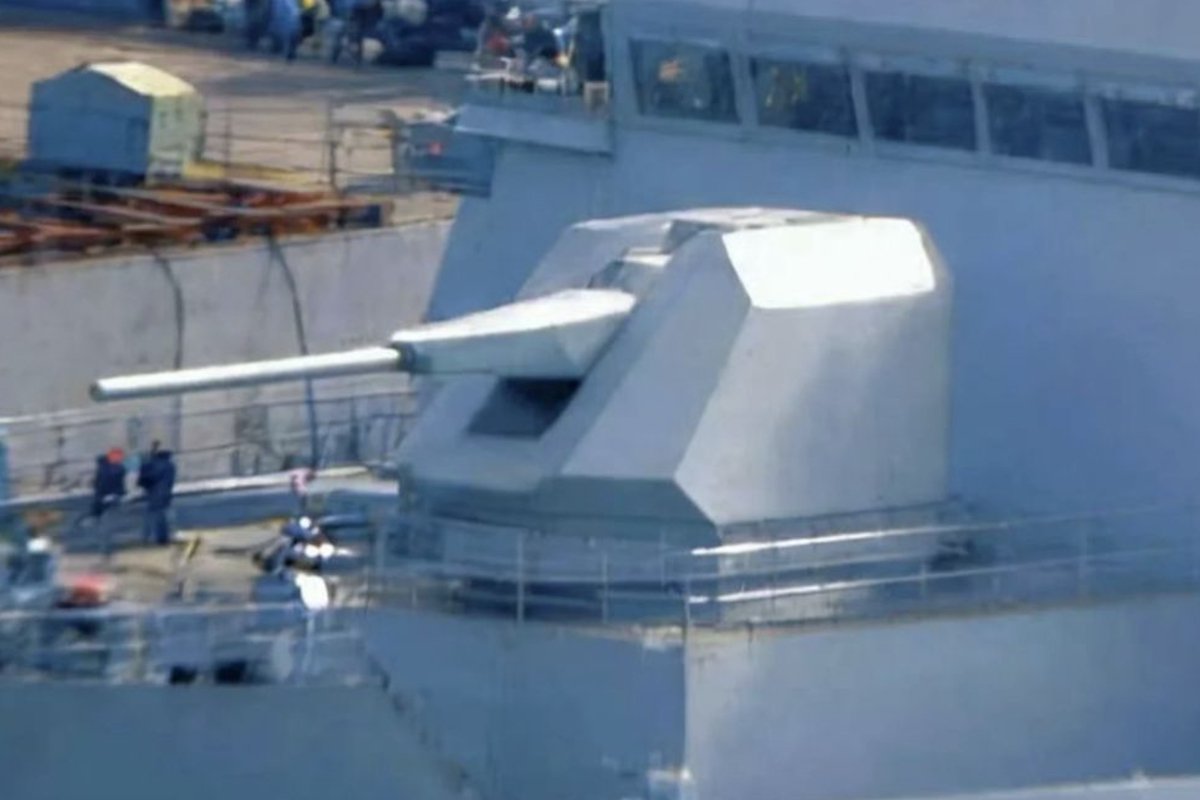
China's People's Liberation Army Navy (PLAN) is advancing a new 155-millimeter naval gun system, a weapon that promises to deliver unprecedented range and firepower in a potential conflict over Taiwan. The system, developed by state-owned Norinco, completed a prototype in March 2025 and underwent live-fire sea trials near Dalian in early May aboard the 6,000-tonne experimental warship Wu Yunduo. With a stealth turret designed to reduce radar visibility, it will become the largest caliber naval gun in active service worldwide.
The gun's extended-range ammunition can hit targets up to 200 kilometers away, a capability that would allow PLAN warships to bombard Taiwan's coastal defenses while staying beyond the reach of shore-based anti-ship missiles. This range is notable because it approaches that of tactical ballistic missiles (TBMs), which typically cover up to 300 kilometers. For context, the U.S. Navy's canceled 155mm Long-Range Land Attack Projectile (LRLAP) achieved only 83 kilometers, while North Korea's 170mm M-1978 Koksan howitzer reaches 57 kilometers with rocket-assisted projectiles. The new Chinese system thus represents a significant leap in naval artillery.
Strategic Role in Amphibious Operations
The revival of large-caliber naval guns reflects a shift in PLAN doctrine toward high-volume, precision-guided fire support for amphibious landings. According to a November 2024 report by Andrew Erickson and colleagues for the China Maritime Studies Institute (CMSI), the PLAN is moving away from traditional linear tactics toward a "systems-destruction warfare" framework. The new gun would target critical nodes such as early-warning radars, command centers, and entrenched coastal defenses, helping to dismantle Taiwan's anti-access networks before the first wave of landing forces arrives.
This approach contrasts with the U.S. Navy's decision to repurpose its Zumwalt-class destroyers from stealthy shore bombardment platforms into hypersonic missile launchers. The U.S. program faced prohibitive costs—each LRLAP round reached $800,000 to $1 million in 2017 dollars—leading to the decommissioning of the Advanced Gun System (AGS) on the three Zumwalt ships. China, by contrast, could fit its new 155mm gun on existing platforms like the Type 052D destroyers and Type 055 cruisers, which currently carry 130mm guns. As of June 2026, China operates 35 Type 052D destroyers and 10 Type 055 cruisers, providing economies of scale that could keep ammunition costs manageable.
Cost and Magazine Depth Advantages
Beyond shore bombardment, the gun system offers a defensive layer against low-intensity threats, including subsonic cruise missiles and swarms of unmanned surface vessels. This addresses a critical vulnerability in modern naval warfare: magazine depth. Missile-based interceptors are expensive and limited in number. For instance, the U.S. Navy's Arleigh Burke-class destroyers carry 96 vertical launch system (VLS) cells, while the aging Ticonderoga-class cruisers have 112. Reloading at sea is difficult, and the high cost of missiles—an SM-2 costs $2.1 million, an SM-3 Block IIA $27.9 million, and an SM-6 $9.57 million—compounds the problem. From October 2023 to December 2024, the U.S. Navy expended 168 SM-2s, 17 SM-3s, and 112 SM-6s defending Israel and countering Houthi attacks in the Red Sea, highlighting the strain on missile inventories.
In contrast, each AGS aboard the Zumwalt could carry up to 335 LRLAP rounds, and China's new gun may have a comparable magazine. This allows for sustained fire without the logistical burden of missile replenishment. As Johannes Fischbach noted in a December 2024 article for the International Institute for Strategic Studies (IISS), limited reloading capabilities at sea handicap missile-based systems, making gun-based alternatives attractive for high-volume engagements.
The development of this supergun is part of a broader Chinese strategy to project power across the Taiwan Strait and beyond. It complements other capabilities, such as China's missile swarm strategy targeting U.S. carrier groups from 3,000 kilometers, as reported by Asian Examiner. The gun's interoperability with existing army munitions also reduces supply chain costs, a lesson learned from the U.S. experience with the AGS.
However, the effectiveness of the new gun in a Taiwan invasion scenario remains uncertain. Taiwan's defenses are layered, including anti-ship missiles, air defenses, and hardened positions. The gun's 200-kilometer range may allow PLAN ships to strike from relative safety, but overcoming Taiwan's anti-access area denial (A2/AD) network will require coordinated strikes from multiple platforms. The CMSI report emphasizes that the gun is part of a broader "systems-destruction" approach, not a standalone solution.
China's naval modernization is also reshaping regional dynamics. As India builds its Great Nicobar base to challenge China's Malacca Strait dependence, and as Indonesia and China forge paths for local currency finance, the Indo-Pacific security landscape grows more complex. The new naval gun is a tangible example of how Beijing is investing in asymmetric capabilities to achieve its strategic objectives.