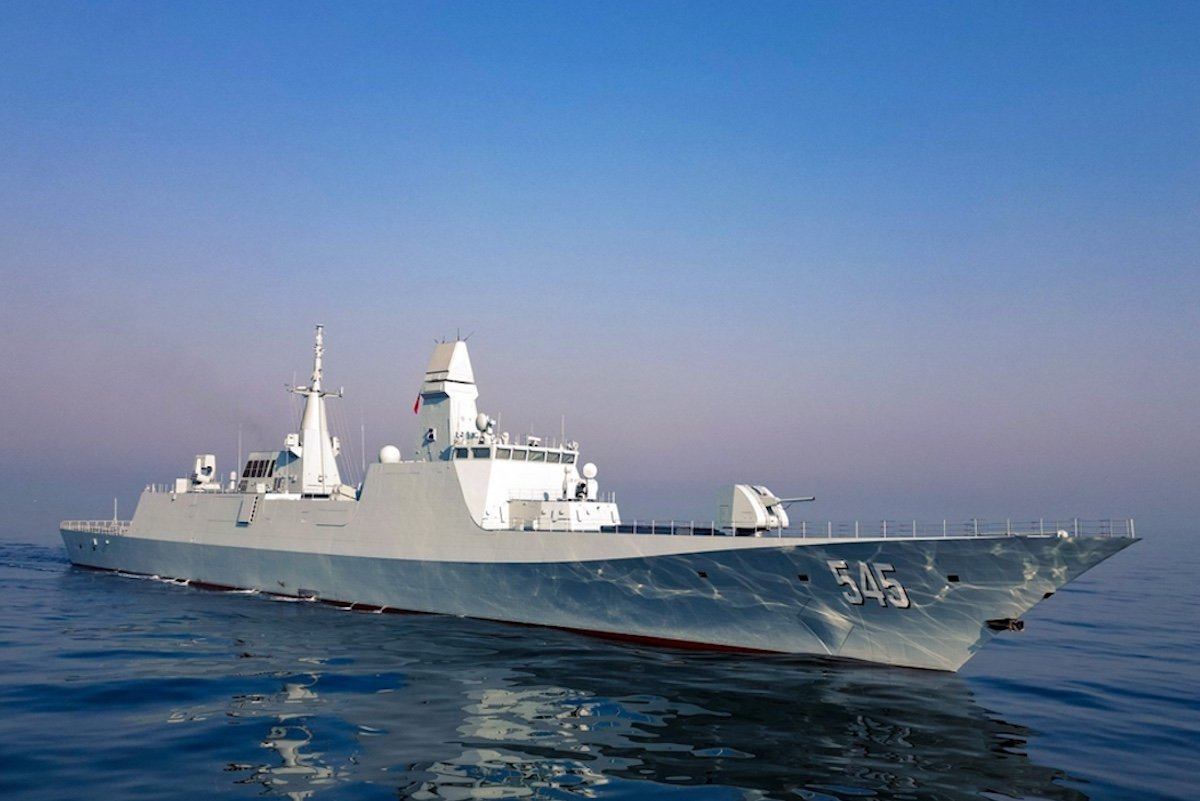
China's latest iteration of its Type 054B guided-missile frigate is not just a modest tweak—it is a clear signal that Beijing intends to win any future naval contest through a combination of raw firepower and sheer numbers. According to a report by the South China Morning Post, satellite imagery captured by US intelligence firm Vantor in June reveals that a new hull under construction at the Hudong Zhonghua shipyard in Shanghai is being fitted with a 48-cell vertical launch system (VLS), a 50% increase over the 32 cells on the first two commissioned ships of the class, the Luohe and Qinzhou.
More missiles, more staying power
The additional cells—which can launch HHQ-16 surface-to-air missiles and Yu-8 rocket-assisted anti-submarine torpedoes—are designed to significantly enhance the 5,000-ton warship's ability to fend off saturation attacks and extend its regional air-defense coverage. The Type 054B, which features radar-reducing stealth and AI-assisted combat systems, serves as an escort for aircraft carrier strike groups and conducts long-range patrols in the Western Pacific and South China Sea.
Dmitry Filipoff, writing for the Center for International Maritime Security (CIMSEC) in April 2023, explained that a larger magazine depth allows a platform to sustain force distribution longer by firing multiple small salvos while remaining on station. He noted that an isolated or stressed ship benefits from a high magazine depth, enabling it to launch significant volleys independently or as a final effort. Conversely, a shallow magazine depth forces more frequent reloads during conflict, disrupting operations and reducing the chance of overwhelming an adversary.
Comparing with US and allied designs
The Type 054B occupies a similar frigate category as the US Navy's Constellation-class and its planned FF(X) successor, though each design reflects different trade-offs. The roughly 5,000-ton Type 054B sits below the nearly 8,000-ton Constellation but close to the planned 4,750-ton FF(X). The most striking difference is missile magazine depth: the Constellation carries 32 Mk 41 VLS cells, while the upgraded Type 054B appears to have 48. The initial FF(X) is planned without an integrated VLS, instead emphasizing modular weapons, unmanned systems, and up to 16 Naval Strike Missiles.
Despite these differences, the Type 054B and Constellation share comparable multi-mission roles—anti-submarine, anti-surface, and air-defense warfare—as part of larger naval formations. The FF(X), by contrast, leans more toward surface warfare and unmanned teaming.
Role in carrier operations
Daniel Rice, in a July 2024 report for the China Maritime Studies Institute (CMSI), noted that the Type 054A frigate—and possibly the up-armed Type 054B—serves as a dedicated escort within the carrier's “Middle Defense Zone,” spanning 45 to 185 kilometers. Rice described these ships as the carrier's “constant bodyguard,” acting as a secondary defensive barrier alongside the Type 052D destroyer, tasked with neutralizing any subsurface, surface, or aerial threats that slip past the outer perimeter of carrier-based fighters and submarines.
Mass as a strategic asset
The expansion of the Type 054B's missile load also reinforces China's quantitative naval advantages. An April 2025 report from the US Congressional Research Service (CRS) stated that the People's Liberation Army Navy (PLAN) is the world's largest, with 370 platforms, and projects the fleet to grow to 435 ships by 2030. In contrast, the US Navy had 296 battle force ships as of September 2024, a number expected to shrink to 294 by 2030.
Numerical superiority enhances scouting, facilitates saturation attacks through massed fires, and allows forces to absorb enemy first salvos while maintaining striking power. Superior numbers also deplete enemy precision-guided munition inventories, create targeting dilemmas, and provide a reserve to replace combat losses in prolonged attrition warfare. However, as analysts caution, mass alone does not guarantee naval superiority—training, sensors, networking, logistics, and command effectiveness all matter.
US struggles with affordable mass
The US still holds qualitative advantages in high-end warships, submarines, carrier aviation, and networked warfare, but quality cannot fully compensate for a shortage of affordable combat mass. Kevin Eyer, writing in a Proceedings article, argued that the US has failed to produce affordable surface combatants due to requirements creep and gold-plating, which led to the cancellation of the Constellation-class frigate program in November 2025, leaving only the first two of six procured ships under construction. Eyer noted that overloading small hulls with unproven technologies and complex multi-mission requirements caused costs to spiral and construction to stall.
As China continues to expand its frigate fleet with greater missile capacity, the balance of naval power in the Indo-Pacific is shifting. The Type 054B upgrade is a reminder that the next arms race may be won not by the most advanced single platform, but by the fleet that can combine firepower with mass—a lesson that Washington is still grappling with.