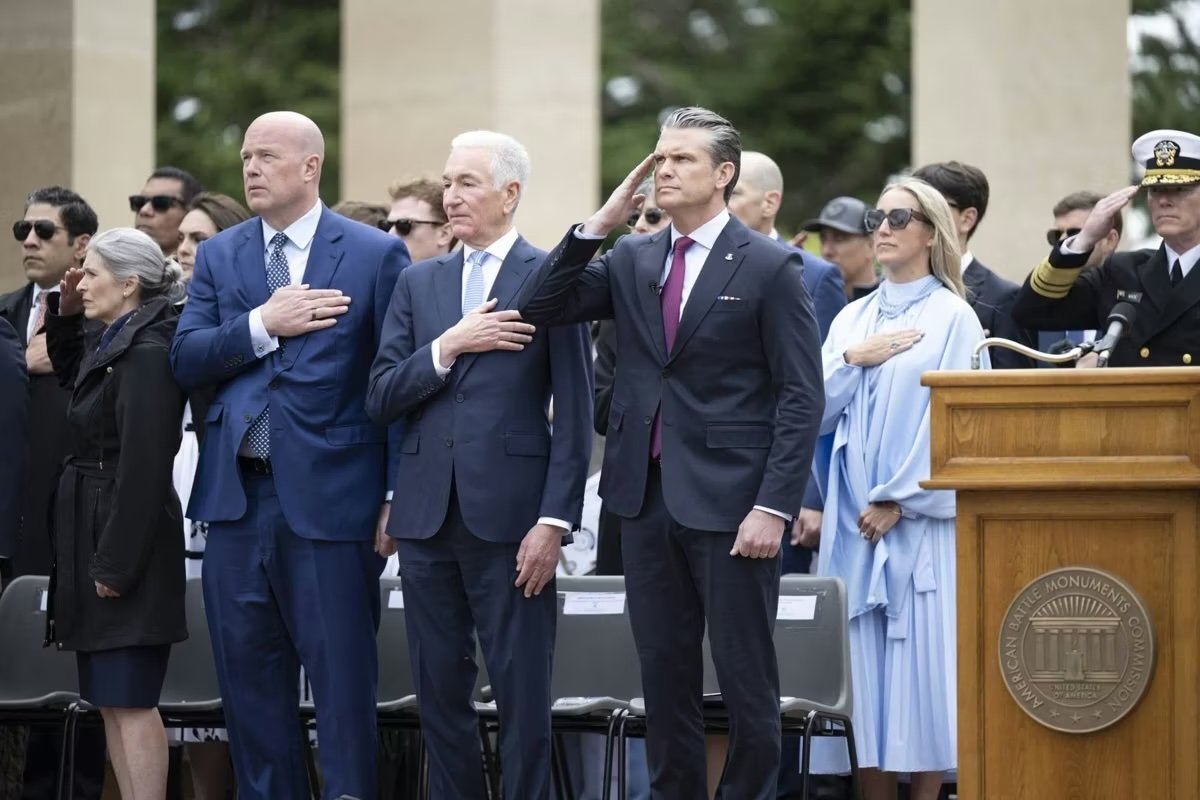
US Defense Secretary Pete Hegseth sparked international outrage this weekend after using a ceremony marking the 81st anniversary of the D-Day landings to deliver a blistering attack on migration into Europe. Speaking at the Normandy American Cemetery in Colleville-sur-Mer, Hegseth pivoted from commemorating the Allied invasion of Nazi-occupied France to warning that “different European beaches are stormed by different dangerous ideologies.”
“Beaches in Spain, in Italy, in Greece, and Bulgaria – boats and men arrive,” Hegseth said. “When will European capitals do something about that invasion? Or is it too late?” The remarks, delivered at a site where thousands of American, British, and Canadian soldiers are buried, were immediately denounced by veterans, politicians, and local French officials.
Backlash from Across the Atlantic
US Army veteran and progressive advocate Mike Lavigne called Hegseth “a disgrace to his office and to the nation.” Senator Tim Kaine (D-Va.) posted on social media: “Apparently our nitwit secretary of war(drobe) thinks a D-Day commemoration is an appropriate time to push his far-right ideology in Europe.” House Minority Leader Hakeem Jeffries (D-NY) said: “Thousands of American heroes died on D-Day to defend freedom and defeat fascism. Pete Hegseth should honor and respect their memory. Not politicize their ultimate sacrifice.”
In France, the reaction was equally sharp. Sylvie Lamy Thepaut, a member of the municipal association Langrune en commun, told BFM TV that Hegseth “has very warlike views and it seems to us that this man does not share our democratic values.” The association had called for his visit to be canceled, stating that Hegseth “espouses values contrary to democracy, human rights and peace” and has made “numerous anti-European remarks” and “American supremacist pronouncements.” Hegseth reportedly skipped the main international ceremony later that afternoon, a move that France 24 noted was conspicuous.
The speech aligns with the Trump administration’s broader National Security Strategy, released in December, which accuses the European Union of enacting “migration policies that are transforming the continent and creating strife.” The document warns that “should present trends continue, the continent will be unrecognizable in 20 years or less” and pledges US policy to help “Europe to remain European, to regain its civilizational self-confidence.”
Hegseth’s comments came a day after US Vice President JD Vance claimed on social media that a British teenager fatally stabbed by a fellow Briton would still be alive “if the last few generations of European elites had stood their ground against the mass invasion of migrants.” UK Prime Minister Keir Starmer’s spokesperson responded that “people trying to interfere in our democracy and seeking to stir up division on our streets” should respect the grieving family’s wishes not to politicize the murder.
The Trump administration’s migration rhetoric has drawn comparisons to its domestic policies. The EU recently moved forward with an overhaul of its migration framework, which human rights advocates say mirrors US Immigration and Customs Enforcement (ICE) tactics. Silvia Carter, a spokesperson for the Brussels-based Platform for International Cooperation on Undocumented Migrants, told the Associated Press: “Across the Atlantic, we see the violence and fear created by ICE’s brutal immigration enforcement. Europe should be learning from the harms of that model, not building its own version of it.”
The human cost of migration remains stark. The International Organization for Migration reported in February that at least 7,667 people died or went missing on migration routes worldwide last year, including at least 2,185 in the Mediterranean Sea and 1,214 on the Western Africa/Atlantic route toward the Canary Islands. The real toll is likely higher.
For Asian readers, the episode underscores the Trump administration’s willingness to use historical commemorations to advance a nationalist agenda that resonates with some populist movements in Europe and beyond. The administration’s focus on European migration may also distract from its broader Indo-Pacific strategy, including ongoing tensions in the Strait of Hormuz and the resilience of alliances like the Quad. As Hegseth’s remarks show, the Trump team sees migration as a wedge issue that can be deployed across continents, even at the risk of alienating key allies.