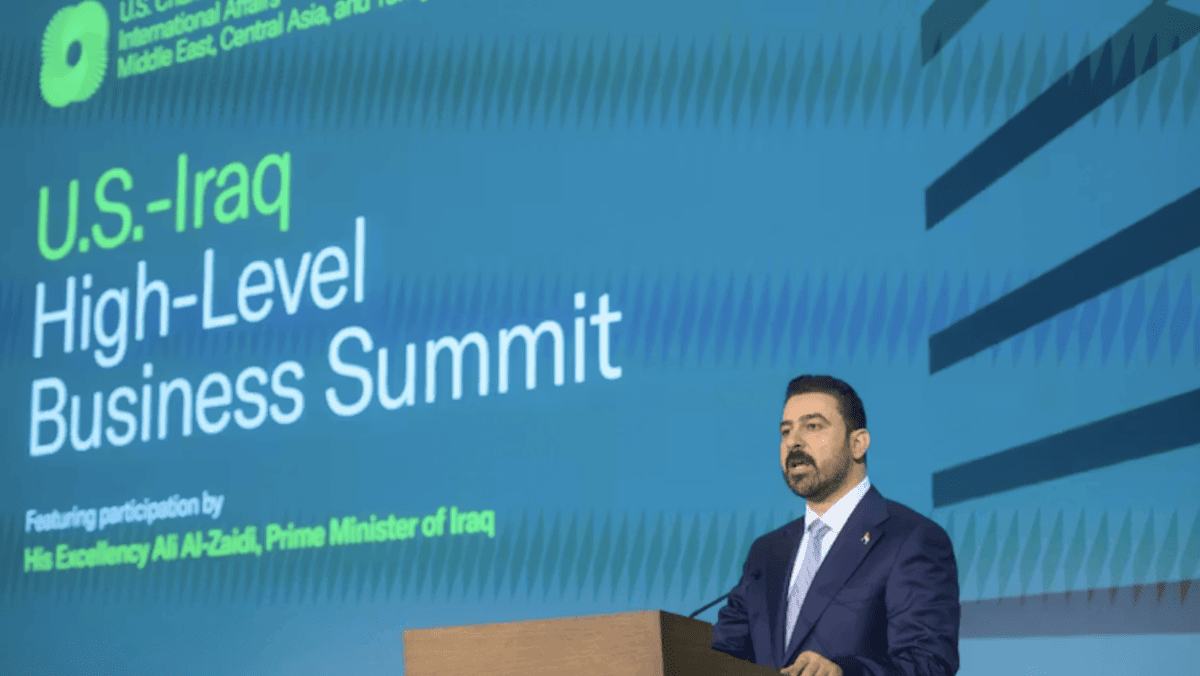
Iraqi Prime Minister Ali al-Zaidi is on a diplomatic roll. After a weeklong visit to the United States that ended July 19, 2026, where he charmed President Donald Trump, al-Zaidi is now expected in Tehran to court Iran's new leaders. His itinerary also includes stops in Qatar, Saudi Arabia, Turkey, and Syria.
The US visit was the first and most critical leg of a broader effort to bolster his government's domestic legitimacy, attract foreign investment, and elevate Iraq's regional standing. Baghdad aims to maintain its long-standing ties with Tehran even as US-Iran tensions escalate and the Strait of Hormuz disruptions cause economic shocks. By positioning itself as a bridge between the two adversaries—and potentially hosting Iran-US negotiations—Iraq seeks to secure a delicate but advantageous role.
The US trip, which featured a high-level business summit and meetings with American energy executives in Houston, was carefully orchestrated to align with Washington's new regional strategy centered on trade and investment, with Iraq as a key component. This shift marks a departure from the post-Iraq War focus on counterterrorism and military stabilization.
Iraq's Rising Strategic Value
Iraq's emergence as a potential nexus for diplomacy and commerce reflects both domestic changes and broader regional shifts. The degradation of the Islamic State group, improved security, and Baghdad's more active diplomacy have expanded its room to maneuver. Meanwhile, the fall of the Tehran-aligned Assad regime in Syria, the weakening of Iran's proxies, and the US-Iran war have heightened the strategic importance of Iraq's geography and institutions.
For Washington, the reassessment means viewing Iraq beyond the lens of counterterrorism. New economic deals aim to strengthen Iraq's energy sector, modernize infrastructure, and expand private-sector investment. Security cooperation remains important but now complements a broader strategy to build a resilient Iraqi state capable of managing external pressures.
For Tehran, Iraq is central to its regional strategy at a time when Iran faces a more challenging environment elsewhere. Iraq provides a strategic buffer, extensive commercial ties, and a critical corridor connecting Iran to partners across the Levant. As Tehran's allies like Hezbollah and Yemen's Houthis come under pressure, preserving its position in Iraq has become even more important.
The Arab Gulf states have also recalibrated their approach. Saudi Arabia, the UAE, and other Gulf kingdoms view Baghdad's post-ISIS trajectory as an opportunity for engagement through investment and economic integration. A more stable Iraq can link Gulf markets with global trade while reducing risks from instability emanating from Iran.
China's role illustrates another dimension. As Baghdad becomes an arena for geopolitical and commercial competition, Chinese companies will need to compete more aggressively for contracts. Yet Beijing's interests are not limited to outcompeting rivals; a stable, economically viable Iraq is valuable as a reliable energy partner and a potential hub for regional connectivity. In this respect, US and Chinese interests are broadly compatible.
These developing relationships do not represent a simple competition among rival countries. Instead, they coexist, reflecting Baghdad's effort to diversify external relationships while avoiding excessive dependence on any single power.
What distinguishes Iraq is not just its geography but the unusual overlap of relationships few other Middle Eastern states possess. Baghdad can engage Washington on security and energy, Tehran on political and commercial ties, Beijing on infrastructure and trade, and the Gulf states on investment and regional connectivity. This gives Iraq the characteristics of an “intermediary state”—a country whose influence derives from its ability to remain connected to competing political, economic, and security networks.
For context on how regional dynamics are shifting, see Iranian Foreign Minister Mocks Trump's Strait of Hormuz Toll Plan and Iranian Foreign Minister Claims 'Major Progress' in Swiss Peace Talks.