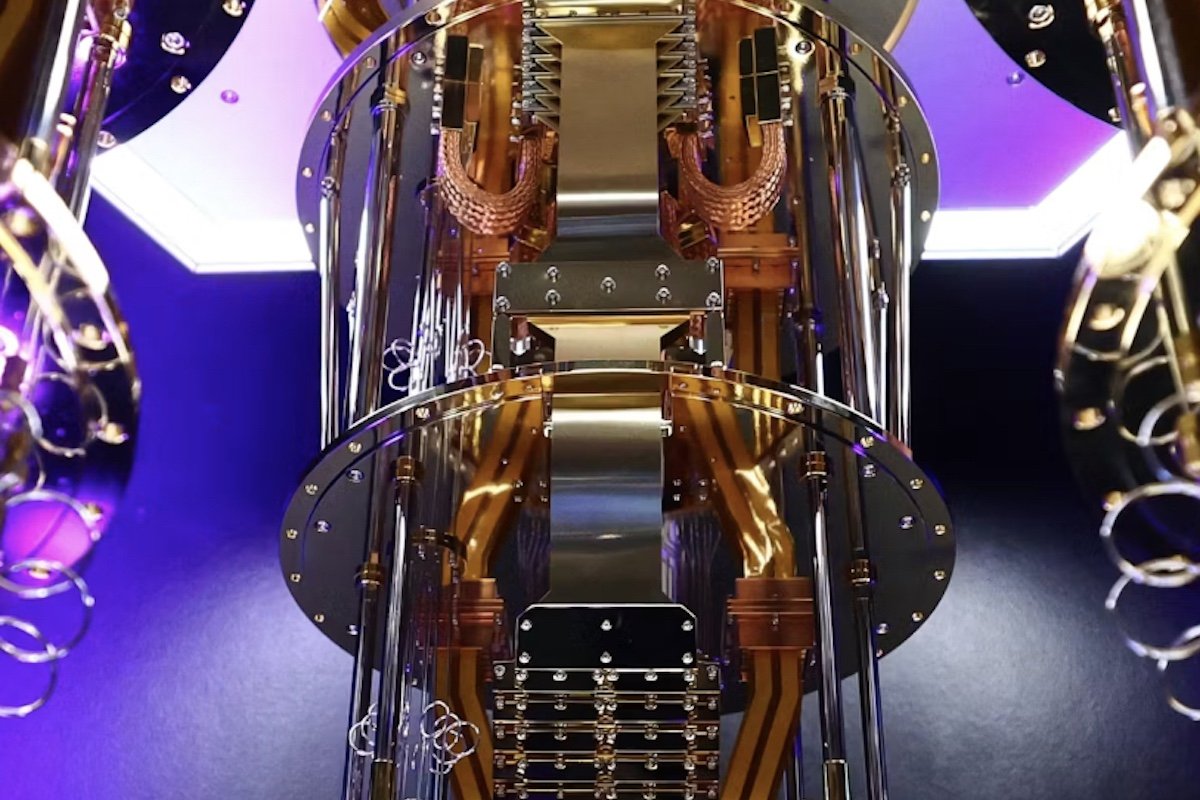
In a laboratory in Broomfield, Colorado, 98 atoms are suspended in mid-air by electric fields and cooled to near absolute zero. These atoms, each carrying quantum information, form the core of Helios, a new quantum computer built by the British-American company Quantinuum. Helios is a trapped-ion quantum processor, a design that uses charged atoms as qubits manipulated by laser pulses.
A paper published in Nature describes Helios as a 98-qubit processor with high accuracy and performance that pushes beyond what classical computers can easily simulate. While the previous largest trapped-ion system, System Model H2, had 56 qubits, the key advance is not just scale but quality. Quantum computers rely on qubits that can exist in superposition states, unlike classical bits, enabling certain calculations that could eventually outperform supercomputers. Potential applications include new materials, optimization methods, chemistry simulations, and cryptography.
Why Accuracy Matters More Than Qubit Count
Qubits are fragile, easily disturbed by temperature, control imperfections, and environmental interactions. The race in quantum computing is therefore about having more good qubits that can perform long, meaningful calculations. Helios addresses this with very low error rates: single-qubit gates average about 2.5 errors per 100,000 operations, and two-qubit gates—more critical for computation—average about 7.9 errors per 10,000, comparable to the best demonstrations of around 5 per 10,000.
Quantum operations are cumulative; a small error in one step can compound over thousands or millions of steps. Lower error rates enable more complex algorithms before quantum information degrades. Helios also features all-to-all connectivity, allowing any qubit to interact with any other directly, unlike many designs where qubits only talk to neighbors. This reduces the need for intermediate steps that add time and errors.
Hardware and Architecture
Helios uses barium ions in a quantum charge-coupled device (QCCD) architecture, which can be visualized as a tiny quantum railway. Ions are stored in memory regions and physically moved into operation zones where laser pulses perform quantum gates. A ring-shaped storage area and junction help route ions efficiently. This separation of storage, movement, and computation signals that quantum computing is evolving from laboratory components into full computing systems.
The machine also uses software that makes routing and control decisions in real time, deciding which physical ion represents each qubit and the order of operations. This is crucial for advanced programs where later steps depend on intermediate measurements. The paper reports that Helios can run random quantum circuits extremely difficult to simulate classically, a benchmark of computational power but not yet a general-purpose problem solver.
This advance comes amid a global quantum race with significant implications for Asia. The US and China intensify quantum race with competing investment drives, while quantum firms sidestep US-China rivalry as Trump pushes domestic supply chains. The quantum computing's cryptographic threat accelerates, prompting regional security rethink across the Indo-Pacific.
Helios represents a serious step forward, but practical quantum computing remains years away. Its combination of high qubit count, low error rates, and flexible connectivity sets a new watermark for the field, moving closer to machines that can solve real-world problems in medicine, climate science, and engineering.