Every time you boot up a smartphone or load a webpage, you are relying on open-source software. It underpins the global digital economy—from operating systems and web servers to databases and encryption protocols.
While the United States and Europe have historically led open-source development, China is now aggressively building its own ecosystem. The Chinese government has elevated open-source to a national strategic priority, and its companies and institutions are actively redefining how such technology is created, licensed, and deployed.
This push could have worldwide implications, especially as artificial intelligence becomes embedded in daily life. But China's success may hinge on overcoming deep-seated mistrust over intellectual property theft and state control.
From Red Flag to OpenHarmony: China's open-source journey
China's early open-source efforts were driven by a desire to escape foreign dependence. In the late 1990s, a government-backed institute developed Red Flag Linux as a domestic alternative to Microsoft Windows, which officials viewed as costly and vulnerable to foreign surveillance. Later, a military university created Kylin, an operating system used by the People's Liberation Army and other state bodies.
In recent years, Chinese tech giants have turned to open-source as a workaround for sanctions and export controls. When the US blacklisted Huawei in 2019, Google revoked its access to licensed Android services. Huawei leveraged Android's open-source code to keep its smartphones running, and eventually developed its own HarmonyOS NEXT, releasing an open-source version called OpenHarmony.
Today, President Xi Jinping's emphasis on keji zili ziqiang—science and technology self-reliance—has accelerated state support for domestic platforms. The Ministry of Industry and Information Technology backs the OpenAtom Foundation, a government-guided body for open-source projects, and Gitee, a Chinese alternative to GitHub. Domestic operating systems like openKylin and openEuler are now central to securing China's IT infrastructure.
Setting global standards
China is also positioning itself as a key player in open-source hardware standards. Its work on RISC-V, an open chip architecture, allows Chinese firms to reduce reliance on foreign semiconductor intellectual property, making them less vulnerable to export controls. Similarly, Chinese telecom companies, already leaders in 5G, are collaborating with international alliances to shape the 6G standard, including the Open-RAN architecture, which carries complex cybersecurity and strategic implications.
This strategy of "overtaking on a turn"—following closely and then passing the leader—appears to be yielding results. As China's uneasy calculus in a shifting global order continues, open-source leadership offers a path to technological influence.
Open-source AI: Chinese characteristics
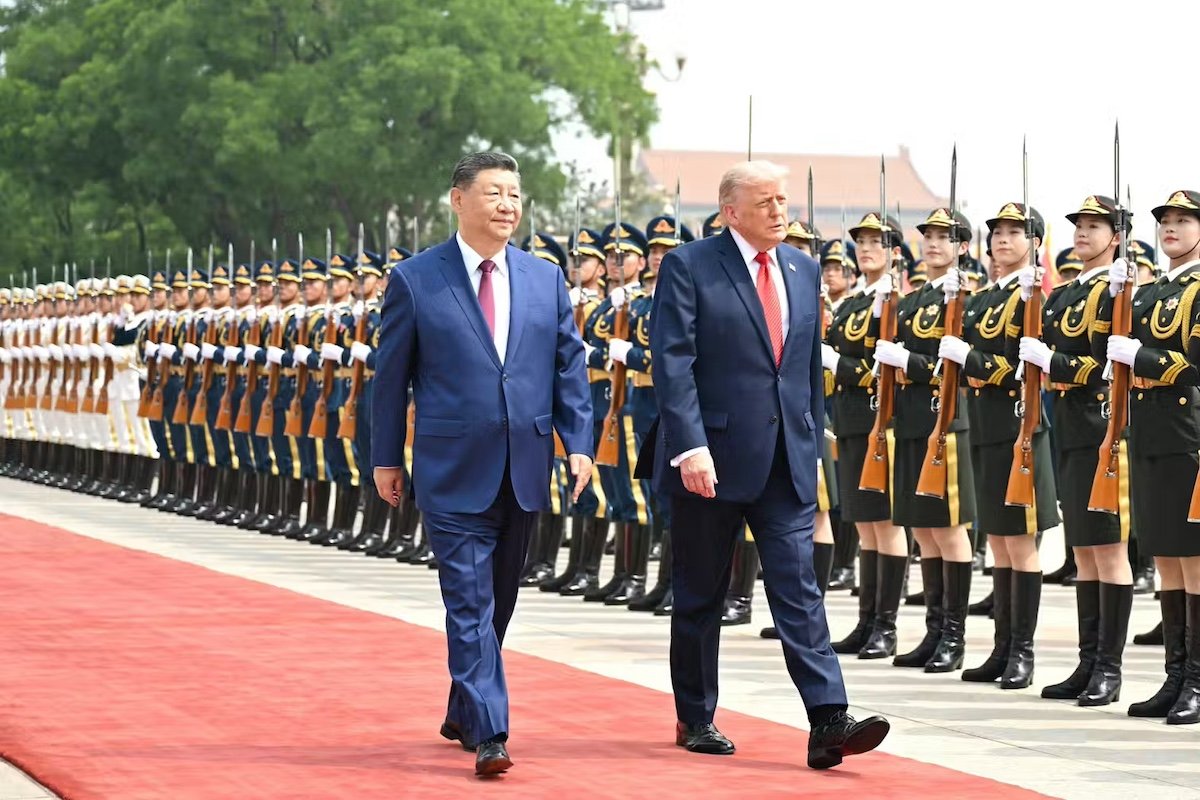
The AI contest has moved beyond chip export controls to who leads open-source AI development. Xi is expected to discuss AI with US President Donald Trump during his visit to the US in September.
Major Chinese AI models—Qwen, DeepSeek, Kimi, and GLM—are generally open-weight rather than fully open-source. That means the model software and final parameters are public, but training data and methodology remain proprietary. Companies often offer models in proprietary, open-weight, and smaller open-source versions.
The White House and Silicon Valley are split on the merits of open-source AI. Anthropic and OpenAI have accused Chinese open-weight makers of large-scale, unauthorized distillation—a technique to copy proprietary models. The Trump administration and some lawmakers have proposed restricting access to Chinese open-weight models, and several federal and state agencies have already banned DeepSeek on security grounds.
Users of Chinese AI also face less-publicized risks. Chinese open-weight models are designed to align with government censorship and propaganda. While many are distributed under standard licenses like MIT and Apache 2.0, some impose extra compliance obligations. For instance, Moonshot's Kimi K3 license requires licensees above certain revenue or user thresholds to prominently display the Kimi name. MiniMax M3's community license prohibits uses barred by "applicable laws or regulations," leaving unclear which jurisdiction applies.
Bilingual licenses developed under Chinese government guidance give Chinese authorities additional levers. These licenses often include clauses that could be interpreted to require compliance with Chinese law, even for foreign users. This raises concerns about data sovereignty and censorship extending beyond China's borders.
China's open-source ambitions are part of a broader strategy to reduce dependence on foreign technology and shape global standards. As Nvidia's $500B financing plan deepens the AI chip challenge, open-source offers an alternative path. Yet, the success of this approach will depend on whether China can build trust with the international developer community—a community that remains wary of state influence and IP theft.
For now, China is a formidable force in open-source, but its long-term influence will be determined by its ability to balance national priorities with global cooperation.