For decades, the global arms trade has been dominated by a handful of Western powers, with the United States and its European allies controlling the flow of advanced weaponry and the technology that underpins it. But a quieter revolution is underway, driven not by fighter jets or tanks, but by the humble components and industrial machinery that make modern warfare possible. China, through its vast manufacturing base, has become an indispensable supplier of dual-use goods—items that serve both civilian and military purposes—thereby chipping away at the West's monopoly on military capability.
The war in Ukraine has laid this transformation bare. As Russian forces have intensified strikes on Ukrainian energy infrastructure, they have relied heavily on fiber-optic drones—unmanned aircraft that maintain a direct, jam-resistant link to their operators via hair-thin cables. These drones have proven devastatingly effective on the front lines. When a Ukrainian long-range strike in 2025 knocked out Russia's only fiber-optic plant, Moscow's supply chain seemed vulnerable. Yet Chinese manufacturers quickly stepped in, filling the gap and keeping Russian operations running.
Fiber-optic cables are just one example of the Chinese-made equipment found in Russian drones. From microchips and lithium-ion batteries to 5G technology and mesh modems, Chinese components are ubiquitous in Moscow's military hardware. Beyond finished commercial drones that can be weaponized, Chinese firms supply the building blocks for Russia's own defense production. This includes everything from antennas for electronic-warfare systems to the milling machines, lathes, and computer numerical control (CNC) equipment that Russian factories need to manufacture weapons and ammunition.
Beyond the official arms trade
The scale of this dependence is difficult to quantify precisely, but multiple analyses point to Beijing's outsized role. The Jamestown Foundation estimated that in 2023, up to 90% of Russia's metalworking machine tools came from China. The Kyiv School of Economics found that China accounted for roughly three-quarters of Russia's reported imports of Common High-Priority goods, including integrated circuits and microelectronics. Much of this trade flows through opaque networks and intermediaries, making it harder to track than conventional arms deals.
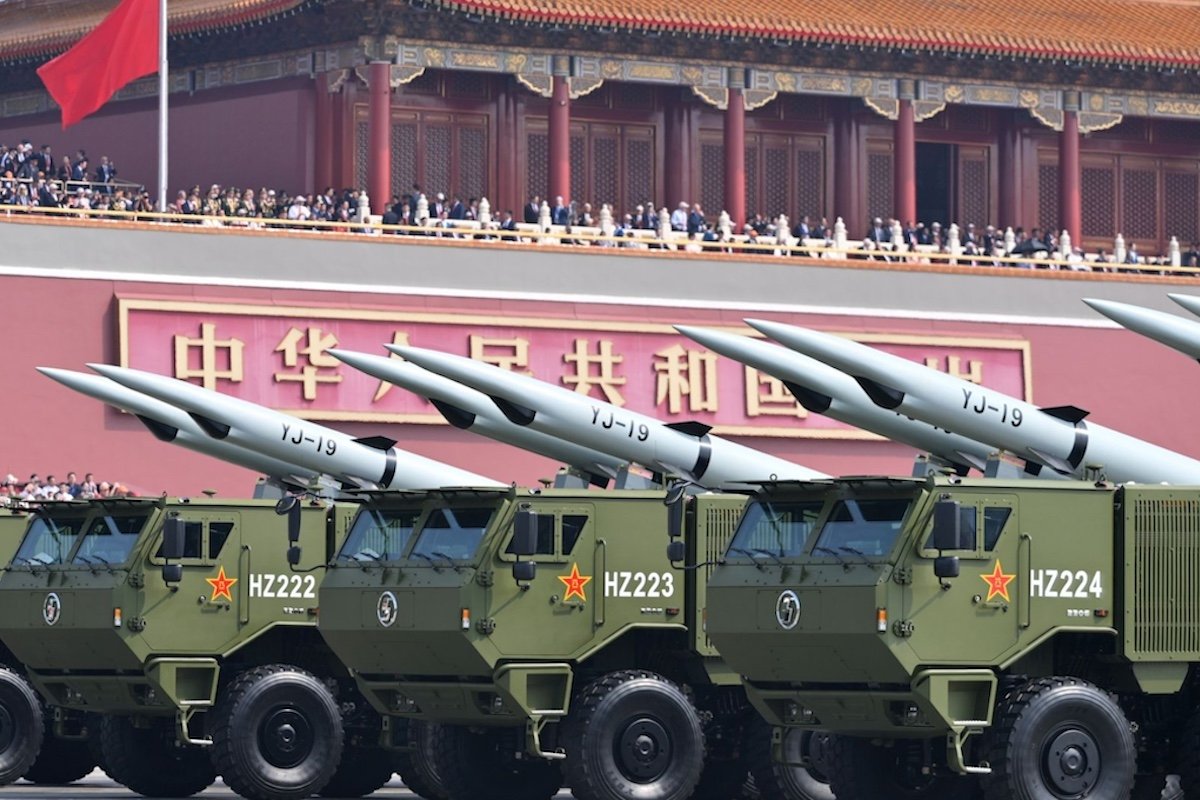
This shift is all the more striking given the historical relationship between the two countries. During the 1950s and again in the 1990s and early 2000s, China's armed forces relied heavily on Russian imports for combat aircraft, tanks, submarines, and advanced technology, according to the Center for Strategic and International Studies. Today, China has become an international arms exporter in its own right, competing with Russia even in markets Moscow once dominated. Yet Beijing remains an important customer for Russia's official arms industry, even as it supplies the components that sustain Russia's war effort.
The implications extend far beyond Ukraine. China's growing role in these supply chains challenges the West's ability to control the flow of military technology. The United States and Western Europe together accounted for 74% of global major arms exports between 2021 and 2025, according to the Stockholm International Peace Research Institute (SIPRI), with the US alone at 42%. But this traditional measure of the arms trade fails to capture the influence that comes from supplying the components and machinery that other countries need to wage war.
Western dominance in high-end military electronics remains formidable. Dutch firm ASML is the world's sole manufacturer of extreme ultraviolet (EUV) lithography machines, essential for producing the most sophisticated semiconductors that power cutting-edge military computing and artificial intelligence. Allies such as Taiwan, South Korea, and Japan also hold critical positions in global electronics and manufacturing supply chains. This concentration gives Western companies significant economic and political power, as arms control expert Hiruni Alwishewa notes, enabling them to drive strategic interests in exporting arms to conflict zones.
Yet China's dual-use exports are eroding that leverage. By providing the components and equipment that other nations and armed groups need, Beijing is gaining influence over their military capabilities and campaigns. This complicates China's stated neutrality in foreign conflicts, as its exports to Russia demonstrate. It also raises questions about the effectiveness of export controls, as Western products are often rerouted through China, and Chinese-made goods fill the gaps.
China's dominant and still-growing share of global vehicle production has created a vast industrial base for Russia to draw on. Russian forces have purchased hundreds of light armored personnel carriers from Shaanxi Baoji Special Vehicle Manufacturing Co., Ltd., as well as all-terrain vehicles from Shandong Odes Industry Co., Ltd. Chinese antennas are used in electronic-warfare systems to disrupt communications and navigation. The list goes on.
This transformation is not the result of a deliberate strategy to break the West's arms monopoly, but rather a byproduct of Beijing's drive to become the world's manufacturing leader. The ease with which commercial products can be repurposed for military use has turned the arms business on its head. As China's role in these supply chains grows, the traditional measures of military power—and the assumptions that underpin them—are becoming increasingly outdated.
For the Indo-Pacific, this has profound implications. As Taiwan moves to restrict AI chip exports and the US tightens controls on advanced technology, China's ability to supply dual-use goods to other nations could become a key lever in regional competition. The Belt and Road Initiative's evolution toward profit-driven deals may also shape how Beijing wields this influence. Meanwhile, financial channels between Russia and China continue to operate beyond Western reach, further entangling the two economies.
The West's arms trade monopoly was never absolute, but it was long assumed to be unassailable. China's quiet rise as a supplier of the components and machinery of war is changing that calculus. As conflicts from Ukraine to the Indo-Pacific evolve, the ability to sustain military operations may depend less on who builds the most advanced weapons and more on who controls the supply chains that make them possible.