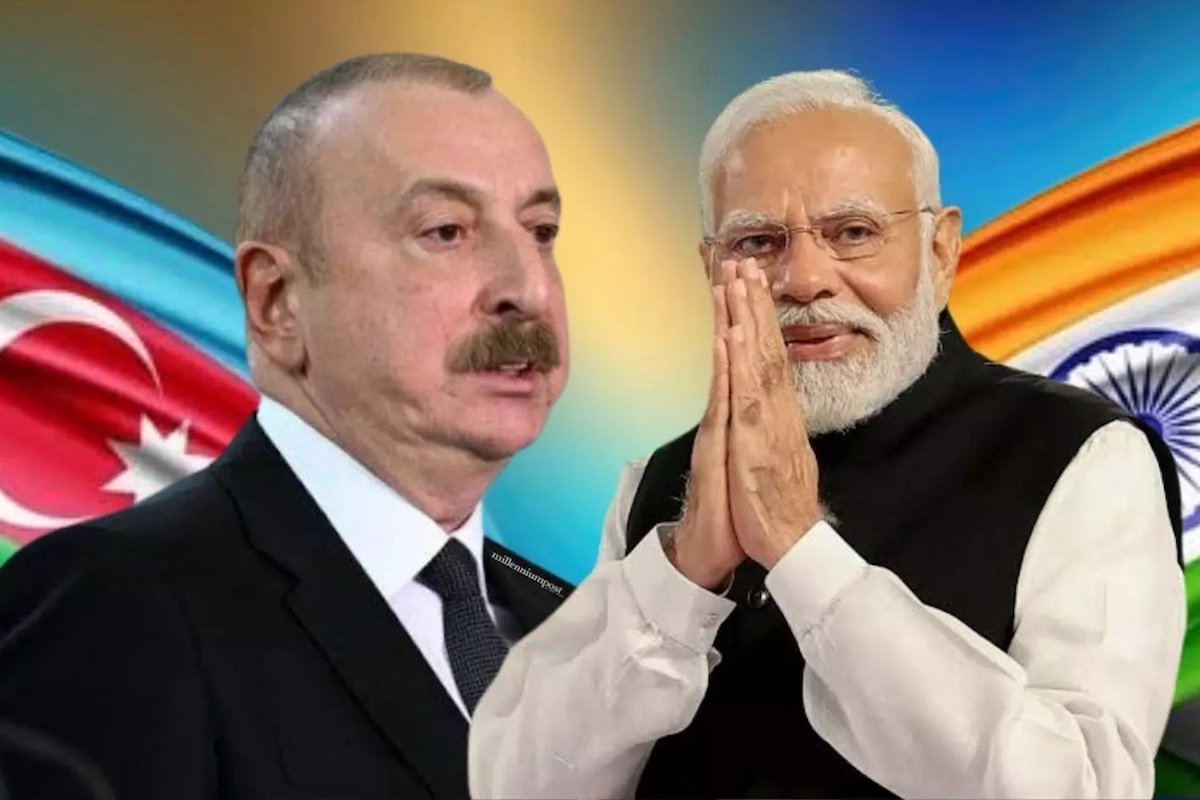
On October 23, 2026, Indian Foreign Minister S. Jaishankar met with Azerbaijani President Ilham Aliyev in Baku and held talks with his counterpart, Foreign Minister Jeyhun Bayramov. The visit, the first by an Indian foreign minister since 2018, came seven weeks after Aliyev and Indian Prime Minister Narendra Modi met in person for the first time at the Shanghai Cooperation Organization summit in Bishkek.
The discussions were grounded in practical interests: long-standing Indian investment in Azerbaijani oil production and joint efforts to repatriate Indian citizens from Iran earlier in 2026. Jaishankar and Bayramov agreed to expand energy investment and coordinate more closely on north–south freight transport, a corridor that could channel Indian cargo through Azerbaijan's railways and ports.
Balancing rival partnerships
For New Delhi, ties with Baku have evolved alongside a deepening partnership with Armenia, which has purchased Indian military equipment, including Swathi artillery-locating radars and 155-millimeter towed howitzers. Azerbaijan, meanwhile, maintains a close security relationship with Pakistan, reflected in its acquisition of jointly developed JF-17C fighters. The October talks gave both governments a chance to reassess how far these competing alliances should constrain their bilateral agenda.
The India–Pakistan conflict in May 2025 had a tangible impact on civilian ties. After Baku expressed solidarity with Pakistan, Indian travel companies reported a wave of cancellations, and Indian tourist arrivals to Azerbaijan fell by 56% between May and August compared with the same period in 2024. Direct flights had previously made Azerbaijan a popular destination for Indian travelers.
When Iranian airspace closed during the March 2026 fighting, Indian nationals—many of them students—crossed by road into Azerbaijan or Armenia to reach India. By April 2, India's embassy in Tehran had helped 1,200 citizens, including 845 students, leave Iran through those land borders. During his Baku visit, Jaishankar thanked the Azerbaijani government for its assistance.
Oil trade recovers
India's ONGC Videsh has held stakes in the Azeri–Chirag–Gunashli oil fields and the Baku–Tbilisi–Ceyhan pipeline since 2013, increasing its holdings in 2024. Azerbaijani crude bound for India travels west by pipeline to Turkey's Mediterranean coast, where tankers load it for the voyage. Indian imports from Azerbaijan, predominantly crude oil, fell from $734 million in 2024 to $175 million in 2025, partly due to a pricing dispute that halted shipments in October 2024. Exports resumed in August 2025, and by the end of that month, Azerbaijani customs had recorded some 524,000 metric tons of crude exports to India.
From January through September 2026, Azerbaijan's crude exports to India were worth $399 million, about two-thirds of the $600 million in bilateral trade Bayramov reported for that period. In October, the focus shifted to future investment, with Bayramov highlighting pharmaceuticals, a sector where Indian manufacturers already sell in Azerbaijan. The ministers agreed to exchange business delegations to explore local investment opportunities.
Transport corridor ambitions
The International North–South Transport Corridor (INSTC), founded by India, Iran, and Russia in 2000 and joined by Azerbaijan in 2005, offers India a sea-and-overland route to Russia and beyond. For Azerbaijan, it brings Indian Ocean freight within reach of its transport network, which also runs west through the South Caucasus. The two governments agreed to coordinate more closely on this corridor, which could become a key artery for regional trade.
Bayramov acknowledged that disagreements had affected bilateral relations and dealings in international organizations, while Jaishankar noted that each government forms its own judgments on international questions. The understanding reached in Baku gives each side room to manage bilateral issues without sacrificing their respective security partnerships. As India and Azerbaijan test the limits of pragmatic ties, their ability to compartmentalize differences will determine whether this nascent rapprochement deepens into a durable economic relationship.