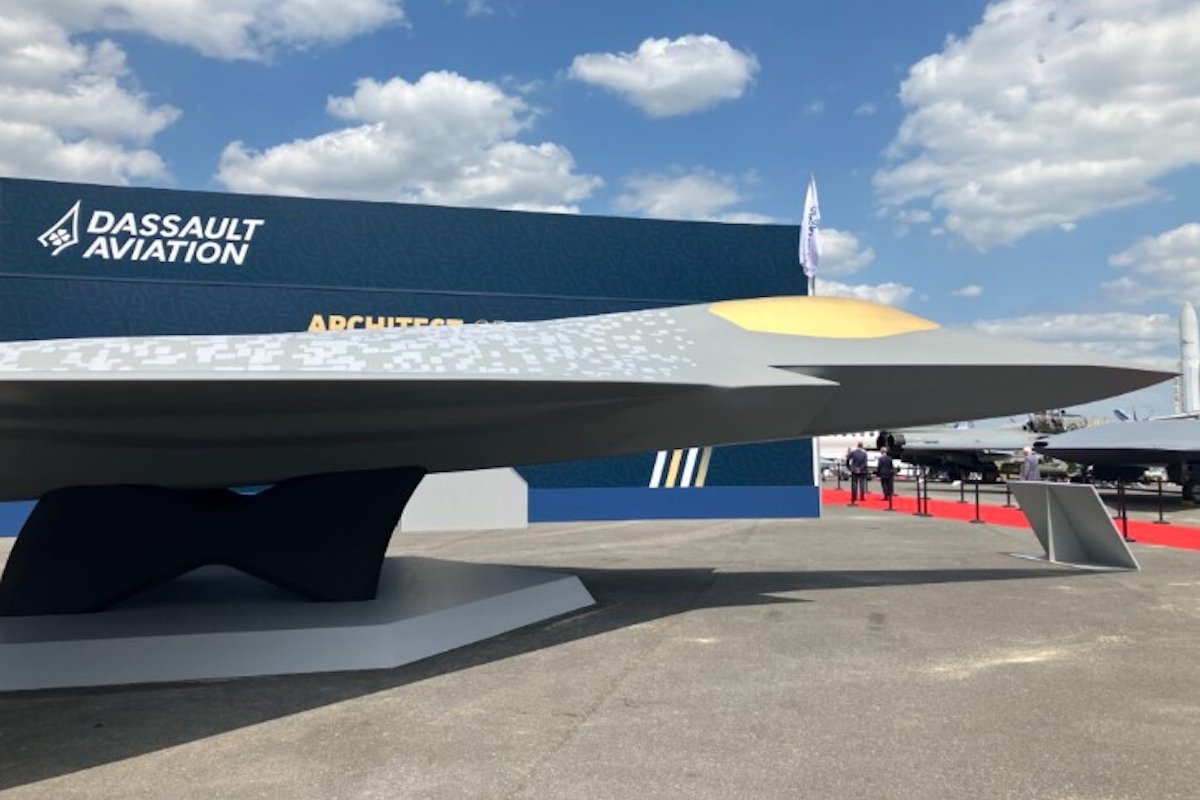
India has formally begun exploring participation in France's Future Combat Air System (FCAS) program, according to disclosures by its Ministry of Defense to a parliamentary standing committee. The move reflects a convergence of strategic necessity: India needs a credible path to next-generation airpower, while France needs a financially and industrially viable partner to sustain its sixth-generation fighter ambitions.
The strategic push follows the collapse of the Franco-German joint fighter effort in June 2026, which fell apart over unresolved disputes between Dassault Aviation and Airbus regarding industrial workshare, intellectual property, and design leadership. With that partnership in tatters, France is looking for new allies to keep its FCAS project alive.
India's airpower crunch
India's interest is driven by a rapidly modernizing Chinese air force and a domestic fighter shortfall. According to a February 2026 report by the International Institute for Strategic Studies (IISS), the Indian Air Force (IAF) has dwindled to 29 squadrons against an authorized 42-squadron target. Douglas Barrie and Tom Waldwyn, the report's authors, note that protracted procurement cycles and chronic manufacturing delays at state-owned Hindustan Aeronautics Limited (HAL)—most notably on the decades-delayed Light Combat Aircraft (LCA)—have compounded force depletion.
In contrast, regional adversaries are advancing rapidly. China has fielded over 300 stealth J-20 fighters alongside next-generation platforms, while Pakistan demonstrated superior long-range missile reach during 2025 air skirmishes. India's aging inventory is technologically outmatched and urgently reliant on delayed indigenous replacements and foreign acquisitions.
The problem extends beyond squadron numbers. Former Indian Air Force Vice Chief Marshal Nagesh Kapoor has criticized the slow progress of the Tejas LCA program, saying HAL's chronic delays are hampering air force readiness. The first Tejas Mk1A batch has been postponed to March 2027 due to engine shortages, complex software validation, and stringent requirements. Kapoor warned that the upcoming Tejas Mk2 will lack operational relevance when it is inducted in the mid-2030s, as China deploys 500 fifth-generation J-20 fighters.
The Advanced Medium Combat Aircraft (AMCA), India's indigenous fifth-generation program, offers no near-term solution either. Funding delays, changing requirements, and slow technology maturation pushed prototype requests to May 2026, with operational induction projected around 2035—potentially leaving India without a domestically produced stealth fighter for another decade.
France's fiscal and industrial imperatives
France has equally compelling reasons to keep FCAS alive. French Defense Minister Catherine Vautrin noted that FCAS already represents US$2.9 billion in investment over eight years, allowing work on the project to continue into the 2040s. Vautrin pointed out that France is one of the few countries capable of producing a fighter jet entirely independently.
But technological sovereignty does not mean financial self-sufficiency. Le Monde estimates that developing FCAS alone would cost France more than $11.6 billion over the next decade. France also urgently needs to recapitalize its aging fighter fleet. Procurement delays, aging airframes, and expanding operational commitments are placing growing strain on French combat aviation. Legislative changes have deferred roughly 20 Rafale F4 deliveries in anticipation of the F5 standard in 2033–2034, while the French Navy's aging Rafale Marine fleet and expanded nuclear-deterrence requirements are increasing demand for additional Rafale B and C aircraft.
With 80% of France's fighter fleet airborne during peak operations, military leaders have warned that sustained overuse could exhaust existing aircraft before replacements arrive. Cooperation with India could provide cost-sharing for FCAS and raise production volumes to achieve economies of scale.
Technology sharing: the sticking point
While the strategic fit seems apparent, technology sharing remains a significant obstacle. Ramon Cuerda Riva notes in a Digital Shield article this month that while France is willing to transfer 100% of its advanced jet engine intellectual property to India to secure significant procurement contracts, it remains fiercely reluctant to share source code for other sensitive systems. Doing so would mean relinquishing decades of proprietary engineering—the same sovereignty problem that has already plagued European cooperation on FCAS.
India and France have already built defense ties around the Scorpene submarine program and Rafale fighter sales, but a sixth-generation partnership would be a leap in ambition. Bilateral discussions will center on co-development, technology transfer, and domestic production rights for critical propulsion, radar, and “combat cloud” networked architectures.
India is pursuing this exploratory venture alongside its indigenous AMCA program and potential acquisitions of additional Rafale fighters, though no formal financial commitments or workshare agreements have been signed yet. Russia, long a preferred Indian defense partner, has been sidelined: India declined its offer of the Su-57, choosing instead to modernize its Su-30MKI fleet. Russia's limited Su-57 production and the effects of Western sanctions on its aerospace industry make a major new investment in a Russian-origin fighter increasingly risky.
The apparent strategic fit, however, masks a harder question: whether India and France can overcome the industrial, financial, and technology-sharing constraints that could derail cooperation. As defense ties across the Indo-Pacific deepen, the outcome of these talks will be closely watched. For now, both sides are exploring a partnership that could reshape the region's airpower balance—if they can bridge their differences.