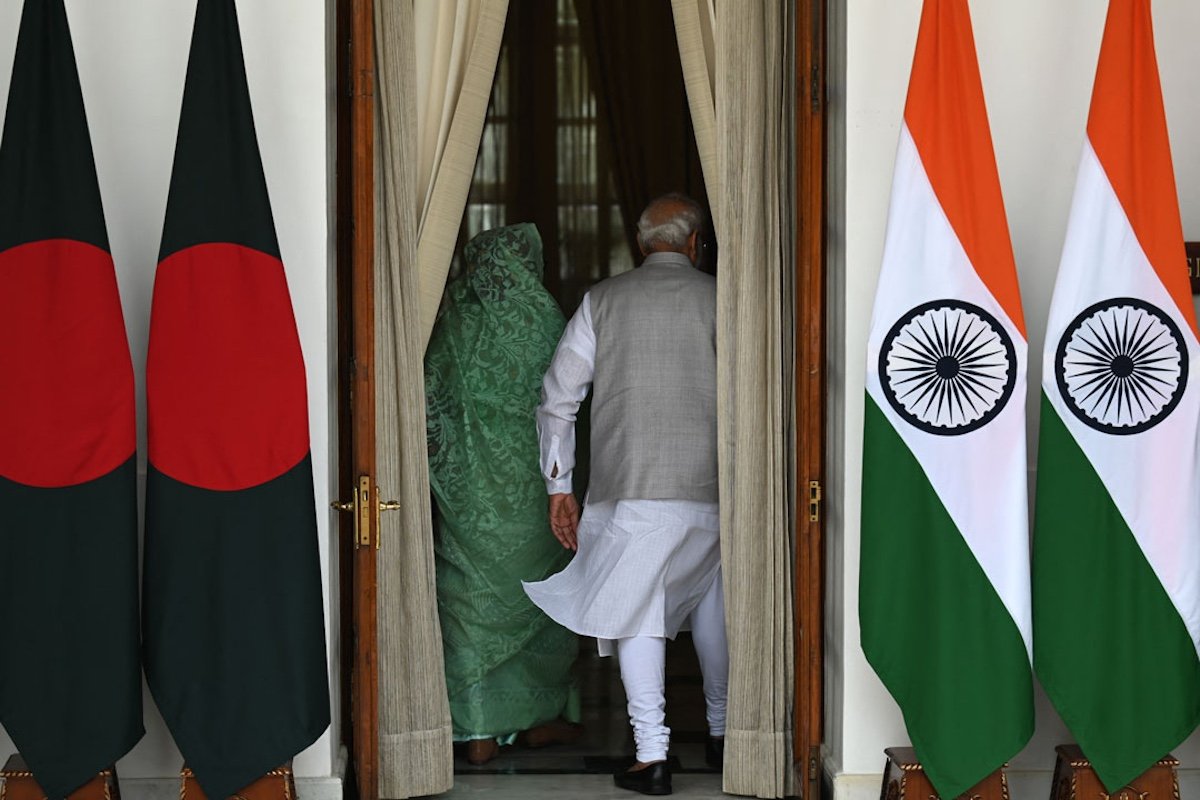
When Bangladesh's newly elected Prime Minister Tarique Rahman took office earlier this year, there was cautious optimism that New Delhi and Dhaka might move past the bitter fallout from Sheikh Hasina's 2024 ouster. India's diplomatic tone softened, officials spoke of continuity, and analysts predicted a long-overdue reset after nearly two years of corrosive mistrust.
Yet in South Asian geopolitics, statecraft is rarely defined by sterile communiqués. It is revealed in the unvarnished realities of border posts and airport terminals. The friction became undeniable with the recent treatment of Zahed Ur Rahman, an adviser at the rank of a State Minister to Bangladesh's prime minister, at Delhi's Indira Gandhi International Airport.
Asked to wait for hours under the clinical guise of a “verification process,” Indian media later revealed he had been flagged on an immigration watchlist for past anti-India commentary. The reaction in Dhaka was swift: Bangladesh's Foreign Ministry summoned the acting Indian High Commissioner and lodged a formal protest, viewing the episode as an affront to a senior representative of the prime minister's office.
New Delhi offered little beyond a brief explanation that Rahman had been stopped for “verification,” a response many in Bangladesh saw as inadequate given that the individual involved was not an ordinary traveler but a high-ranking government adviser. For a relationship attempting to find a new footing, this incident is detrimental. If New Delhi genuinely seeks to cultivate a functional rapport with Rahman's administration, subjecting one of his close confidantes to an abrasive airport ordeal signals the exact opposite.
In an editorial, The Daily Star, Bangladesh's largest English-language daily, branded the episode “unfortunate and avoidable,” warning that it cast a long shadow over bilateral ties precisely when both capitals needed to dismantle accumulated distrust. If New Delhi harbored legitimate grievances regarding the adviser, the paper noted, discreet diplomatic channels—rather than public humiliation—should have been employed.
Border Pushbacks and Political Tinder
This airport skirmish was not an isolated bureaucratic hiccup; it was a symptom of a deeper malaise. It coincides with an increasingly volatile confrontation along the two sides' 4,000-kilometer shared border, where Dhaka has protested India's aggressive “pushbacks” of alleged undocumented migrants. While Indian officials maintain they are merely repatriating illegal residents, Bangladesh counters that these unilateral expulsions lack proper verification and violate established bilateral protocols. The issue is a political tinderbox in Dhaka, directly bruising national sovereignty and public dignity.
Images of destitute individuals stranded in the borderlands feed a potent domestic narrative of Indian heavy-handedness, complicating matters for a Bangladeshi administration trying to stabilize relations with its overbearing neighbor. The result is a stark, widening chasm between diplomatic rhetoric and transactional reality. On paper, the incentives for alignment are overwhelming: Bangladesh remains India's vital security buffer and its gateway to regional connectivity, while New Delhi is an inescapable economic and geographic reality for Dhaka.
Yet the institutional muscle memory developed during the Hasina era has proven remarkably resistant to change. For over a decade, India's Bangladesh policy was mono-focused on a cozy, exclusive partnership with Hasina's Awami League. The cataclysm of 2024 demolished that diplomatic architecture. While India has formally accepted Bangladesh's democratic transition, deep institutional discomfort persists toward a political class long viewed with suspicion by New Delhi's security establishment.
The airport incident perfectly encapsulates this myopia. Immigration officials may view the enforcement of a watchlist as a routine administrative exercise, but diplomacy demands an acute sensitivity to optics. What a bureaucrat deems standard operating procedure can easily be interpreted by a neighbor as a deliberate, calculated insult.
Compounding this friction is the reality that India's foreign policy toward Dhaka is increasingly hostage to its own provincial politics. New Delhi's stance is heavily contaminated by electoral calculations in West Bengal. In the hyper-polarized environment of border-state politics, illegal migration and demographic shifts are potent electoral currency. This reality incentivizes a hawkish posture that may yield domestic dividends in Kolkata and Delhi but severely cripples India's diplomatic maneuverability with Dhaka.
Dhaka's strategy has also yielded meager returns. Since the post-Hasina transition, the interim administration, largely through its appointed High Commissioner, leaned heavily on a strategy overly dependent on cultural symbolism. Exhibitions of sarees, culinary festivals, and events highlighting a shared heritage became the preferred instruments of engagement. While soft power possesses inherent value, it is effective only when it serves as a handmaiden to hard political diplomacy. It can never serve as its substitute.
History is replete with examples of this structural limitation. Decades of cricket diplomacy and cultural exchanges between India and Pakistan have evaporated instantly whenever hard security crises—from Kargil to Pulwama—occur, exposing the underlying absence of foundational political trust. Similarly, Sri Lanka's deep cultural and religious affinity with India has never sufficed to resolve thorny, politically sensitive disputes over Tamil rights and regional security. When hard questions arise, regional dynamics often override cultural goodwill.
For a deeper look at the challenges facing Rahman's administration, see Bangladesh's Democratic Reconstruction: A Front-Row View of Tarique Rahman's First 100 Days. The broader context of India's regional posture is also explored in India's Water Infrastructure Push Threatens South Asia's Fragile Peace.