Five months after its founding, India's Cockroach Janta Party (CJP) has become an unlikely force in the country's political landscape, demonstrating both the potential and the fragility of youth-led democratic movements. Born from an insult, the movement has already secured a significant political scalp and is now taking on the ruling Bharatiya Janata Party (BJP) over the integrity of the electoral rolls.
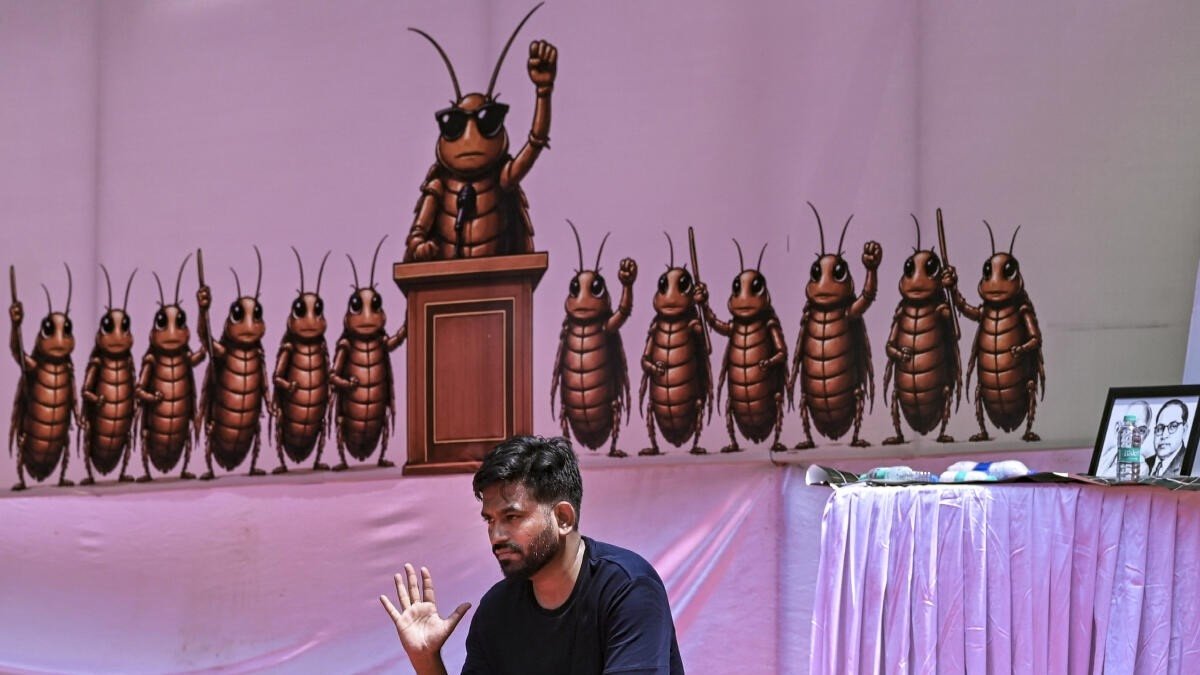
The CJP emerged in May 2026 in response to the government's cancellation of medical school entrance exams and a remark by Chief Justice Surya Kant, who compared unemployed youth to cockroaches. By July, the largely Gen Z movement had forced the resignation of Education Minister Dharmendra Pradhan. Now, it has turned its attention to a far more consequential issue: allegations that the Election Commission has struck approximately 130 million names from the voter rolls.
Since October 2, protesters have gathered in Delhi, Mumbai, and other cities, demanding the resignation of Chief Election Commissioner Gyanesh Kumar, an independent inquiry into the deletions, and the restoration of the old rolls before the next elections. The government has responded with a crackdown, detaining two CJP spokespersons, Ashutosh Ranka and Saurav Das. Prime Minister Narendra Modi and the BJP have refused to budge, accusing the protesters of undermining democracy.
Redefining democracy and 'the people'
Modi frequently describes India as the "Mother of Democracy," a phrase that invokes both the nation's civilizational heritage and the Hindu goddess Bharat Mata. He insists that democracy is not a Western import but a native inheritance, implying that modern India has always been and will always be democratic. Yet international monitors, such as Sweden's V-Dem Institute, classify India as an "electoral autocracy," noting that while multiparty elections are held regularly, the country fails basic democratic benchmarks like legislative and judicial checks and balances and meaningful citizen participation.
The CJP, by contrast, sees peaceful protest and adherence to the constitution as the essence of democracy. Demonstrators frequently invoke B. R. Ambedkar, the architect of India's constitution, in their posters and slogans. The movement's leader, 30-year-old Abhijeet Dipke, is, like Ambedkar, a Dalit. The BJP's vision of a Hindu civilizational identity is seen by critics as exclusionary, particularly towards India's 197 million Muslims. The CJP, however, draws no such lines, defining community by shared commitment rather than faith, caste, or birth.
The voter roll dispute highlights what is at stake. The Election Commission says the revision aims to remove duplicates, deceased voters, and noncitizens. But critics argue that the burden of proof falls unfairly on voters, especially poor Muslims, Dalits, and migrant workers who may lack decades-old documents. Those struck from the rolls also fear being branded illegal immigrants.
Cracks in BJP dominance
Since Modi's 2014 election, the BJP has dominated Indian politics, partly by attracting young and first-time voters with promises of employment and prosperity. While GDP growth has been strong, inequality remains rampant, and youth unemployment is staggering. According to official data, 40% of college graduates under 25 are unemployed, compared to just 3.4% for illiterate youth. For the CJP's core constituency, the rate is nearly 29%.
The CJP has seized on this discontent, using the slogan "Achhe Din" (good days) ironically in memes and posters. Its manifesto opens with a pointed joke: "If you are going to call us cockroaches, the least you can do is pay our rent." It calls for making "lazy"—a code word for the unemployed—a protected political identity. Underlying the humor is a serious critique of the stigmatization of the jobless.
The movement's ability to puncture the BJP's aura of invulnerability is notable, especially given the West's continued engagement with India despite its democratic backsliding. The CJP's protests have also drawn attention to the Supreme Court's demand for answers on the voter roll deletions. As the movement grows, it remains to be seen whether it can sustain its momentum and force broader political change, or whether it will be crushed by the state's machinery.