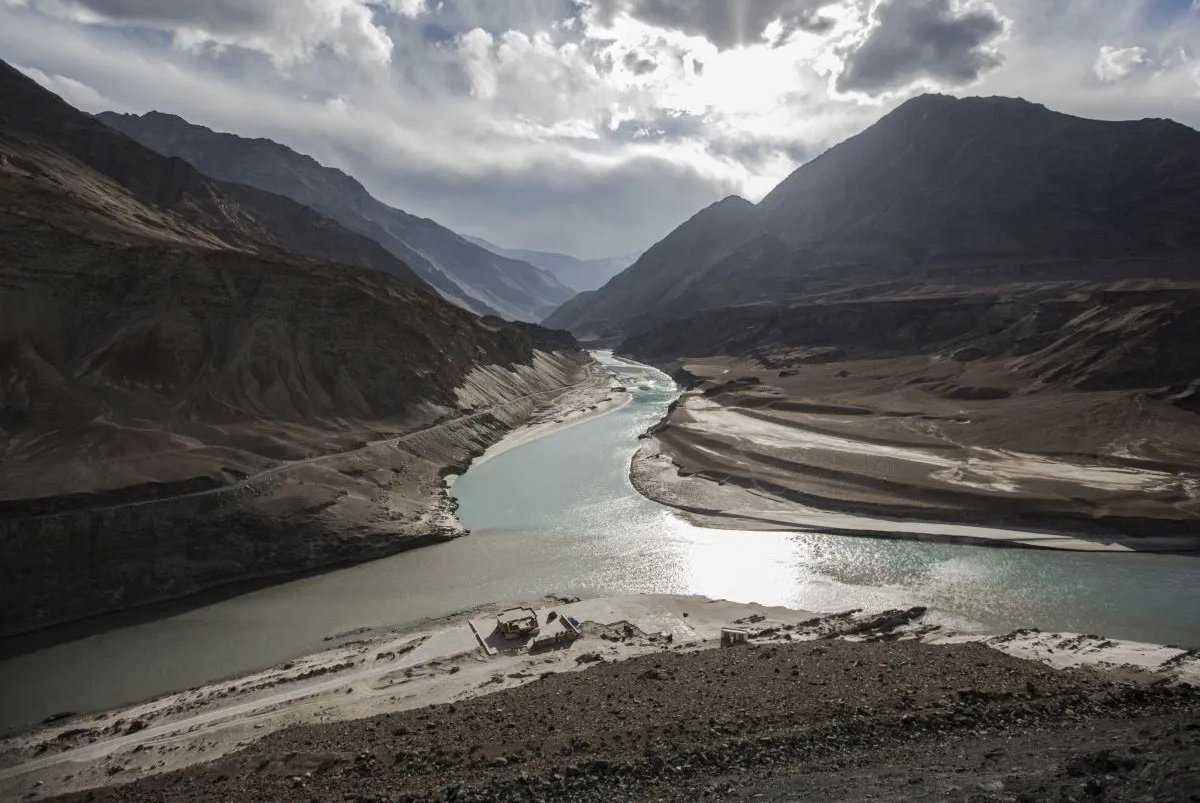
On June 4, Pakistan's foreign ministry spokesperson Tahir Andrabi stated what many analysts had long suspected: India is weaponizing water. The accusation came after New Delhi announced two infrastructure projects on the Chenab River—a ₹2,352 crore (US$246 million) tunnel diverting surplus Chenab water into the Beas basin in Himachal Pradesh, and a ₹268 crore sediment bypass at the Salal Dam in Jammu. Both are to be executed by India's National Hydroelectric Power Corporation.
Andrabi warned that these projects carry dangerous implications not only for Pakistan's economy but also for regional stability and international peace. The statement reflects a broader shift: since placing the Indus Waters Treaty (IWT) in abeyance in April 2024, India has systematically dismantled the cooperative framework that governed South Asia's most critical shared resources for over six decades.
The Treaty That Survived Wars
Signed in 1960 after nine years of World Bank-brokered negotiations, the IWT allocated the western rivers—Indus, Jhelum, Chenab—to Pakistan, and the eastern rivers—Ravi, Beas, Sutlej—to India. The treaty survived three full-scale wars, the 1998 nuclear tests, the Kargil conflict, the 2001 Parliament attack, the 2008 Mumbai massacre, and the 2019 Pulwama bombing. Its endurance reflected a mutual recognition that some frameworks are too fundamental to sacrifice for domestic politics. US President Dwight Eisenhower, present at the signing, called it “one bright spot in a very depressing world picture.”
That bright spot was extinguished on April 23, 2024, one day after the Pahalgam terror attack killed 26 tourists in Indian-administered Kashmir. Hydrological data-sharing stopped. The Permanent Indus Commission went dark. Within weeks, India conducted reservoir flushing operations at Salal and Baglihar dams without notifying Pakistan.
India then launched Operation Sindoor on May 7, 2024, striking nine targets in Pakistan and Pakistan-occupied Kashmir. A ceasefire was reached three days later, but the water dispute continued. By December, Pakistan's foreign ministry reported that Chenab flows had plunged to 870 cusecs between December 10 and 16—against a historical minimum of over 4,000 cusecs, a drop of nearly 80%. Satellite imagery confirmed a significant reduction followed by a sudden increase in the surface area of the Baglihar reservoir.
Redrawing the Hydraulic Map
The two Chenab projects announced in recent weeks are consistent with this trend. Since the IWT's suspension, India has fast-tracked the Pakal Dul, Kiru, Kwar, Ratle, Dulhasti Stage-II, and Sawalkote projects—a ramped-up portfolio of infrastructure on rivers the treaty designated for Pakistan's unrestricted use. The Chenab-Beas diversion tunnel is the most structurally significant because it physically transfers water out of Pakistan's allocated western river basin into an eastern basin entirely under India's control. This effectively redraws the hydraulic partition of 1960.
The Permanent Court of Arbitration in The Hague has ruled against India twice—in August 2024 and again on May 15, 2025, issuing a supplemental award on pondage limits at Ratle and Kishanganga, affirming that the treaty places substantive limits on India's water-control capability on the western rivers. India has categorically rejected both rulings, calling the court illegally constituted and its awards null and void. The legal architecture intended to resolve such disputes is being demolished by the same country that helped design it.
Pakistan's position—that the treaty remains fully in force and India's abeyance declaration is unlawful—may be correct, but without enforcement mechanisms, it is a paper shield. Pakistan now confronts an upstream state with vastly greater economic capacity, a decisive conventional military advantage demonstrated in May 2024, and a government that has made water nationalism part of its electoral identity.
Pakistan's water storage covers roughly 30 days of river flow. Its agricultural sector accounts for 80% of irrigation and nearly a quarter of GDP. Nearly 11 million Pakistanis were in acute food insecurity in 2025. When the Chenab's timing is manipulated—water withheld during sowing season, released without warning during harvest—the consequences are severe. This dynamic echoes broader challenges in the region, as seen in the ongoing CPEC 2.0: Green Ambitions vs. Debt Realities in Pakistan.
Beyond India and Pakistan
This is not merely an India-Pakistan issue. Bangladesh shares 54 rivers with India, and the 1996 Ganga Water Sharing Treaty—governing dry-season flow allocations at the Farakka Barrage—expires in December 2025. India has indicated it will not renew the treaty in its current form and seeks renegotiation on modified terms. The new Bangladesh Nationalist Party-led government in Dhaka has publicly linked the entire trajectory of India-Bangladesh relations to the outcome of negotiations over an equitable replacement. In the Bangladeshi delta, reduced upstream flow means salinity intrusion, disrupted agriculture, and heightened food insecurity. The political fragility in Dhaka, as explored in Zia's Ghost Still Haunts Bangladesh's Fragile Power Pact, adds another layer of complexity.
The implications extend beyond South Asia. India's assertion that water is an instrument of state power—to be allocated, withheld, and redirected according to political calculus—sets a precedent for transboundary water negotiations worldwide. From the Mekong to the Brahmaputra, upstream states may be emboldened to follow suit. The region's fragile peace, already tested by territorial disputes and terrorism, now faces a new and potentially more corrosive threat: the weaponization of water itself.