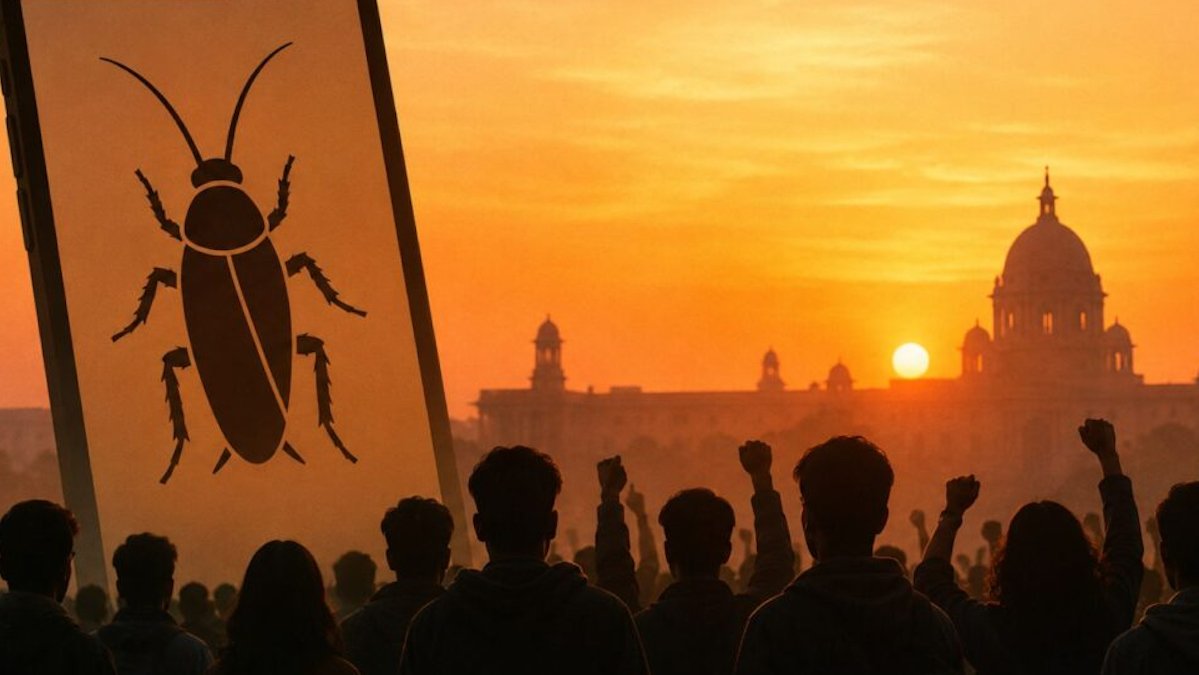
When India's Chief Justice Surya Kant compared unemployed young people to cockroaches last week, he likely anticipated outrage, an apology cycle, and then silence. Instead, he ignited a movement that has already overtaken the ruling Bharatiya Janata Party's social media presence. The Cockroach Janta Party (CJP), born from the insult, now boasts 15 million Instagram followers in five days, a cockroach logo on a mobile phone, and a sharp political critique.
The CJP calls itself the 'Voice of the Lazy and Unemployed,' with membership criteria including being chronically online and able to rant professionally. The irony is deliberate: these are not people who gave up. They are a generation that studied hard, followed the rules, and watched the system fail them—and decided to say so loudly.
Growth That Excludes
Prime Minister Narendra Modi's government prefers to focus on GDP numbers. With projected growth of 6.3% to 6.8% for 2025-26, India's economy performs well by global standards. Modi has made this the centerpiece of his legacy: a rising India, a confident India, set to become the world's third-largest economy by 2030. But headline growth conceals an economy that has failed to deliver broad-based opportunity.
Data from the Centre for Monitoring Indian Economy tells a different story. Youth unemployment among those aged 20 to 24 hovered around 44 to 45% for much of 2025—substantially worse than before 2014, when the current government came to power. Even the more conservative official measure, the Periodic Labor Force Survey, puts youth unemployment at 9.9% for the 15-to-29 age group, more than three times the general rate. In urban areas, it reaches 14.7%.
Education, supposed to be the great equalizer, has become an additional cruelty. Unemployment among Indians with secondary education and above stands at 6.5%, meaning staying in school does not protect you from joblessness—it often just delays it at greater personal cost. For women, the numbers are extreme: female youth unemployment hits 41% in Goa and 44% in Kerala, and nearly 40% among degree-holding women in Jammu and Kashmir. This is the country the CJP's 400,000 members signed up to criticize, more than 70% of them aged 19 to 25.
Meanwhile, wealth generated by India's growth has flowed in a strikingly narrow direction. According to the Centre for Financial Accountability, the top 1% of Indians now control more than 40% of national wealth, while the bottom 50% survives on just 15% of national income. Between 2019 and 2025, the wealth of India's richest 1,688 individuals grew by 227%, from roughly 31 lakh crore rupees to 88 lakh crore rupees. Household debt nearly doubled in the same period. India's Gini coefficient for wealth concentration, at 0.74, now matches the United States—a comparison few in Modi's government would welcome.
This is not a coincidence. It results from policy choices: a growth model built around services and consumption that generates GDP but not mass employment; tax structures concentrating gains at the top; and persistent failure to invest in education and job creation for an aspirational generation.
When the System Eats Its Own Children
Nothing illustrates institutional rot more clearly than the NEET examination scandal. In May 2024, approximately 2.4 million young Indians sat for NEET-UG, the sole nationwide gateway to medical education. The question paper had already been sold. In Bihar, police arrested 13 people who allegedly charged students up to 50 lakh rupees (roughly $60,000) for advance access. A student whose family sold land and took on debt to fund coaching died by suicide after the NEET-UG 2026 exam was canceled over another paper leak.
This is the system the Chief Justice was defending when he called unemployed youth cockroaches for holding 'fake and bogus degrees.' The more honest question is: who ran the institutions that produced those degrees? Who administered the leaked examinations? Who built the economy that cannot absorb two million medical aspirants, let alone the hundreds of millions beyond them?
The CJP's 30-year-old founder, Abhijeet Dipke, now based in Boston after leaving India two years ago, told Reuters: 'The youth of India has largely vanished from mainstream political discourse. Nobody is talking about us. Nobody is listening to our issues or even trying to acknowledge our existence.' The brain drain embedded in that quote is itself data: Dipke is one of countless educated young Indians who concluded the country's future would not include them and left.
A Democracy That Stopped Listening
India is, by law and election, a democracy. It is also, by press freedom metrics, one of the more constrained media environments in the world. In the 2026 World Press Freedom Index by Reporters Without Borders, India ranked 157th out of 180 countries—a six-place decline from 2025, and lower than Bangladesh and Nepal. RSF cited rising violence against journalists, highly concentrated media ownership, and outlets with 'increasingly overt political alignment.' The political indicator sub-score placed India 160th globally.
This matters for the CJP story because if India's mainstream media functioned as an accountability mechanism, it would not have taken a viral meme movement to put youth unemployment, exam leaks, and financial insecurity onto the national agenda. These issues have been visible for years. They were made invisible by a media ecosystem that found it more comfortable to broadcast GDP growth projections. The CJP's rise is a verdict on a system that created its own cockroaches—and now cannot exterminate them.