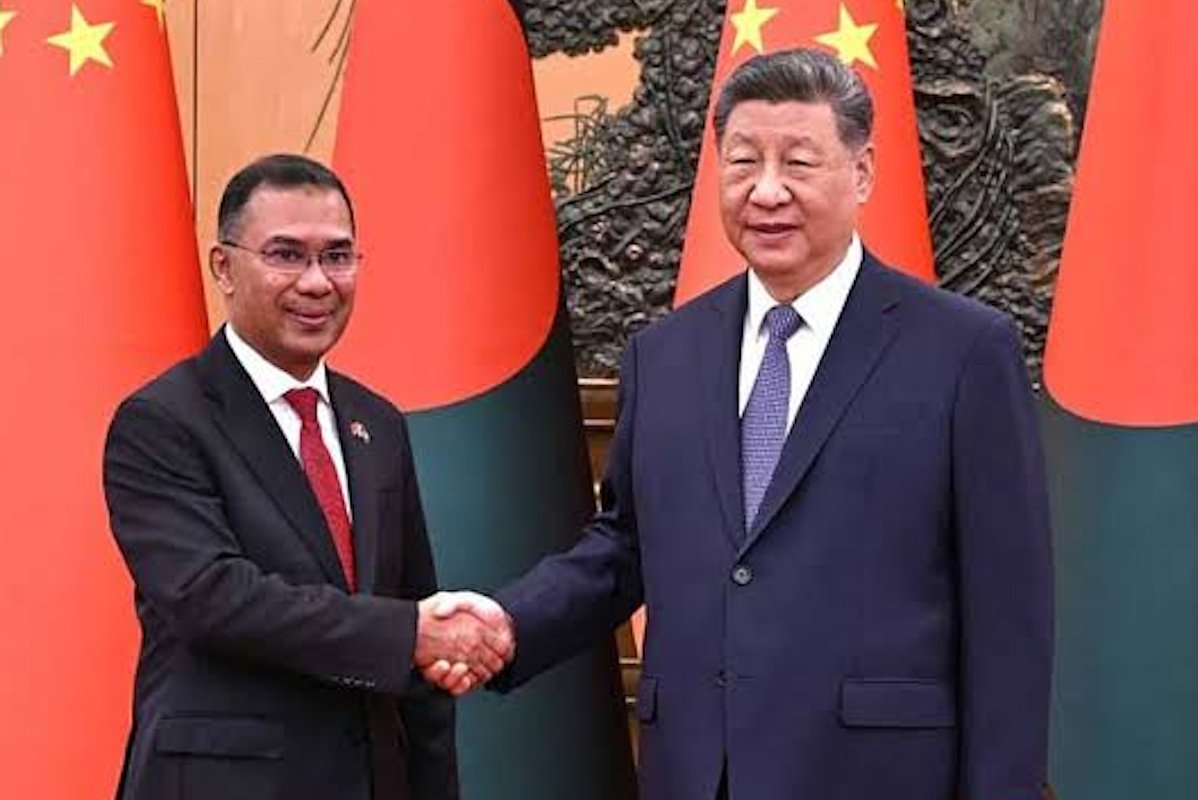
Bangladesh Prime Minister Tarique Rahman's first four-day official visit to China produced a predictable array of trade and green technology agreements. But the real story lies in the elevation of a single, long-stalled infrastructure initiative: the Teesta River Comprehensive Management and Restoration Project.
Once a marginal diplomatic topic, the project now anchors a deepening strategic partnership between Dhaka and Beijing, signaling a shift from political intent to concrete implementation. The reception in Beijing underscored the visit's gravity, with Rahman securing audiences with Premier Li Qiang, National People's Congress Chairman Zhao Leji, and President Xi Jinping. Xi pledged that China would remain Bangladesh's “trusted friend,” endorsing Dhaka's long-term development agenda and its ambitions to join BRICS and the Shanghai Cooperation Organisation.
Yet it was the explicit, repeated references to the Teesta project that resonated most across the region. Chinese foreign ministry spokesman Guo Jiakun framed the initiative as a crucial “livelihood project” that Beijing is prepared to support to the best of its ability.
Why the Teesta Matters
For Bangladesh, the Teesta River represents an acute developmental vulnerability. Seasonal monsoons regularly inflict devastating floods on the country's northern plains, followed by severe dry-season water shortages that cripple local agriculture. The proposed multi-billion-dollar restoration scheme aims to tame these extremes through extensive dredging, embankment construction, reservoir creation, and modernization of irrigation networks. Crucially, because the project is entirely contained within Bangladeshi territory, it bypasses the fraught question of transboundary water allocation.
This distinction is vital. For over a decade, a formal water-sharing treaty between Dhaka and New Delhi has been blocked by political opposition within the Indian state of West Bengal. Frustrated by fifteen years of Indian inertia on a critical environmental security issue, Dhaka has turned to Chinese engineering and capital to manage the water it already receives.
Inevitably, this pivot has caused consternation in New Delhi. Indian security analysts view any Chinese footprint in northern Bangladesh through a lens of intense geopolitical rivalry. The Teesta basin sits in uncomfortable proximity to the Siliguri Corridor — the narrow “Chicken's Neck” of land connecting mainland India to its northeastern states. The prospect of Chinese state-owned enterprises undertaking large-scale engineering works near this strategic chokepoint causes significant discomfort to India's military establishment.
Anticipating these anxieties, both Beijing and Dhaka have sought to decouple the project from regional power plays. Guo, at a press conference on the last day of Rahman's visit, took the unusual step of explicitly dismissing India's concerns, asserting that China-Bangladesh relations are not directed against any third party and should not be viewed through the prism of geopolitical competition. Bangladeshi officials have been equally disciplined, steadfastly presenting the Teesta initiative as a purely humanitarian and economic priority designed to enhance agricultural productivity rather than alter regional strategic balances.
This rhetorical caution reflects the delicate balancing act that defines Bangladesh's contemporary foreign policy. Dhaka finds itself navigating one of the world's most competitive diplomatic environments. China has established itself as Bangladesh's primary supplier of military hardware and its largest source of development finance. Conversely, India remains Bangladesh's most critical geographical neighbor, an essential trading partner, and a traditional security ally with deep historical and cultural ties.
Rahman's strategy represents the execution of a multi-vector foreign policy. Rather than succumbing to a binary choice between Beijing and New Delhi, Dhaka is attempting to maximize economic concessions from both while jealously guarding its strategic autonomy. By advancing the Teesta project with Chinese backing, Bangladesh is subtly signaling to New Delhi that its patience regarding unresolved bilateral grievances is not infinite, and that it possesses viable alternative partnerships.
How India chooses to respond will dictate the next chapter of South Asian diplomacy. New Delhi cannot realistically challenge Bangladesh's sovereign right to pursue domestic infrastructure development without appearing indifferent to the welfare of millions of Bangladeshi citizens — a blunder that would only accelerate Dhaka's drift into Beijing's orbit. Instead, India is likely to adopt a more sophisticated counter-strategy. This could involve a renewed political effort to revive the moribund Teesta water-sharing treaty, alongside accelerating Indian-financed cross-border energy and connectivity projects designed to anchor Bangladesh more firmly to the Indian economy. New Delhi may ultimately be forced to accept Chinese commercial participation in Bangladesh's development, provided it does not translate into permanent military infrastructure.
For China, underwriting the Teesta project offers rewards that extend far beyond a lucrative engineering contract. It cements Beijing's reputation as a reliable development partner capable of delivering high-impact, politically resonant infrastructure. Furthermore, it breathes new life into the Belt and Road Initiative in South Asia and advances the proposed China-Myanmar-Bangladesh Economic Corridor, securing a commercial conduit toward the Bay of Bengal. This aligns with broader regional dynamics, as seen in China's role in Indonesia's nickel boom and its strategic investments across Southeast Asia.
Technical planning and rigorous risk assessments must still be finalized before construction crews break ground. Nevertheless, the political momentum generated in Beijing suggests that the Teesta project is no longer a distant possibility but a near-term reality. For Bangladesh, it represents a calculated gamble: leveraging Chinese capital to address a critical domestic need while sending a clear message to India that the status quo is no longer acceptable.