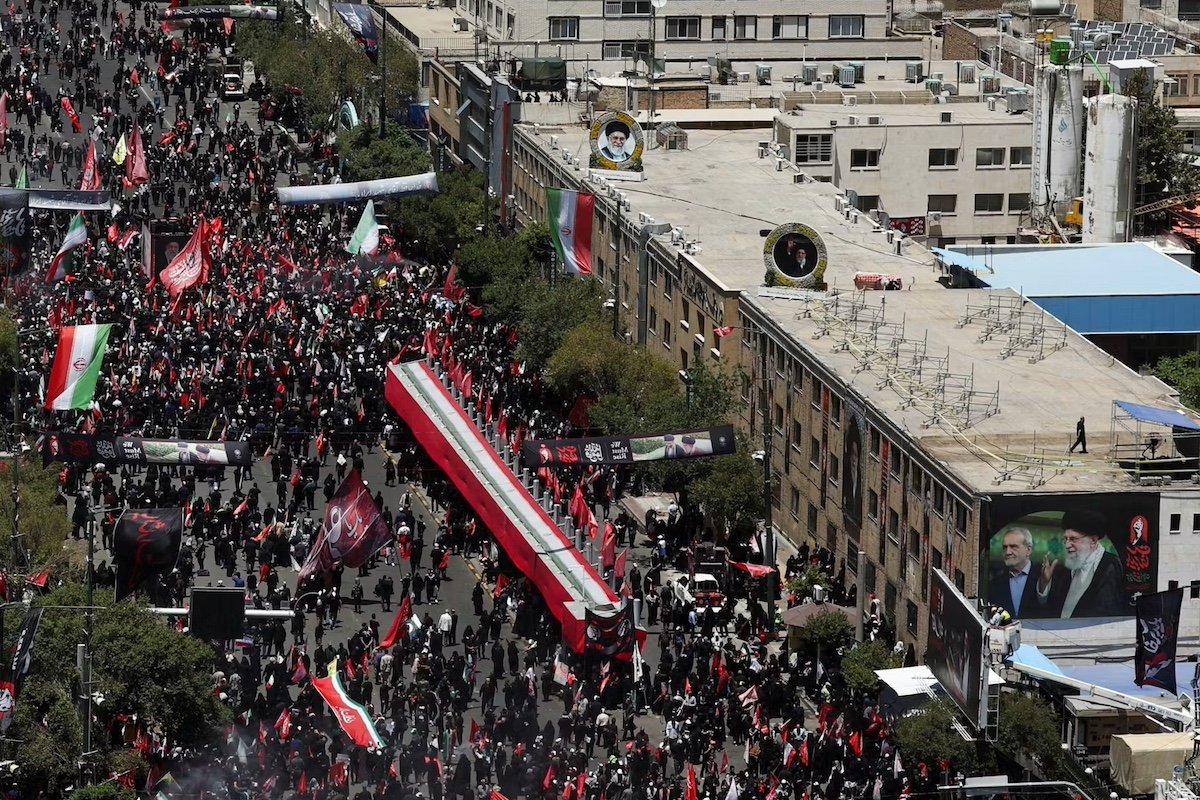
Earlier this month, the funeral of Iran's Supreme Leader, Ayatollah Ali Khamenei, in Mashhad drew international delegations, but the level of representation varied sharply. Only two nations—Iraq and Pakistan—sent their prime ministers, a decision that goes beyond diplomatic protocol and signals a realignment of alliances in a region that defies the traditional boundaries of the Middle East and South Asia.
Pakistan's Prime Minister Shahbaz Sharif and Iraq's Prime Minister Ali Falih Kadhim al-Zaidi attended the four-day ceremony, while India, South Asia's largest power and Pakistan's rival, sent a delegation led by a senior military figure, General Ata Hasnain, but not Prime Minister Narendra Modi. Modi had also refrained from condemning Khamenei's assassination in a joint US-Israeli airstrike on February 28, a stance that Indian media, such as WIONews, framed as a gesture of goodwill. One headline read, "'Iranians will never forget': Iran appreciates India's participation in Khamenei funeral," but such coverage obscures a deeper geopolitical shift.
Necropolitics and the Geopolitics of Emotion
The funeral was not merely a burial but a necropolitical ceremony, as defined by Cameroonian scholar Achille Mbembe—a choreographed display of power that tested which nations would send a "delegation of lamentation." In the context of the second Trump administration, every diplomatic gesture must account for the US president's volatile reactions. Dominique Moisi's concept of the "geopolitics of emotion" has evolved into a "geopolitics of mollification," where nations calibrate their moves to appease Trump. Sending a head of state to Khamenei's funeral required a calculated risk, and only Pakistan and Iraq felt emboldened to do so.
India's delegation, while respectful of Iran's Shi'a majority through General Hasnain's presence, did not carry the same geopolitical weight. In forging alliances, heft trumps religious sectarianism.
Pakistan's Rising Diplomatic Role
Pakistan has emerged as a key broker in the region. During the 40-day Gulf conflict in 2026, Pakistani mediation provided Iran with a diplomatic off-ramp, bringing both Tehran and Washington to the negotiating table in Islamabad. Pakistan also insisted that the ceasefire extend to Israeli operations in Lebanon, demonstrating influence that reaches the Mediterranean. This role contrasts sharply with India, which, despite military ties to Israel, did not push for a ceasefire. The India-Israel alliance runs deep, with Modi's February 2026 visit to the Knesset and admiration among Hindu nationalists for the Zionist model, but it has not translated into regional mediation.
Pakistan's assertive diplomacy is reshaping its ties with Iran, a relationship that was historically fraught. In the 1990s, the two countries fought a proxy war in Afghanistan, and as recently as 2024, they exchanged fire over Baloch separatists along their shared border. The rapprochement born from the 2026 war now allows them to cooperate on managing tensions with the Taliban in Afghanistan and Balochi insurgents. This shift is part of a broader transformation in Southwest Asia, where geography matters: Iran and Pakistan share a long border, while India does not border the UAE, Israel, or the US.
The emerging "Axis of Sympathy" is more symbolic than Iran's harder Axis of Resistance, but it carries tangible benefits. Pakistan and Iraq's decision to send their highest officials does not mean they are picking a side, but for Pakistan, assertive brokering and strategic ties with Tehran are redefining alliances. As the region navigates the aftermath of Khamenei's death and the ongoing US-Iran conflict, Pakistan's role as a diplomatic broker is likely to grow, with implications for the entire Indo-Pacific.
For more on Pakistan's evolving role, see Why Europe Needs Pakistan Now More Than Ever and Gwadar Port's Missing Cargo and the Fast-Closing Window for Pakistan's Strategic Gamble.