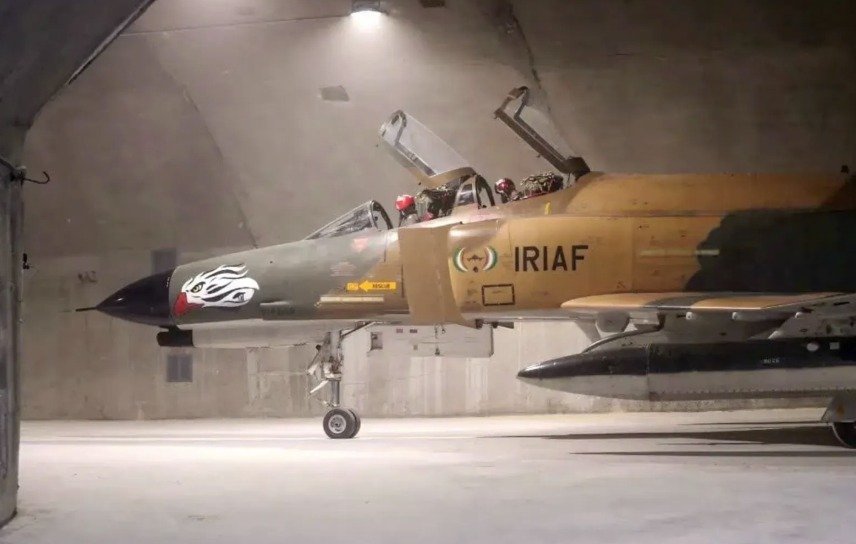
Iran's swift recovery of its Eagle 44 airbase, carved into a mountain in Hormozgan province, demonstrates that hardened subterranean shelters remain a decisive shield against precision firepower. This resilience offers a strategic blueprint for Taiwan, which faces a similar threat from China.
Satellite imagery from Planet Labs, reported by The War Zone, shows Iran actively repairing and expanding the base despite at least three rounds of US and Israeli airstrikes this year. The complex, located roughly 160 kilometers northwest of the Strait of Hormuz, was targeted in March and July under Operation Epic Fury, which aimed to sever its underground hangars from the 4.35-kilometer runway.
By late September, Iran had cleared strike debris, reopened runway sections, and begun paving a western taxiway, while also preparing an adjacent area for a redundant access link. Although three support buildings remain damaged and deep portal conditions are unclear, the rapid reconstruction signals a priority on restoring sortie capability.
This contradicts assessments from the US Department of Defense and the Trump administration that Iran's air force and missile infrastructure had been functionally eliminated. Instead, Iran's wartime preservation of combat aviation through hardened facilities shows how an inferior air force can absorb pre-emptive strikes and conduct asymmetric counter-offensives.
Iran's fortress doctrine in action
According to Dylan Malyasov in an April 2026 Defense Blog article, Iran's fortress doctrine—sheltering combat aircraft in subterranean facilities like Eagle 44—preserved an estimated two-thirds of its operational air fleet under heavy bombardment. Before Operation Epic Fury, Iran had 250 to 300 combat aircraft, including about 135 fighters, but only a fraction were airworthy at any given time, as Harrison Kass noted in The National Interest.
Despite the strikes, Iran lost only 38 exposed aircraft, dispersing its fleet into deep mountain tunnels rather than engaging a technologically superior coalition. While US and Israeli strikes cratered portal entrances and obstructed runways, post-ceasefire flights of surviving F-4s, MiG-29s, and Mi-28s proved the underground network achieved its primary objective: surviving a first strike.
Iran's remaining fighter fleet consists largely of pre-1979 aircraft, but they can still inflict damage under the right conditions. In April 2026, an Iranian F-5 bombed US Camp Buehring in Kuwait, and F-4s struck another US base using standoff glide bombs, as Paul Iddon reported in Forbes. Iran also launched two Su-24 bombers toward Qatar, though both were shot down.
Iran relies on the fog of war, air defense gaps, and Vietnam War-era low-altitude tactics to evade enemy defenses, inflict casualties, and disrupt coalition operations across the Persian Gulf. Its airpower serves as an asymmetric strike adjunct rather than a bid for conventional air superiority, integrating with drones and missiles to target US aircraft on the ground, runways, and command facilities.
Lessons for Taiwan
Taiwan faces a similar predicament. The War Zone reported in July 2022 that Taiwan relies on heavily fortified subterranean shelters, primarily the Chiashan and Shizishan mountain complexes on its Pacific-facing eastern coast, to shield its combat aircraft from an initial Chinese bombardment. The three-story tunnel network at Chiashan, excavated inside granite mountains and protected by massive steel blast doors, can shelter up to 200 fighters, along with independent power generators, medical facilities, and months of fuel supplies.
Under Taiwan's wartime dispersal doctrine, it plans to evacuate main fleet elements into these hardened redoubts, preserving vital F-16Vs armed with anti-ship missiles to resist an amphibious invasion. Matthew Revels noted in the Journal of Indo-Pacific Affairs that China plans to neutralize Taiwan's air force on the ground through a concentrated joint firepower strike campaign, viewing crewed fighters and runways as primary targets.
Iran's experience suggests that even if runways are cratered and portals damaged, a dispersed and sheltered fleet can survive and later strike back. For Taiwan, adopting a similar fortress doctrine could provide a credible deterrent, ensuring that a first strike does not eliminate its air power. As the US-China AI rivalry intensifies, the strategic value of such resilience grows.
While Iran's aging aircraft are no match for modern US systems, their ability to inflict damage through surprise and asymmetric tactics offers a model. Taiwan's newer F-16Vs, combined with hardened shelters, could pose a significant challenge to any invasion force. The lesson from Eagle 44 is clear: underground infrastructure can turn a first strike into a mere inconvenience, not a knockout blow.