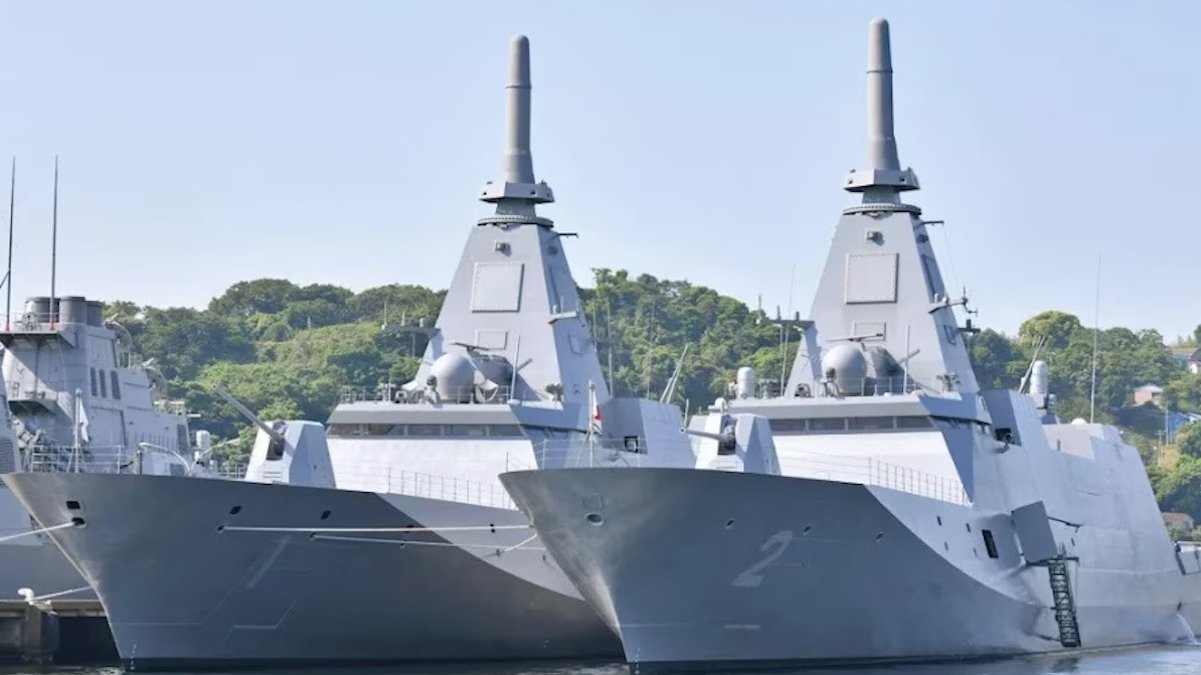
Japan and Australia have formalized a landmark defense agreement worth approximately A$10 billion (US$6.5–US$7 billion) to supply the Royal Australian Navy with next-generation frigates, signaling a significant shift in regional security dynamics as both nations grapple with China's growing maritime reach and questions about the United States' long-term role in the Indo-Pacific.
The contract, signed by Australian Defense Minister Richard Marles and Japanese Defense Minister Shinjiro Koizumi aboard the Mogami-class frigate JS Kumano in Melbourne, covers an initial three vessels to be built by Mitsubishi Heavy Industries in Japan. The first frigate is expected for delivery around 2029, with an additional eight to be constructed in Western Australia. The warships, designed for anti-submarine warfare, surface strikes, and air defense, will replace Australia's aging ANZAC-class fleet and are intended to secure vital sea lanes and northern approaches amid China's expanding military presence.
Strategic Motivations Behind the Deal
George Friedman, in a recent interview with Geopolitical Futures, frames the frigate sale as part of a broader evolution in Pacific geopolitics. He argues that Japan and Australia—both maritime island nations positioned to the north and south of China—share a common strategic interest in maintaining control of surrounding sea lanes. Their cooperation, he emphasizes, is driven less by trust than by a “common fear” that China could expand its economic and potentially military influence if the United States is not present to constrain it.
Doubts over US commitment in the Pacific have been a recurring theme. Zack Cooper, speaking in a March 2026 interview for the Center for Strategic and International Studies (CSIS), noted that the US Pivot to Asia was long on rhetoric but short on action. He pointed to the continued pull of Middle Eastern conflicts, including the redeployment of US forces from Asia, as evidence that US policy has repeatedly fallen short of its stated ambitions in the region. Against this backdrop, the frigate deal is less a procurement decision than a test case for how far regional powers can go in securing their interests without the US.
Such US shortcomings may have increased security anxieties in Japan. A December 2025 International Crisis Group (ICG) report notes that Japanese strategists worry China may seek to take Taiwan by force, potentially leaving Japan isolated in a region where China is increasingly dominant and projecting power beyond the first island chain. Tensions have intensified following Japanese Prime Minister Sanae Takaichi's remarks that a blockade of Taiwan could constitute a “survival-threatening situation,” highlighting concerns over Japan's proximity to Taiwan and the risk that a contingency there could escalate into a wider regional crisis involving US forces based in Japan.
China's Naval Reach and Australian Concerns
Highlighting Australia's concerns over China's expanding naval reach, Zong He notes in a February 2026 China Maritime Studies Institute (CMSI) report that the February 2025 deployment of a Type 055 destroyer-led task force into the Tasman Sea—operating about 150 nautical miles off Sydney and circumnavigating Australia—demonstrated long-range navigation capabilities and sustained operational endurance. While Australian officials stated the deployment complied with international law and posed no threat, they emphasized the need to “carefully study” the mission and conduct a “comprehensive assessment” of its objectives, reflecting caution over China's growing ability to operate in Australia's surrounding waters.
The Mogami-class frigate program could deepen Australia–Japan defense cooperation by strengthening interoperability, enhancing deterrence, and reinforcing supply chain coordination, according to Moyuru Tanaka in a November 2025 CSIS article. Operating common platforms and systems would support long-term sustainment over a roughly 40-year service life, enabling shared maintenance, spare parts production, and closer industrial collaboration between the two countries.
Alex Bristow, in a December 2025 report for the Australian Strategic Policy Institute (ASPI), adds that Australia and Japan are pursuing a “partial division of labor” in the Pacific to better coordinate defense activities, particularly in securing sea lines of communication and preparing for potential conflict with China. Such coordination would improve efficiency, reduce duplication, and strengthen deterrence, while still operating alongside the US, which remains central to both countries' security planning in the region.
Yet this emerging minilateralism carries structural limits. Shiro Armstrong notes in a July 2025 article in Asia-Pacific Review that middle powers such as Australia and Japan are “lacking the power to unilaterally” shape regional security outcomes, underscoring the continued importance of the US alliance even as both nations take on greater responsibility. The frigate deal, while a significant step, ultimately highlights the complex interplay of trust, fear, and strategic necessity that defines the evolving security architecture of the Indo-Pacific.