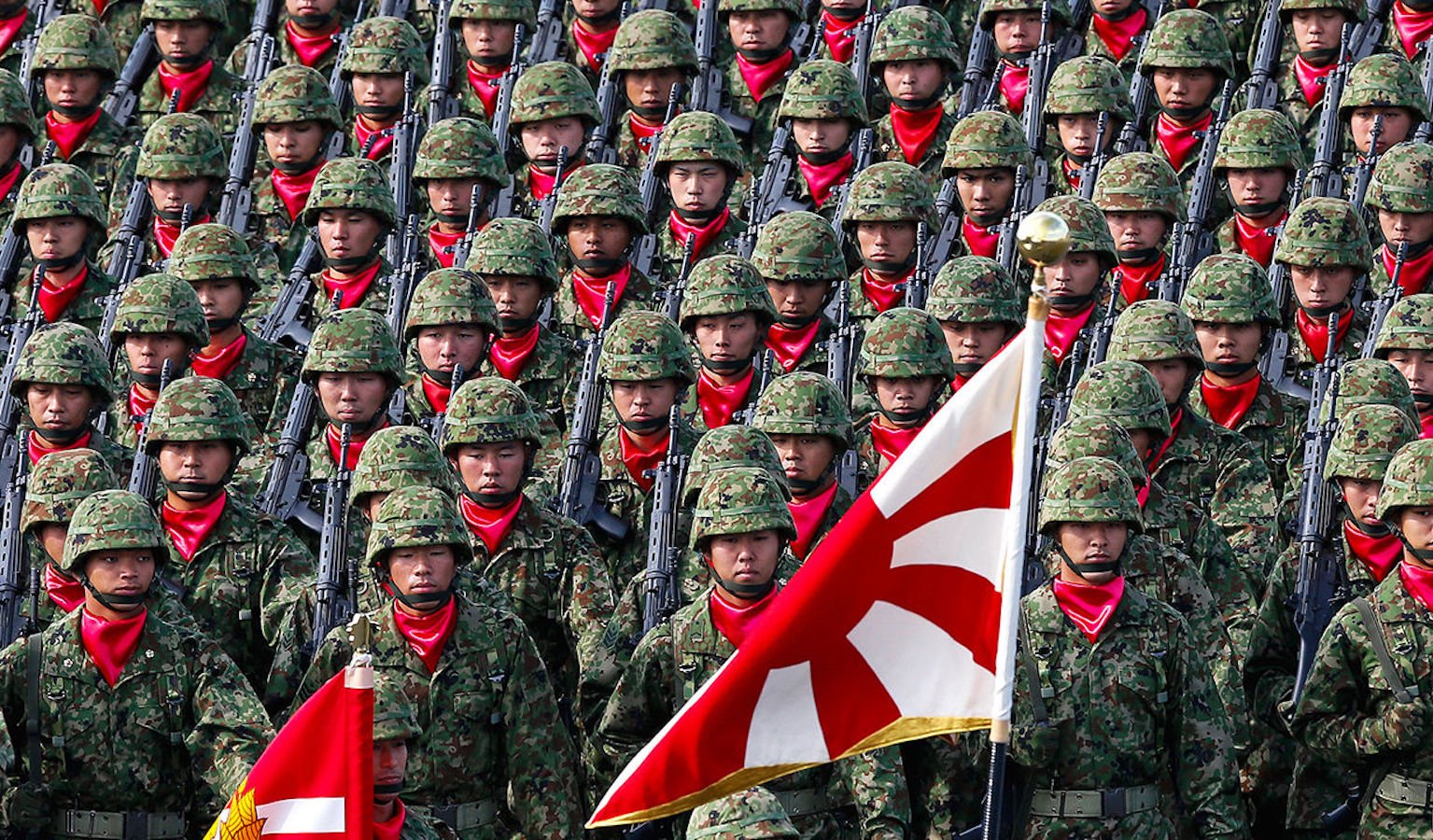
Despite constitutional constraints on its armed forces, Japan has continued to move closer toward military normalization this year. Although it is controversial, most countries in the Asia-Pacific region should welcome this trend.
Arms Export Reforms and Defense Cooperation
In April, Japan's cabinet approved revisions to its regulations on the export of Japan-made arms to other countries. Previously, exports were limited to non-lethal defense equipment such as rescue, surveillance or minesweeping gear. Exports of lethal equipment are now allowed, with some restrictions. Japan can sell warplanes, warships, missiles and killer drones. Erstwhile foes, the US and the Philippines, immediately praised the change. The move will strengthen Japan's defense industrial base by providing a larger stream of orders.
Similarly, Japan is moving toward closer cooperation with security partners in developing and manufacturing weapons systems. Japan is contracted to sell Australia up to 11 frigates, some to be built in Japan and some in Australia, as detailed in the Japan-Australia Frigate Deal Cements New Defense Axis in Indo-Pacific. Japanese engineers are jointly developing a new generation of fighter jets with the UK and Italy. Japan already repairs US Navy vessels and may soon start building them also. A Japanese project to build nuclear-powered submarines with US assistance might be in the offing.
The Myth of Japanese Pacifism
Japan's postwar military posture is often misleadingly called "pacifist." Actual pacifism is a commitment to non-violence out of moral conviction. If they take this principle to its logical extreme, real pacifists will allow an enemy to kill them rather than fight back. Japan's "peace constitution," on the other hand, is a product of the postwar US occupation of Japan, Tokyo's recognition that Japan needed reputational rehabilitation, and an alliance that allowed Japan to rely heavily on the US for military protection.
This so-called Japanese pacifism is ending gradually, not suddenly and dramatically. Since the 1950s, Japan has periodically taken important steps in this direction, starting with the establishment of a paramilitary "National Police Reserve" in 1950 in response to the outbreak of the Korean War. Other steps included the dispatch of Japanese troops overseas as peacekeepers starting in 1992; expansion of Japan's defensive perimeter to "areas surrounding Japan" in 1997; providing logistical support for combat operations in the Middle East in the 2000s; raising the target for defense spending from 1% to 2% of GDP in 2022; and deciding to acquire long-range strike weapons, also in 2022.
Constitutional Revision Prospects
Japan's current government wants to go further. In May, Prime Minister Sanae Takaichi said Japan's postwar constitution "should periodically be updated to reflect the demands of the times." She said she aims for the ruling LDP to put forward a plan to amend the constitution by next year. Procedurally, actually changing the constitution would not be easy. It would require the approval of two-thirds of the legislators in both houses of the Diet. Takaichi's ruling Liberal Democratic Party could pull that off in the lower house, but not in the upper house as presently constituted. The next upper house election is in 2028. Constitutional revision would also require a majority of affirmative votes in a national referendum. Currently, a slight majority of the Japanese public opinion favors revising the constitution in principle, but that support ultimately depends on the specific proposed changes.
Countering the Arguments Against Revision
There are several arguments against Japan revising its constitution to give its armed forces the same legal status as the militaries in other countries. These arguments, however, are unpersuasive.
Argument 1: Japan will fall back into militarism. The Chinese and North Korean governments argue that Japan is eternally "militarist," ignoring the transformation of Japan's society and political system since the end of the Pacific War 81 years ago. They will play this card until the end of time if they can. Many Chinese and Koreans have legitimate hard feelings toward Japan, but there are ulterior motives: Beijing wants to suppress competing Japanese regional leadership, and Pyongyang bolsters its domestic political legitimacy by playing up the alleged Japan threat. A recent example: on May 6, Japanese troops participating in the Balikatan military exercise—the first deployment of Japanese forces to the Philippines since World War II — test-fired an anti-ship missile. Chinese Foreign Ministry spokesperson Lin Jian argued that any military activity by Japan outside its own borders is a threat to the region because Japan is a "former aggressor." But Lin also condemned the "collusion" between Japan and the Philippines that "may evolve further toward greater alliance-like" cooperation. This is a contradiction. Tokyo cannot be guilty of aggression if countries in the region are welcoming deeper security cooperation with Japan. Over half of Japanese believe the international vilification of Japan for its Pacific War crimes has become excessive. (Some even deny that Japan did anything wrong during the war, but this is a fringe position.) A majority of Japanese want stronger armed forces. These attitudes are similar to the nationalistic beliefs widely held in most countries. They do not, however, necessarily imply "militarism," which is support for a foreign policy of imperialist conquest. There is no evidence of such support in Japan.
Argument 2: The "peace constitution" gives Japan international credibility and moral authority. Conversely, removing the unique restrictions on Japan's military would destroy the trust Japan has built with neighboring states. Japan does indeed enjoy a positive reputation. In the most recent survey of elite opinion in Southeast Asia by the ISEAS-Yosof Ishak Institute in Singapore, 65% of respondents said they believe Japan "will do the right thing in contributing to global peace, security and governance," as opposed to 44% for the US and 40% for China. This trust is built on Japan's postwar behavior, not on constitutional constraints. Japan's defense shift is driven by preparation, not pacifism, as explored in Japan's Defense Shift: Preparation, Not Pacifism, Drives New Arms Export Rules. The region should recognize that a militarily normal Japan is a stabilizing force, not a threat.