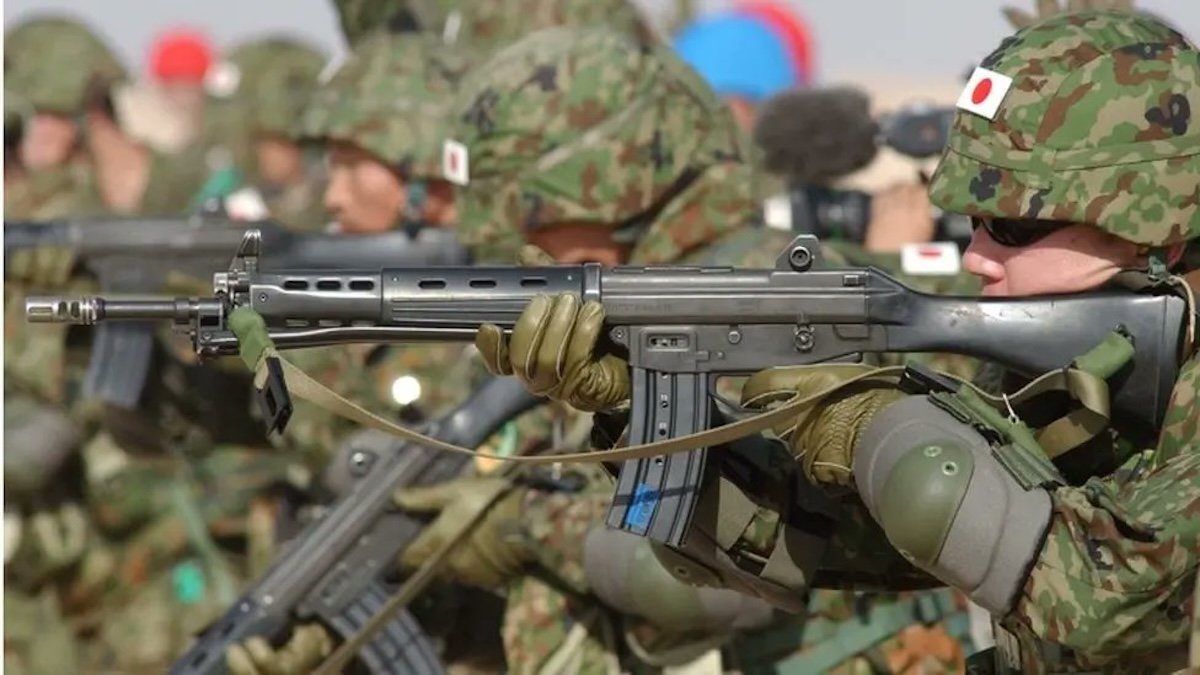
This week, the Japanese cabinet of Prime Minister Takaichi Sanae approved a revision to the country's “Three Principles” governing defense equipment and technology transfers. The decision allows Japanese companies to sell arms to nations with which Tokyo has a bilateral export agreement—currently 17 countries, including the United States, with expectations of soon reaching 20. The National Security Council will review each sale, and the Diet will be notified afterward. Exports to countries engaged in active combat remain restricted, though exceptions may be made for compelling national security reasons.
The move has been widely described in global media as a break with Japan's postwar pacifism. But that framing, according to several experts, is misleading. Japan has never been strictly pacifist in the sense of refusing all use of force. The Self Defense Forces (SDF), established in 1954, are a standing military in all but name. Tokyo has repeatedly called on Washington to reaffirm that Article 5 of the Mutual Defense Treaty covers the Senkaku Islands—meaning Japan expects its ally to use force in its defense.
Pragmatic Adaptation, Not Ideological Shift
Prime Minister Takaichi explained the policy change as a response to an “increasingly challenging security environment,” adding that “no single country can now protect its own peace and security alone.” She also stressed that “there is absolutely no change in our commitment to upholding the path we have taken as a peaceful nation over the past 80 years since the end of the war, as well as our fundamental principles.”
Andrew Oros, professor of political science at Washington College and author of Japan's Security Renaissance: New Policies and Politics for the Twenty-First Century, noted that Japanese leaders have long used the language of pacifism to describe policies that are anything but. He pointed to former Prime Minister Shinzo Abe's call for a “proactive pacifism”—a phrase so at odds with the philosophy that English translations often rendered it as “proactive contributions to peace.”
Japan's defense evolution has been gradual but consistent. In 1992, it passed laws enabling SDF participation in UN peacekeeping. In 1997, revisions to the US-Japan defense guidelines extended the SDF's jurisdiction to “situations in areas surrounding Japan.” After the September 11 attacks, the SDF supported Operations Enduring Freedom and Iraqi Freedom. More recently, Tokyo has reorganized its forces, pursued counterstrike capabilities, and embraced collective self-defense operations.
As Christopher Hughes detailed in Japan as a Global Military Power, the country now boasts the world's third- or fourth-largest military budget, the largest F-35 fleet outside the US, military satellites, mini-aircraft carriers, and amphibious forces. These are not the tools of a pacifist state.
Beijing has reacted sharply. A Chinese Foreign Ministry spokesman called the cabinet decision contradictory to Japan's identity as a peaceful nation and evidence of “new militarism.” Yet Hughes, in earlier correspondence, argued that Japan's overall defense evolution “in no way implies a rewind to the wartime period.”
The revision also aligns with broader trends in the Indo-Pacific. Japan's growing defense cooperation with Australia, as seen in the Japan-Australia frigate deal, and its participation in exercises like Balikatan, signal a strategic shift toward interoperability with allies. Meanwhile, the cost asymmetry in defense is reshaping how regional powers approach security.
In short, Japan's latest policy change is not an abandonment of pacifism—it is a recognition that preparation, not ideology, defines modern defense. The country is adapting to a more dangerous neighborhood, but it is doing so within the constraints of its constitutional framework and political consensus. The headlines may scream otherwise, but the reality is more nuanced: Japan is not becoming a militarist power; it is becoming a more capable one.